


DUBAI: Saudi Arabia has quadrupled its renewable connected capacity in the last two years as part of its acceleration toward reaching net zero by 2060, according to the minister of energy.
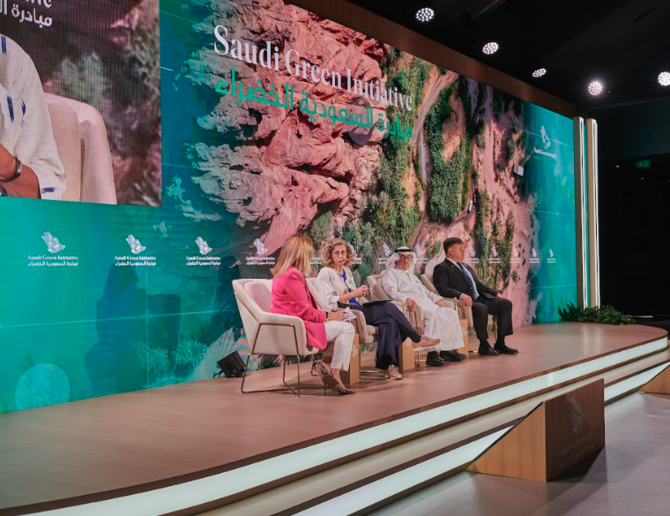
During the inauguration of the third edition of the Saudi Green Initiative Forum, held on the sidelines of the 2023 UN Climate Change Conference, Prince Abdulaziz bin Salman highlighted that the Kingdom witnessed a surge in renewable energy from 700 megawatts of capacity to 2 GW in the past two years, with more than 8 GW of renewables under construction and around 13 GW in various development stages.
According to the minister, the region is on track to achieving its goal of reducing carbon emissions by 278 million tons per annum by 2030, with a plan to tender an additional 20 GW by 2024.
The minister said: “Today in the UAE, in tandem with the COP28, we show our concrete action in progress toward this ambitious on renewable.”
He added: “Our actions are examples of solutions or technologies which are consistent with the Paris Agreement and its bottom-up approach. We will be working together to develop technology-based initiatives to advance the implementation of effective climate action on advancing international collaboration.”
In its attempts to encourage international cooperation in emission reduction, the minister highlighted the economic corridor connecting India, the US, and Europe, deeming it a “key enabler” for energy exports.
The corridor will include electricity transmission lines and hydrogen pipelines, supplying clean energy at scale reliably and affordably, as outlined by Prince Abdulaziz.
Speaking on a panel during the SGI Forum, Yasir Al-Rumayyan, governor of the Public Investment Fund, further addressed the implications of the economic corridor, saying: “When we have a corridor from India, through Saudi all the way to Europe, one of the things that we get to have in the corridor, in addition to the railways and the communication lines is green hydrogen and renewable energy.”
The role of funding within the energy transition was further underscored by Khalid Al-Falih, the Kingdom’s minister of investment, who noted that the intersection of environmental and economic sustainability succeeds through strategic investments.
The Saudi government consistently ranks among the top three in every metric that promotes the highest levels of efficiency and minimal emissions for both industries and consumers, emphasizing that investment and consumerism are not independent of the ongoing green efforts, adding that the Ministry of Energy is “keeping Aramco on its trajectory of being the world’s lowest emitting oil company.”
“My key point about sustainability is economic sustainability, and that’s where I think investment comes in ... the future is about responsible climate action in the Kingdom of Saudi Arabia. We have global policies, and we’re at COP. This is where global policies are being written and architected,” Al-Falih said.
Saudi Arabia’s growth toward net zero emissions is not linear, the Minister of State and Saudi Climate Envoy, Adel Al-Jubeir, said during his address at the forum, adding that it entails the intersection of varying means of accelerated climate goals.
The minister added that the region has launched more than 80 programs and committed almost $200 billion to climate initiatives while still exploring new areas of development.
He said: “I would say that the approach that we have used in Saudi Arabia is a ‘whole of government, all of society’ approach. We don’t believe that you can segment different areas. We have to work, so to speak, on all cylinders.
"I believe our approach has to be comprehensive, not just in specific areas, there is room for reducing waste, there is room for increasing efficiencies there is room for planting trees. There is room for combating desertification, there is room for combating plastics, there is room for carbon capture and sequestration.”
Emphasizing this notion in his address, the minister of energy outlined that this year, the Kingdom is commissioning four “highly efficient” gas-fired power plants with a total capacity of 5.6 GW that simultaneously have carbon capture readiness while also building additional gas powerplants with a capacity of approximately 8.4 GW.
It also intends to become a “hub” for “clean green hydrogen” with the launch of the $8.4 billion green hydrogen plant in NEOM, poised to claim the title of the world’s largest facility of its kind.
Several bilateral agreements have been signed with international counterparts throughout 2023, aiming to produce and export clean, environmentally safe hydrogen, the minister noted.
Speaking to Arab News on the sidelines of the forum, the CEO of NEOM Green Hydrogen Co., David Edmondson, said: “It’s a pretty exciting time. It ties in perfectly with what the region are trying to do with Vision 2030. I mean, the Kingdom has aspirations to export 4 million tonnes of low-carbon hydrogen by 2030. When our plant comes on stream in 2026, we’ll be exporting about 250,000 tonnes. So it’s a step in the right direction.”
The comprehensive strategy implemented since the inception of SGI has resulted in the planting of 43.9 million trees and shrubs, along with the rehabilitation of over 94,000 hectares of degraded land across the Kingdom, contributing to the target of growing 10 billion trees in Saudi Arabia over the coming decades, the CEO of the National Center for Vegetation Cover Development and Combating Desertification, Khaled Abdullah Al-Abdul Qadir, told Arab News on the sidelines of the forum.
According to the CEO, over 40 initiatives are already underway, directly supporting progress toward the interim target of planting of over 600 million trees and rehabilitating 8 million hectares of land by 2030.
Speaking to Arab News on the sidelines of the forum, the Kingdom’s Minister of Industry and Mineral Resources, Bandar Al-Khorayef, said that these fulfilled benchmarks and ongoing initiatives are indicative of Saudi Arabia setting an example for the world of how many undertakings can be achieved at once.
He said: “We are a great believer of transition and we put our beliefs into action. We really have great also at teams that are working. Young Saudis very excited to find the right way to help. And I think it’s great to celebrate also the results but also be mindful of the responsibility that we have. So I’m really happy that we are able to see great results, some of which can be scalable ideas which will not only help Saudi, but I think it would be also helping the global community in general.”


