Israeli strike destroys prestige Qatar-funded Gaza complex

1 / 4
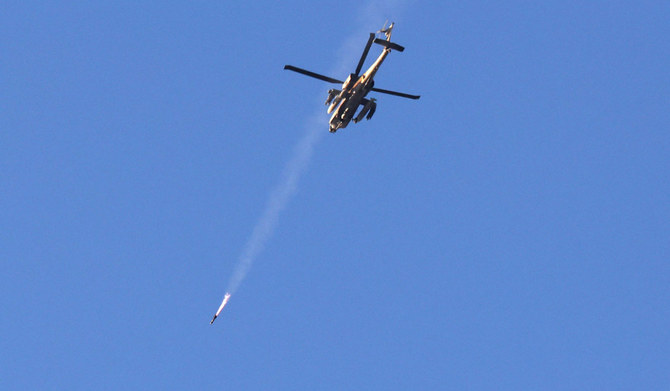
An Israeli air force attack helicopter fires a missile while flying over the border with the Gaza Strip near southern Israel on December 2, 2023, after battles resumed between Israel and Hamas militants. (AFP)
2 / 4
This picture taken from southern Israel near the border with the Gaza Strip shows smoke rising from buildings after being hit by Israeli strikes, after battles resumed between Israel and Hamas militants, on December 2, 2023. (AFP)
3 / 4
A Palestinian girl wounded in an Israeli strike is assisted, after a temporary truce between Hamas and Israel expired, at Nasser hospital in Khan Younis in the southern Gaza Strip, December 1, 2023. (REUTERS)
4 / 4
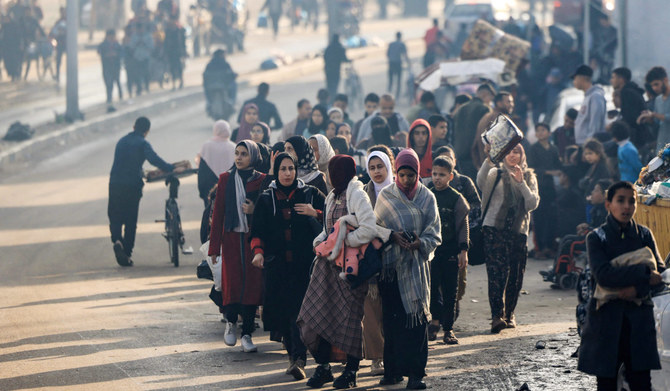
Palestinians walk toward safer areas following the resumption of Israeli strikes on Rafah in the southern Gaza Strip on December 1, 2023, after the expiration of a seven-day truce between Israel and Hamas militants. (AFP)
Short Url
Updated 03 December 2023
Follow

Israeli strike destroys prestige Qatar-funded Gaza complex

  • The Gaza health ministry said at least 193 Palestinians had been killed since the truce ended on Friday, adding to the more than 15,000 Palestinian dead since the start of the war
  • Israel said it had recalled a team from Qatar, host of indirect negotiations with Hamas, accusing the Palestinian faction of reneging on a deal to free all the women and children it was holding

KHAN YUNIS, Palestinian Territories: At almost exactly the same time Israeli negotiators pulled out of deadlocked truce talks in Qatar on Saturday, Israeli jets sent a prestige Doha-funded housing development in the Gaza Strip up in smoke.
Hamad City is named for the former emir of the Gulf petro-state, Sheikh Hamad bin Khalifa Al-Thani, who laid the foundation stone on a visit 11 years ago.
Inaugurated in 2016, it was still among the newest projects in the Gaza Strip, the housing complex in the city of Khan Yunis boasting an impressive mosque, shops and gardens.
The first flats — more than 1,000 of them — were provided to Palestinians whose homes were destroyed in the war between Israel and Hamas two years earlier.
On Saturday it happened again, a day after a Qatar-brokered pause in the current war between Israel and Hamas expired.
First their phones pinged around noon with an “immediate” evacuation order SMS sent by the Israeli army, which says the system is aimed at minimizing civilian casualties.
Around an hour later, five Israeli air strikes rained down on the neighborhood in the space of just two minutes.
Bombs slammed into the pale apartment blocks one by one, reducing them largely to rubble and sending a huge pall of black smoke into the sky, as people fled and cries of ‘help!’ and ‘ambulance!’ rang out.
“At least we got through it,” 26-year-old Nader Abu Warda told AFP, amazed he was still alive.

The Israeli military has divided the Gaza Strip into 2,300 “blocs” and is now sending SMS messages to residents telling them to leave before they launch the strikes which they say will “eliminate Hamas.”
Around 1,200 people, mostly civilians, died in the Islamist movement’s October 7 assault on southern Israel and some 240 were taken hostage, according to Israeli authorities.
The Hamas-led Gaza Strip government says Israel’s campaign has killed more than 15,000 people, also mostly civilians, since it was launched eight weeks ago.
The United Nations humanitarian agency, OCHA, has highlighted that the warning messages do not indicate where the recipients should go.
Ibrahim Al-Jamal, a civil servant in his 40s, said he does not have any “Internet, any electricity or even a radio to receive information” and that he has “never seen this map” setting out the different blocs.
“Many people in Gaza have never heard of it and it wouldn’t matter anyway as the bombings are taking place everywhere,” he said.
Humanitarian bodies say the most vulnerable in Gaza are the estimated 1.7 million displaced people.
Many of them do not have access to phones and have to rely on warning leaflets dropped by planes, not visible from inside an apartment.

According to the Gaza Strip’s Civil Defense emergency and rescue organization, in recent weeks “hundreds of displaced families” had been taking refuge in 3,000 apartments at Hamad City.
Mohammed Foura, 21, already displaced once from Gaza City, told AFP that half an hour before the strike he had been warned by other residents to flee.
They shouted “get out, get out,” he said, as families piled their belongings into cars or carried them away in enormous bundles.
Nader Abu Warda fled Jabalia, near Gaza City, at the start of the war and no longer knows which way to go or what to do.
He, his wife and three children had been staying in a friend’s apartment in the complex.
“They told us ‘Gaza City is a war zone’, now it’s Khan Yunis,” he said. “Yesterday, they were saying ‘evacuate the east of Khan Yunis’. Today, they say ‘evacuate the west’,” he added, visibly exasperated.
“Where are we going now, into the sea? Where are we going to put our children to bed?“


Palestinian PM: Gaza reconstruction advancing amid US talks, Saudi support

In an interview with Arab News, Mohammed Mustafa said “Palestinian objective is clear,’ but we need to ‘get Gaza right first.’
Updated 21 January 2026
Follow

Palestinian PM: Gaza reconstruction advancing amid US talks, Saudi support

  • In an interview with Arab News, Mohammed Mustafa said “Palestinian objective is clear,’ but we need to ‘get Gaza right first’
  • Speaking at Davos panel, PM calls Kingdom a key stakeholder in the Palestinian cause

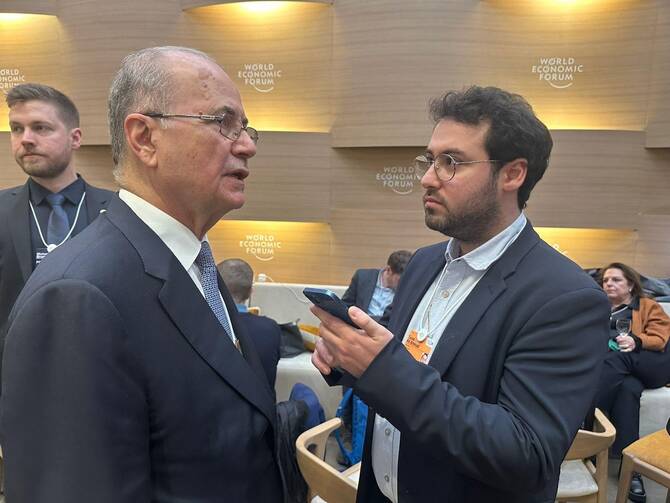
DAVOS: Palestinian Prime Minister Mohammed Mustafa told Arab News that progress is underway in Gaza’s reconstruction talks, with clear dialogue between the Palestinian Authority, US President Donald Trump and Special Envoy Steve Witkoff.

“I think the Palestinian objective is pretty clear, it has been for a long time, which is to establish their own independent state, (achieve) international resolution,” Mustafa said, noting that “we need to get Gaza right first.”

Despite a ceasefire taking hold earlier in 2025, Gaza remains under what the international community describes as an Israeli-enforced blockade. Basic supplies such as food and medicine are still subject to Tel Aviv’s scrutiny, which controls all access in and out of the Strip.

On Sunday, Trump announced that his Gaza plan had entered its second phase, in which Hamas would release all remaining hostages, Israel would free more Palestinian prisoners and fully withdraw its forces — a step international actors say should pave the way from ceasefire to lasting peace.

The formation of a technocratic National Committee for the Administration of Gaza, or NCAG, composed of Palestinian figures, marks the first concrete step toward implementing the plan and restoring Palestinian ownership of the next phase.

A precise timeline for reconstruction remains unclear, with analysts warning that major works hinge on Hamas disarmament — a politically fraught task assigned to the Gaza Peace Board.

“It’s going to take more than two years to fix Gaza, but at least we want to make sure that things are in the right direction,” continued Mustafa, adding that the West Bank remains part of the broader conversation.

He stressed the urgency of reunifying Gaza’s institutions with the West Bank to achieve the PA’s political goal of independence. 

“Our priority is what’s happening to our people in Gaza today. Despite four months passing (after) the ceasefire, people are still dying. Yes, there is a ceasefire but it’s not fully observed due to Israeli military actions,” he said, stressing that “shelter is the biggest challenge” at the moment.

Mustafa revealed he held “very active and useful” talks with US officials on Tuesday, saying both sides “share the same goals” on the matter.

Later in his panel, Mustafa said a Palestinian reform plan is in the works with the help of partners including Saudi Arabia.

In a session at the World Economic Forum in Davos, Mustafa said Saudi Arabia and other partners such as Egypt and Jordan were not just contributors but key stakeholders in the Palestinian cause.

“Saudi Arabia along with France have been working with us on the two state solution and integrating it,” he said.

“We want to work with the board of peace to ensure that they do their part of things to prepare for reconstruction efforts,” he added.

Mustafa said although some view the Oslo treaty as outdated, it still holds its place as an internationally recognized framework.

“According to the Oslo agreement, Israel should have withdrawn from most of the West Bank and Gaza. We want to see Israel respecting this agreement,” he said.

“The Israelis did not respect the economic part of the treaty. We are praying for a heavy price, not only in Gaza and people being killed every day. But also actions on the ground in the West Bank. We said clearly, we want to achieve our goals by peaceful means,” he said.

“Israel today holds $4 billion of our government’s money. They control the borders and collect the tax fines. For the past four months they have sent zero dollars. Our ability to govern has been impacted due to this,” Mustafa said.

In a sideline interview with Arab News, Palestinian Ambassador to Switzerland Ibrahim Mohammad Khraishi said that he met an Egyptian minister who expressed hope that the Rafah crossing could soon reopen on both sides.

“We need the understanding from all,” Khraishi said. “Yes, we have this administrative committee (as part of the Gaza Peace Board), but without the Palestinian Authority, they cannot deliver. Because we have everything. We have the institutions, we have the government,” Khraisi said.

Commenting on recent West Bank developments, including Israeli bulldozers razing the UNRWA compound in occupied East Jerusalem on Tuesday, he warned: “This is the scenario for the Israelis. For them, there is nothing to talk about. It’s total crash and destruction. Now, what they are doing in West Bank is on the way.”