

US pledges $3 billion to Green Climate Fund at COP28

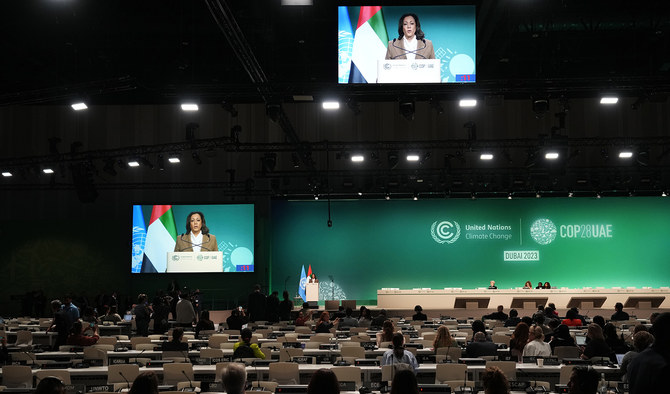
Vice President Kamala Harris speaks during a plenary session at the COP28 U.N. Climate Summit in Dubai, UAE on December 2, 2023. (AP)
Short Url
Updated 02 December 2023
Follow

US pledges $3 billion to Green Climate Fund at COP28

  • The fund funnels grants for adaptation, mitigation projects such as solar panels in Pakistan or flood management in Haiti
  • The last US contribution to the fund was made under then President Barack Obama, who had committed $3 billion in 2014

DUBAI: Vice President Kamala Harris told the UN's COP28 conference on Saturday that the United States will contribute $3 billion to a global climate fund -- its first pledge to it since 2014. 

"Today, we are demonstrating through action how the world can and must meet this crisis," Harris told the climate summit in Dubai. 

The new money, which must be approved by the US Congress, will go into the Green Climate Fund (GCF), which was created in 2010. 

The last US contribution to the fund for developing countries was made under then President Barack Obama, who committed $3 billion in 2014. 

US President Joe Biden sent Harris in his place to COP28. 

The world's biggest climate fund funnels grants and loans for adaptation and mitigation projects in developing countries, such as solar panels in Pakistan or flood management in Haiti. 

Prior to the US announcement, $13.5 billion had been pledged to the GCF. 

The failure of wealthy nations to fulfil financial pledges to help developing nations cope with climate change has fuelled tensions and mistrust at climate negotiations. 

Developing countries least responsible for climate change are seeking support from richer polluting nations to adapt to the increasingly ferocious and expensive consequences of extreme weather, and for their transitions to cleaner energy sources. 

The GCF plays a part in a separate promise by rich countries to supply $100 billion of climate financing to poorer nations annually. But that pledge was only likely met in 2022, two years late. 


Sweden plans to tighten rules for gaining citizenship

Updated 09 February 2026
Follow

Sweden plans to tighten rules for gaining citizenship

  • The country has for years struggled to integrate migrants, with many not learning the language and living in disadvantaged areas with higher crime and jobless rates

STOCKHOLM: Sweden said Monday it planned to tighten rules to acquire citizenship, introducing “honest living” and financial requirements, a language and general knowledge test and raising the residency requirement from five to eight years.
If approved by parliament, the new rules would enter into force on June 6, Sweden’s national holiday, and would apply even to applications already being processed.
Migration Minister Johan Forssell, whose right-wing minority government holds a majority with the backing of the far-right Sweden Democrats, told reporters it was currently too easy to acquire Swedish citizenship.
“Citizenship needs to mean more than it does today,” he said.
“Pride is something you feel when you’ve worked hard at something. But working hard is not something that has characterised citizenship.
“It has been possible to become a citizen after five years without knowing a single word of Swedish, without knowing anything about our Swedish society, without having any own income.”
Referring to a case that recently made headlines, he said: “You can even become one while you’re sitting in custody accused of murder.
“This obviously sends completely wrong signals, both to those who do right by themselves and those who are already citizens.”
Following a large influx of migrants to Sweden during the 2015 migrant crisis, successive left- and right-wing governments have tightened asylum and migration rules.
The country has for years struggled to integrate migrants, with many not learning the language and living in disadvantaged areas with higher crime and jobless rates.
Under the new rules, those who have criminal records — in their home country or in Sweden — and who have served their sentence would have to wait up to 17 years before being allowed to apply for citizenship, up from the current 10 years.
In addition, those deemed to not adhere to “honest living” requirements would not be granted citizenship.
That could include racking up mountains of debt, being served restraining orders or even having a drug addiction.
Applicants would also have to have a monthly pre-tax income of 20,000 kronor ($2,225), excluding pensioners and students.
The citizenship tests would be similar to those used in neighboring Denmark and the United States, the government said, with the first tests due to be held in August.