Senior UK officials discuss Gaza crisis on sidelines of COP28 in Dubai

1 / 4
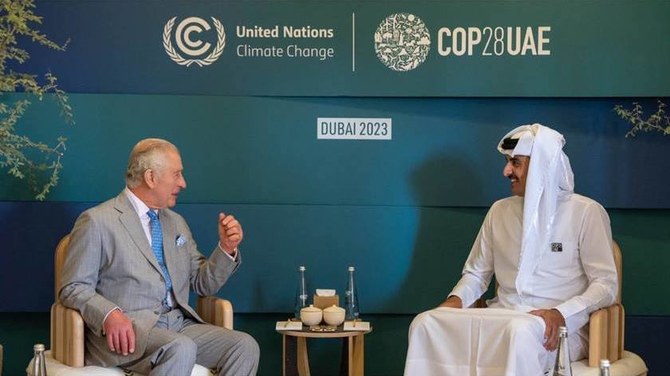
Britain’s King Charles III met with Qatar’s Emir Sheikh Tamim bin Hamad in Dubai. (QNA)
2 / 4
British Prime Minister Rishi Sunak met with Jordan’s King Abdullah II in Dubai. (10 Downing Street)
3 / 4
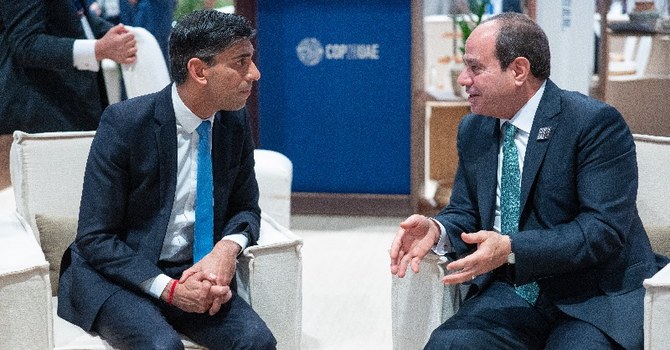
British Prime Minister Rishi Sunak met with Egyptian President Abdel Fattah El-Sisi in Dubai. (10 Downing Street)
4 / 4
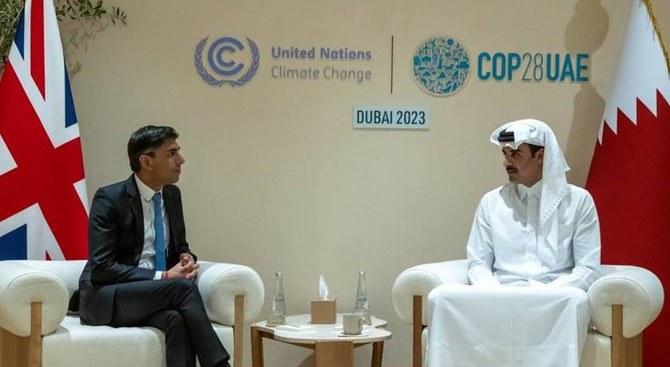
British Prime Minister Rishi Sunak met with Qatar’s Emir Sheikh Tamim bin Hamad in Dubai. (QNA)
Short Url
Updated 02 December 2023
Follow

Senior UK officials discuss Gaza crisis on sidelines of COP28 in Dubai

  • ‘We must work toward a two-state solution,’ Rishi Sunak tells Qatar’s emir
  • Hamas ‘could have no future’ in Gaza, PM’s office says

LONDON: British Prime Minister Rishi Sunak on Friday met Qatar’s Emir Sheikh Tamim bin Hamad on the sidelines of the COP28 climate summit in Dubai, Downing Street said.

Sunak thanked the emir for Qatar’s important role in “facilitating the humanitarian pause in Gaza, which saw the release of dozens of hostages and the vital passage of further aid,” the prime minister’s office said in a statement.

“The leaders deeply regretted the collapse of the pause and reiterated the importance of ongoing efforts to secure the release of all hostages and ensure humanitarian assistance reaches those in need in Gaza,” it said.

In the long term, “we must work toward a two-state solution which guarantees the security and prosperity of both Israelis and Palestinians,” Sunak said, adding that “Hamas had demonstrated that it could not be a partner for peace and could have no future in Gaza.”

Sunak also met Jordan’s King Abdullah II and reassured him that Britain would continue “to press Israel on the need to adhere to international humanitarian law and contain settler violence in the West Bank.”

“The prime minister recognized the vital role Jordan has played in addressing the crisis in Gaza and the generosity they have shown in providing significant humanitarian support to Palestinian civilians, including the provision of military field hospitals,” the statement said.

Sunak reiterated the UK’s commitment to working toward a lasting resolution to the conflict that would deliver “dignity, peace and security for both Israelis and Palestinians.”

Sunak and King Abdullah also agreed on the importance of close cooperation between their countries, especially in trade, defense and clean technology.

During talks with Egyptian President Abdel Fattah El-Sisi, Sunak reiterated “the UK’s support for the humanitarian response in Gaza, with planeloads of UK aid, including warehouse facilities and forklift trucks, sent to Egypt to preposition on the border with Gaza.”

He thanked El-Sisi for Egypt’s efforts to get vital aid into Gaza, its role in helping secure the release of hostages and support in evacuating British nationals.

“He said the UK stands ready to provide further support, recognizing that there must be no forcible displacement from Gaza and that aid must be able to reach people across the Gaza Strip,” the Downing Street statement said.

Sunak and Israel’s President Isaac Herzog also discussed the conflict with Hamas and the end of the humanitarian pause in Gaza earlier on Friday.

The prime minister “once again emphasized the need to take all possible measures to avoid civilian casualties and significantly increase the flow of aid to Gaza,” the statement said.

Meanwhile, the UK’s King Charles III met Sheikh Tamim on the sidelines of the annual summit to discuss “the friendship and cooperation between the two countries and peoples, as well as the means to enhance them,” the Qatar News Agency reported.

They also exchanged views on the most prominent issues on the summit’s agenda and discussed developments of joint interest.

UK Foreign Secretary David Cameron held talks with his Qatari counterpart Sheikh Mohammed bin Abdulrahman on the latest developments in Gaza and the occupied Palestinian territories, as well as ways to reduce escalation and bring about a ceasefire.

During the meeting, Sheikh Mohammed said his country, along with its mediation partners, was committed to its efforts to return calm to the region and that the resumption of bombing of the Gaza Strip after the truce had complicated mediation efforts and exacerbated the humanitarian crisis.

He expressed Qatar’s “firm position in condemning all forms of targeting civilians and that killing innocent people, especially women and children, and practicing the policy of collective punishment are unacceptable, under any circumstance,” the news agency reported.

He also stressed the necessity of opening humanitarian corridors to ensure relief and aid reach the stricken Palestinians.


Israel to partially reopen Gaza’s Rafah crossing

Updated 01 February 2026
Follow

Israel to partially reopen Gaza’s Rafah crossing

  • Reopening comes amid ongoing violence in the Palestinian territory
  • Gaza’s civil defense agency says dozens killed in Israeli attacks on Saturday

RAFAH, Palestinian Territories: Israel is set to partially reopen the Rafah crossing between the war-devastated Gaza Strip and Egypt on Sunday, following months of urging from humanitarian organizations, though access will be limited to the movement of people.

The reopening comes amid ongoing violence in the Palestinian territory, with Gaza’s civil defense agency reporting dozens killed in Israeli attacks on Saturday, while the Israeli military said it was retaliating against ceasefire violations.

The Rafah crossing is a vital gateway for both civilians and aid, but has remained closed since Israeli forces seized control of it in May 2024 during the war with Hamas, aside from a brief and limited reopening in early 2025.

Israel had previously said it would not reopen the crossing until the remains of Ran Gvili — the last Israeli hostage held in Gaza — were returned.

His remains were recovered days ago and he was laid to rest in Israel on Wednesday.

“The Rafah Crossing will open this coming Sunday (February 1st) in both directions, for limited movement of people only,” COGAT, an Israeli defense ministry body overseeing civil affairs in the occupied Palestinian territories, said on Friday.

Entry and exit “will be permitted in coordination with Egypt, following prior security clearance of individuals by Israel, and under the supervision of the European Union mission,” it added.

However, key details remain unclear, including how many people will be allowed to cross and whether those seeking to return to Gaza will be permitted entry.

A source at the border told AFP that Sunday would be largely devoted to preparations and logistical arrangements.

The crossing is set to open on Sunday on a trial basis to allow the passage of wounded individuals, ahead of a regular reopening scheduled for Monday, three sources at the crossing said.

However, no agreement has yet been reached on the number of Palestinians permitted to enter or exit, the sources added, noting that Egypt plans to admit “all Palestinians whom Israel authorizes to leave” the territory.

“Every day that passes drains my life and worsens my condition,” said Mohammed Shamiya, 33, who suffers from kidney disease and requires dialysis treatment abroad.

“I’m waiting every moment for the opening of the Rafah land crossing.”

Anxious wait

Safa Al-Hawajri, who has received a scholarship to study overseas, is also eagerly awaiting the reopening on Sunday.

“I’m waiting in the hope of fulfilling my ambition, which is tied to the reopening of the crossing,” said Hawajri, 18.

“I hope to be able to travel as soon as it opens.”

Located on Gaza’s southern border with Egypt, Rafah is the only crossing into and out of the territory that does not pass through Israel.

The crossing lies in an area held by Israeli forces following their withdrawal behind the so-called “Yellow Line” under the terms of a US-brokered ceasefire that came into effect on October 10.

Israeli troops still control more than half of Gaza, while the rest remains under Hamas authority.

The ceasefire has now entered its second phase and calls for reopening the crossing following the release or return of all Israeli hostages held by Palestinian militants.

Hamas had called for its full reopening in both directions after the remains of Gvili were brought back to Israel.

The reopening is expected to facilitate the entry of a 15-member Palestinian technocratic body, the National Committee for the Administration of Gaza (NCAG), established to oversee the day-to-day governance of the territory’s 2.2 million residents.

The committee is to operate under the supervision of the so-called “Board of Peace” chaired by US President Donald Trump.

The NCAG, headed by former Palestinian Authority deputy minister Ali Shaath, is expected to enter the Gaza Strip once the Rafah crossing reopens.

Violence continued ahead of the crossing’s reopening.

At least 32 people, including children, were killed on Saturday in Israeli air strikes in Gaza, reported the civil defense agency, which operates as a rescue force under the Hamas authority.

Israel’s military said the strikes were retaliation for an incident on Friday in which eight Palestinian fighters exited a tunnel in the city of Rafah, which it said violated the ceasefire.