

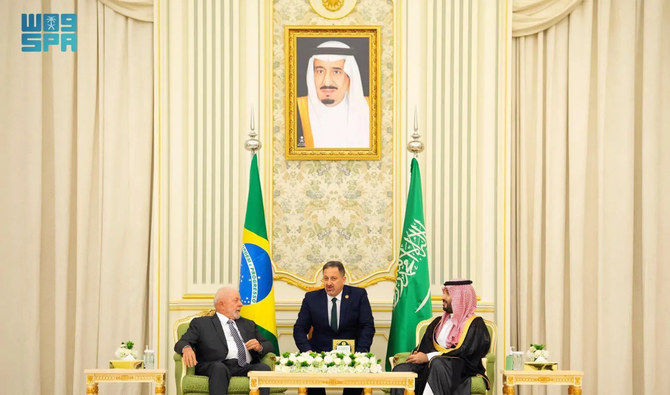


RIYADH: The Saudi Ministry of Foreign Affairs on Thursday released a joint statement on the visit of President of Brazil Luiz Inacio Lula da Silva to the Kingdom and the shared areas the two countries aim to enhance cooperation in.
On Tuesday, Crown Prince Mohammed bin Salman received Lula at Al-Yamamah Palace in Riyadh. The Brazilian president was in the Kingdom from Nov. 28 to Nov. 29.
Lula congratulated the crown prince on winning the bid to host Expo 2030.
The crown prince and Brazilian president reviewed bilateral relations between the two countries and ways to develop them. They also exchanged views on current regional and international situations.
The two countries agreed to establish the Saudi-Brazilian Coordination Council to frame and enhance joint cooperation. The leaders also agreed to complete the initial procedures and activate the council with its committee members in the near future.
The crown prince and the Brazilian president discussed economic, trade and investment cooperation and reviewed the most prominent challenges of the global economy and ways to enhance and diversify intra-regional trade. They also discussed ways to intensify joint private-sector partnerships.
The leaders praised the results of the Brazilian-Saudi Investment Forum, held in Sao Paulo in August 2023, which saw the signing of 25 investment agreements between the two countries, valued at about $3.5 billion.
In light of the recent increase in bilateral trade between Brazil and Saudi Arabia, the two sides discussed ways to further expand trade and investment, and agreed to deepen the partnership in other key areas such as defense, science, technology, renewable energy, education, climate and space cooperation.
The leaders agreed on establishing a mechanism for dialogue on investments to stimulate and facilitate investments.
They also agreed on the need to strengthen negotiations between financial and investment agencies such as the Brazilian Development Bank and the Public Investment Fund, and the need to strengthen the stimulation of bilateral talks to facilitate investment and improve the business environment.
The leaders welcomed the signing of an MoU between the National Industrial Development Center and Brazil’s Vale to develop a factory and logistics center for the manufacture of high-quality iron pellets.
They also welcomed the signing of an MoU between the two countries’ energy ministries.
The two sides discussed the importance of strengthening cooperation in the agricultural, fishery and animal fields. They agreed on the importance of enhancing cooperation in aviation, food manufacturing and distribution, communications, technology, digital economy, innovation and space.
Other areas of enhanced cooperation included combating cross-border corruption crimes, judiciary and justice cooperation, transportation and logistics, health, global initiatives to confront current and future pandemics, education (working with universities to strengthen the exchange of academic, educational and research experiences).
The last areas of enhanced cooperation discussed included radio, television and news exchange, and training and cooperation in the cultural areas of museums, music, theater, performing and visual arts.
On Brazil’s presidency of the G20, the two leaders stressed the importance of giving priority to the three dimensions of sustainable development — economic, social and environmental.
They highlighted the importance of intensifying efforts to reach a comprehensive and just settlement of the Palestinian-Israeli conflict in accordance with the principle of the two-state solution.


