

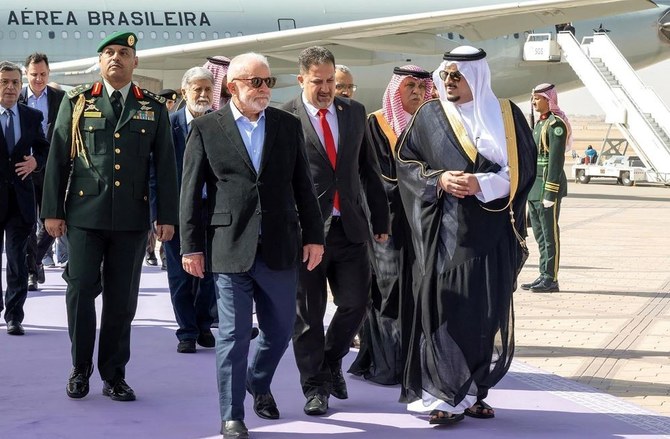

SAO PAULO: The visit of Brazil’s president to Riyadh on Nov. 28-29 with a delegation of ministers and businesspeople showed that he wants to strengthen ties with Saudi Arabia and is counting on its participation in projects, especially those involving green energy.
After an event that gathered Brazilian and Saudi authorities and business leaders on Wednesday, Luiz Inacio Lula da Silva invited the Kingdom to be “Brazil’s partners” in the energy transition that has been taking place in the South American nation.
“If Saudi Arabia is the most important country in the production of oil and gas, in 10 years from now Brazil will be called ‘the Saudi Arabia of green energy’,” Lula said in his speech.
Mining and Energy Minister Alexandre Silveira presented in the same meeting an overview of Brazil’s energy endeavors, and initiatives in which Saudi investors can take part.
The previous day, he met with Saudi Energy Minister Abdulaziz bin Salman and signed a memorandum of understanding aimed at improving cooperation between the two nations.
The MoU encompasses projects in various fields, including oil and gas, electricity, energy efficiency, petrochemicals, hydrogen, renewable energy and the circular carbon economy. The agreement also comprises academic partnerships for joint research involving energy.
“We are in Saudi Arabia demonstrating Brazilian leadership in the energy transition and seeking to further expand our relationship with the country,” Silveira said, adding that one of the visit’s goals was to attract investors.
The Saudi government had already announced in 2019, during former President Jair Bolsonaro’s tenure, a plan to invest $10 billion from its sovereign fund in Brazilian projects. Many of them are expected to be related to green energy and infrastructure.
“Brazil has great growth potential in all segments of renewable energies. Solar energy, wind power and biomass energy already make up a significant part of the Brazilian total energy production, but they can reach a much higher level,” Jose Roberto Simoes Moreira, an engineering professor who coordinates the University of Sao Paulo’s renewable energy program, told Arab News.
In 2022, almost half of Brazilian energy came from renewable sources. Solar and wind power were responsible for 90 percent of the expansion in energy production in 2023.
“Those energy sources were responsible for keeping the system safe and functional. We’ve been operating near the limit. Without the expansion in renewable energy, Brazilians would have problems,” Simoes Moreira said.
Especially in the northeast of the country, where most solar and wind plants have been implemented over the past few years, there is still room for new projects on land. Many entrepreneurs have already developed plans for offshore wind plants.
“They’re more expensive and present additional implementation challenges, but in Europe they’ve been numerous. In Brazil, that’s only the beginning,” Simoes Moreira said.
Enhancing the Brazilian energy system also requires the expansion of its energy distribution infrastructure.
The largest consumer market is in the southeast, which is far from the energy units in the northeast, said Simoes Moreira.
“It’s necessary to also invest in the expansion of transmission lines. The current ones are on the verge of full operation,” he added.
Osmar Chohfi, who heads the Arab-Brazilian Chamber of Commerce, said one of the sectors in which many joint projects can be carried out by Saudi Arabia and Brazil is green hydrogen.
“Brazil has a great opportunity to play the role of a strategic partner of Saudi Arabia. But in order for that to happen, it’s necessary to come up with well-conceived projects led by companies with high-quality governance and with a safe regulations system,” he said in a statement.
Chohfi recalled that Saudi Arabia has the goal of becoming a carbon-free country by 2060, so it has been investing heavily in the development of new energies.
The largest green hydrogen plant in the world, which is being constructed in the Red Sea, is part of that effort.
“In Brazil, Saudi investors can not only take part in projects involving renewable energies, but also in initiatives connected to carbon credits in order to compensate emissions during the transition process,” Chohfi said.
Regarding oil and gas, Simoes Moreira said Brazil still has great potential not only in energy production, but also in the petrochemical industry.
Besides energy, other MoUs were signed between Embraer, a leading aircraft manufacturer in Brazil, and the Saudi government, Saudi Arabian Military Industries, and Saudi airline Flynas.
The Brazilian delegation also discussed infrastructure projects with its Saudi counterparts. Ports and Airports Minister Silvio Costa Filho presented to business leaders opportunities concerning Brazilian ports, which may be partially privatized.
Lula has been looking for funds for his Growth Acceleration Program, a comprehensive public works initiative that will encompass several kinds of public works in the next few years.
Measures to enhance bilateral trade were also discussed between Lula and Crown Prince Mohammed bin Salman.
In 2022, commerce between Brazil and Saudi Arabia reached $8.221 billion. Brazil bought mainly hydrocarbons and fertilizers ($5.297 billion), while the Kingdom mostly bought halal protein ($2.924 billion). The two leaders believe that trade could reach $20 billion by 2030.


