

Klija Festival in Buraidah empowers small businesses

1 / 4
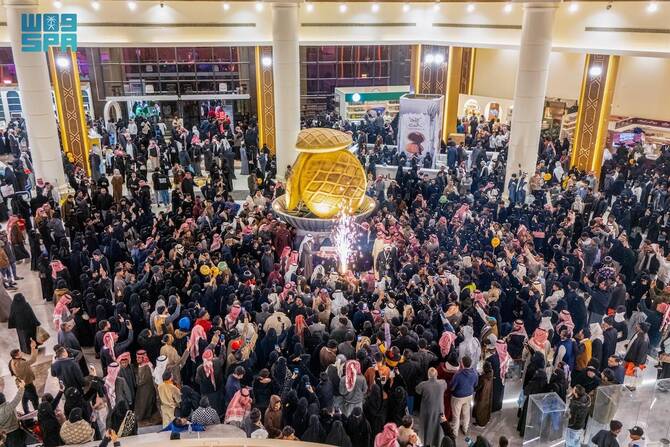
The festival drew more than half a million visitors during its 15-day run. (SPA)
2 / 4
The festival drew more than half a million visitors during its 15-day run. (SPA)
3 / 4
Japanese Ambassador to Saudi Arabia Yasunari Morino visited the 17th Klija Festival in Buraidah. (SPA)
4 / 4
Klija, a traditional cookie made from wheat flour, dates or sugar, date syrup and natural ingredients such as cardamom and lemon. (SPA)
Short Url
Updated 24 January 2026
Follow

Klija Festival in Buraidah empowers small businesses

  • Half a million attend 15-day celebration of heritage; event creates 1,500 seasonal jobs

RIYADH: The 17th Klija Festival in Buraidah drew more than half a million visitors during its 15-day run, celebrating the region’s heritage and entrepreneurial spirit.

Organized by the Qassim Chamber of Commerce, the event highlighted small businesses, providing a platform for entrepreneurs to showcase local products.

More than 340 sales outlets, marketing corners and points of sale welcomed attendees, while the festival provided 1,500 seasonal job opportunities, the Saudi Press Agency reported.

The small business pavilions featured families in the cottage industry, artisans and startups presenting traditional foods, and handicrafts and heritage items that reflect the region’s identity.

Participants said that the festival was a key marketing platform, boosting sales, increasing brand awareness, facilitating knowledge exchange and fostering connections with organizations supporting SMEs.

Mohammed Al-Hanaya, Qassim Chamber secretary-general and festival supervisor, said that the event brought together families, artisans, SMEs, companies and institutions, stimulating commercial activity, opening direct marketing channels and enhancing economic returns.

He added that the festival provided seasonal jobs for more than 1,500 young men and women across operations, marketing and services, supporting the labor market, empowering national talent, and connecting youth to the events and creative economy.

Klija, a traditional cookie made from wheat flour, dates or sugar, date syrup and natural ingredients such as cardamom and lemon, is a rich source of energy, carbohydrates, dietary fiber and natural proteins.

A cultural icon rooted in Qassim’s traditions, the cookie has gained international exposure through the festival, expanding the availability of packaged products.

Starting next year, the festival will be renamed the International Klija Festival, a rebranding approved by Qassim Gov. Prince Faisal bin Mishaal, who described it as a “successful model for turning local initiatives into global economic engines.”

This year’s festival, held at the King Khalid Cultural Center, included international participants from Egypt, Turkiye and Morocco, marking its evolution into a cross-cultural platform.


Iranian ambassador thanks Saudi for not allowing territory to be used during

Updated 8 sec ago
Follow

Iranian ambassador thanks Saudi for not allowing territory to be used during

  • Alireza Enayati tells AFP Iran appreciates Kingdom's pledge not to allow its 'airspace, waters, or territory' to be used in US attacks
  • Envoy also denies that his country hit the US embassy in Riyadh this week with drones
RIYADH: Iran’s ambassador to Saudi Arabia Alireza Enayati said on Thursday his country remained appreciative of Saudi Arabia’s pledge to not allow its airspace or territory to be used during the ongoing war with the US and Israel.
“We appreciate what we have repeatedly heard from Saudi Arabia — that it does not allow its airspace, waters, or territory to be used against the Islamic Republic of Iran,” he told AFP.
Before the outbreak of war, Riyadh had thrown its support behind diplomatic efforts to diffuse tensions between Tehran and Washington and vowed that its airspace would not be allowed to be used for attacks against Iran.
Enayati also categorically denied that his country hit the US embassy in Riyadh this week, after Saudi officials said Iran targeted the compound with drones.
Saudi Arabia has repeatedly accused Tehran of launching missile salvos and drone attacks at its territory and warned that the kingdom reserved the right to defend itself, including by retaliating.
Iran had earlier denied attacking the sprawling Ras Tanura refinery — one of the largest in the Middle East — which Riyadh had also accused Tehran of targeting twice with drones.
Enayati added to the denial, saying Iran also had no hand in the targeting of the US embassy that triggered a fire at the compound.
“We confirmed that Iran has no role in the attack on the US embassy in Riyadh,” the ambassador told AFP.
“If the operations command in Tehran attacks somewhere, it takes responsibility for it.”
The war in the Middle East has engulfed the otherwise stable Gulf region as Iran retaliates over US and Israeli strikes that killed its supreme leader, launching strikes at Israel, the wider region and beyond.
At least 13 people have been killed in the Gulf, including seven civilians, since Iran began its attacks on Saturday.
Enayati, however, denied that Iran was waging a regional war as retaliation for the attacks on his country by the US and Israel.
“This is not a regional war and it is not our war. It was imposed on the region,” he told AFP.