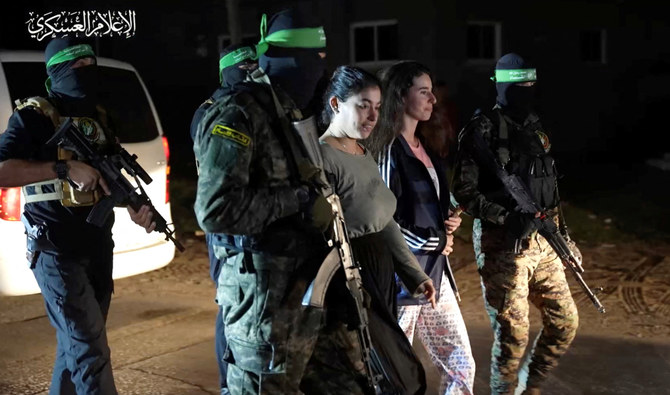
GAZA/TEL AVIV: Hamas on Thursday released eight Israeli hostages in Gaza under a last-minute extension of a truce deal and Israel freed 30 Palestinian prisoners as negotiators sought to renew the pause in fighting again.
Israel identified two women who were released first on Thursday as 21-year-old Mia Schem, among those seized at a dance party that Hamas militants attacked on Oct. 7, and 40-year-old Amit Soussana.
Photos released by the Israeli prime minister’s office showed Schem, who also holds French nationality, embracing her mother and brother after they were reunited at Hatzerim military base in Israel.
The Palestinian militant group Hamas then freed six more hostages, transferring them to the Red Cross, the Israeli military said. Four were women aged 29 to 41 including one Mexican-Israeli dual national, according to official information.
Television images showed some of the women walking past ambulances once they reached Israeli territory.
The other two newly released hostages were a brother and sister, Belal and Aisha Al-Ziadna, aged 18 and 17 respectively, according to the Israeli prime minister’s office. They are Bedouin Arab citizens of Israel and among four members of their family taken hostage while they were milking cows on a farm.
Wahid Alhuzail, who chairs a group for Bedouins kidnapped on Oct. 7, said he was happy they were freed. “But it’s not completely fulfilling. We want everyone to come home and for nobody to be stuck in the hands of the terror organization Hamas,” he told Reuters.
As part of the agreement, 30 Palestinians were released from jails, the Israeli prison service said.
Israel has sworn to annihilate Hamas, which rules Gaza, in response to the Oct. 7 rampage by the militant group, when Israel says gunmen killed 1,200 people and took 240 hostages.
Until the truce, Israel bombarded the territory for seven weeks. Palestinian health authorities deemed reliable by the United Nations say more than 15,000 Gazans have been confirmed killed.
While Israel required Hamas to release 10 hostages daily in to continue the Qatari-mediated truce, a Qatari foreign ministry spokesperson said there would be no more hostages freed on Thursday beyond the eight.
Israeli officials accepted eight rather than 10 hostages because Hamas on Wednesday released two extra hostages, the Qatari spokesperson said. They were Israeli-Russian women whose liberty the Palestinian faction described as a goodwill gesture to Moscow.
Israel and Hamas agreed to add a seventh day of a humanitarian pause on Thursday, while Egyptian and Qatari mediators were working to negotiate a further extension of two days, Egypt’s official state media agency said.
With fewer Israeli women and children left in captivity, extending the truce could require setting new terms for the release of Israeli men, including soldiers. Thus far during the truce, Palestinian militants have freed 105 hostages and Israel has released 240 Palestinian prisoners.
The truce has allowed some humanitarian aid into Gaza after much of the coastal territory of 2.3 million people was reduced to wasteland in the Israeli assault.
More fuel and 56 trucks of humanitarian supplies entered Gaza on Thursday, Israel’s defense ministry and the Palestinian Red Crescent Society said.
But deliveries of food, water, medical supplies and fuel remain far below what is needed, aid workers say. At an emergency meeting in Amman, Jordan’s King Abdullah on Thursday urged UN officials and international groups to pressure Israel to allow more aid into the beleaguered enclave, according to delegates.
US Secretary of State Antony Blinken, in Israel during his third visit to the Middle East since the war began, agreed that the flow of aid into Gaza was not sufficient.
Blinken said he told Prime Minister Benjamin Netanyahu that Israel must do more to protect civilians before any further military operations, and Netanyahu and his cabinet supported this approach.
“Israel has ... one of the most sophisticated militaries in the world. It is capable of neutralizing the threat posed by Hamas while minimizing harm to innocent men, women and children. And it has an obligation to do so,” Blinken told reporters in Tel Aviv.
Separately, the armed wing of Hamas claimed responsibility for a deadly shooting in Jerusalem, which Israel called further proof of the need to destroy the militants, although there were no signs of this scuppering the truce or release of hostages.
Shortly after the last-minute extension of the truce, two Palestinian attackers opened fire at a bus stop during morning rush hour at the entrance to Jerusalem, killing at least four people. Both attackers were “neutralized,” police said.
“This event proves again how we must not show weakness, that we must speak to Hamas only through (rifle) scopes, only through war,” said hard-right National Security Minister Itamar Ben-Gvir at the site of the attack.
Hamas said the attackers were its members, and its armed wing claimed responsibility for the attack in response “to the occupation’s crimes of killing children and women in Gaza.”
But neither side appeared to treat the attack as an explicit renunciation of the truce. A Palestinian official familiar with the truce talks said its terms did not apply to what he characterised as responses to Israeli attacks in the West Bank and Jerusalem.


![]()

Hamas frees eight hostages to Israel as talks seek to extend Gaza truce
Short Url
https://arab.news/p5zd8
Hamas frees eight hostages to Israel as talks seek to extend Gaza truce
- Hamas is expected to demand greater concessions for many of the remaining captives
- Blinken is expected to press for further extensions of the truce and the release of more hostages


Latest updates


© 2026 SAUDI RESEARCH & PUBLISHING COMPANY, All Rights Reserved And subject to Terms of Use Agreement.