

Pakistan plans digital wheat tracking system, steps up Ramadan price monitoring

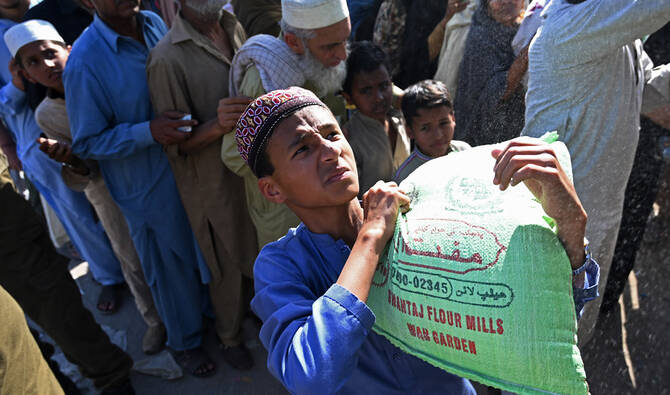
A boy receives free wheat flour at a distribution point in Rawalpindi on March 28, 2023. (AFP/File)
Short Url
Updated 21 February 2026
Follow

Pakistan plans digital wheat tracking system, steps up Ramadan price monitoring

  • Government says adequate stocks available ahead of the upcoming harvesting season
  • It instructs provinces to prevent flour price spikes during the holy month of Ramadan

ISLAMABAD: Pakistan plans to introduce digital traceability and tighter supply chain monitoring in its wheat procurement system under a new long-term policy, the food security ministry said on Saturday, as authorities move to curb price volatility during Ramadan.

The announcement followed a meeting of the National Wheat Oversight Committee chaired by Federal Minister for National Food Security and Research Rana Tanveer Hussain to review procurement arrangements, stock availability and price stability measures ahead of the upcoming harvesting season.

The review comes after riverine floods during last year’s monsoon season damaged farmlands in parts of eastern Punjab, the country’s main wheat-producing region, raising concerns about crop output. Officials at the meeting, however, expressed satisfaction over existing wheat stocks, saying sufficient supplies were available across provinces to meet national consumption needs until the arrival of the new crop.

“The Federal Minister emphasized that the current procurement framework will remain applicable for one year,” the statement said. “He stated that the Federal Government is working on a comprehensive long-term wheat policy for the period 2026–2030, aimed at strengthening national food security through modern reforms.”

“He highlighted that the upcoming policy will focus on digital traceability mechanisms, improved supply chain monitoring, enhanced transparency, and sustained price stability, enabling better coordination between the federal and provincial governments,” the statement added.

The committee was informed that the illustrative wheat procurement price has been fixed at 3,500 rupees ($12.55) per 40 kilograms, and provinces have been asked to ensure smooth implementation of procurement operations.

Special emphasis was also placed on consumer protection during Ramadan.

“The Federal Minister directed all provinces to ensure strict market monitoring and take effective administrative measures to prevent any unnecessary increase in flour prices,” the statement continued.


Pakistan PM calls for faster CPEC implementation, pledges security for Chinese workers

Updated 27 February 2026
Follow

Pakistan PM calls for faster CPEC implementation, pledges security for Chinese workers

  • Shehbaz Sharif pushes expanded cooperation in agriculture, IT and mining under CPEC phase two
  • Chinese envoy reaffirms Beijing’s support for Pakistan’s sovereignty and economic development

ISLAMABAD: Prime Minister Shehbaz Sharif on Friday called for speeding up projects under the China-Pakistan Economic Corridor (CPEC) and pledged stronger security guarantees for Chinese workers and investments, during a meeting with China’s ambassador in Islamabad.

Sharif made the remarks as the two countries strive to launch the second phase of CPEC, a multibillion-dollar infrastructure and energy initiative launched in 2015 as part of China’s Belt and Road Initiative (BRI).

CPEC’s first phase focused largely on power generation and transport infrastructure aimed at easing Pakistan’s chronic energy shortages and improving connectivity. The second phase seeks to expand cooperation into industrial development, with an emphasis on special economic zones and export-oriented growth.

“While highlighting the importance of accelerating ongoing CPEC projects, the Prime Minister stressed on the need to enhance cooperation in agriculture and IT and mining & minerals,” said a statement circulated by the PM Office after the meeting.

“He also underscored Pakistan’s resolve to provide a secure and conducive environment for Chinese personnel, investments, and institutions in Pakistan,” it added.

Chinese nationals and projects in Pakistan have faced security threats in the past, including attacks by militant groups targeting infrastructure sites and convoys. Islamabad has repeatedly vowed to tighten security and has deployed special protection units for Chinese workers.

China is Pakistan’s closest ally in the region and a key economic partner, with CPEC widely regarded by Islamabad as central to long-term economic growth.

During the meeting, the prime minister conveyed greetings to Chinese President Xi Jinping and Premier Li Qiang, particularly on the occasion of the Chinese New Year.

China’s Ambassador to Pakistan, Jiang Zaidong, reiterated Beijing’s support for Pakistan’s sovereignty and socioeconomic development, according to the statement. Both sides also exchanged views on regional and international issues and agreed to maintain close coordination.