

Arab-Islamic ministerial committee meets at UN headquarters to discuss Gaza war

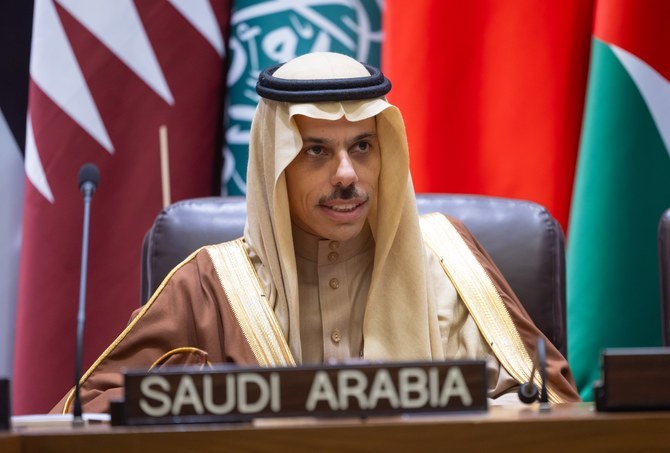
Saudi Foreign Minister Prince Faisal bin Farhan at the Arab-Islamic ministerial committee meeting in New York, USA on November 29, 2023. (SPA)
Short Url
Updated 30 November 2023
Follow

Arab-Islamic ministerial committee meets at UN headquarters to discuss Gaza war

  • Meeting led by Saudi Foreign Minister Prince Faisal bin Farhan
  • Ministers call for lasting peace, implementation of two-state solution

RIYADH: A ministerial committee assigned by the Joint Arab-Islamic Extraordinary Summit held a meeting on Wednesday at the UN headquarters in New York, the Saudi Press Agency reported.

The meeting was led by Saudi Foreign Minister Prince Faisal bin Farhan and attended by representatives from China, Qatar, Jordan, Egypt, Palestine, Turkiye, Indonesia, Malaysia and the UAE.

The agenda focused on recent events in Gaza, including the outcomes of the humanitarian truce for Palestinian prisoners and efforts to achieve a ceasefire.

The meeting underscored the role of the UN Security Council’s permanent members in protecting civilians and enforcing international humanitarian laws, and highlighted the need to establish secure channels to allow urgent humanitarian aid to enter Gaza.

The ministers reiterated their call for lasting peace through the implementation of resolutions supporting a two-state solution and the creation of an independent, sovereign Palestinian state based on 1967 borders, with East Jerusalem as its capital.

The committee also urged the global community to consistently apply international legal and moral principles, and to protect Palestinians in Gaza and the occupied West Bank from the Israeli army and violent illegal settlers.


Najran farmers find sugarcane cultivation viable, promising lucrative economic returns

Updated 07 December 2025
Follow

Najran farmers find sugarcane cultivation viable, promising lucrative economic returns

  • Najran's mountainous parts are blessed with temperate climate and abundant water resources, suitable for sugarcane production

NAJRAN: Farmers in Saudi Arabia's southwestern region of Najran have found that sugarcane production is a viable enterprise, the Saudi Press Agency (SPA) has reported.

One farmer, Ibrahim Shakwan, confirmed to SPA the success of his 7.3-hectare sugarcane farm and noted "growing regional interest due to its high productivity and lucrative economic returns."

Najran was chosen as a trial area for sugarcane production owing to the temperate climate, diverse soils, and abundant water resources in its mountainous parts. The experiment is in line with Saudi Vision 2030, which calls for enhancing food security and self-sufficiency.

Others regions in the Kingdom's southwest, such as Jazan, Asir and Baha, have similar features as Najran. 

Sugarcane is easily propagated via cuttings that yield a high number of plantable pieces. (SPA)

Sugarcane is easily propagated via cuttings that yield a high number of plantable pieces. Planting occurs primarily in the summer, although seedlings can be planted year-round. 

Effective cultivation methods include selecting disease-resistant varieties, proper soil preparation, and balanced irrigation and fertilization, according to the report.

The crop is harvested approximately eight months after planting, with fertilization ending three months before and irrigation ceasing 20 days prior to harvest to boost sugar concentration and improve juice quality, which is rich in natural sugars, vitamins, and minerals.

Several countries in the Middle East have long been growing sugarcane, with Egypt and Iran as key producers. 

Botanists believe sugarcane was first cultivated 10,000 years ago in what is now New Guinea in the southwest Pacific Ocean, where the environment is humid, according to an article titled Sugar Please, published in the Aramcoworld magazine in 2012.