

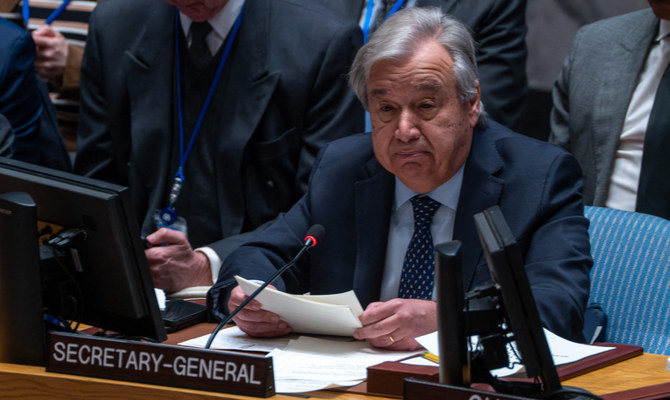

NEW YORK CITY: UN Secretary-General Antonio Guterres said on Wednesday that a “far greater” number of children have been killed by Israel in Gaza in a matter of weeks during the current conflict than the total number of children killed “during any year, by any party to a conflict since I became secretary-general.”
The people of Gaza are in the midst of “an epic humanitarian catastrophe before the eyes of the world. We must not look away,” he added.
As he welcomed the ongoing, last-minute negotiations taking place in an attempt to extend the truce in the war, Guterres once again stressed the need for “a true humanitarian ceasefire.”
Speaking during a meeting of the Security Council, he said it is imperative that the people of the region are given “a horizon of hope” in the form of efforts to move in a “determined and irreversible” way toward a two-state solution.
“Failure will condemn Palestinians, Israelis, the region and the world to a never-ending cycle of death and destruction,” he added.
The high-level Security Council meeting, which took place on the annual UN-organized International Day for Solidarity with the Palestinian People, was chaired by Chinese Foreign Minister, Wang Yi. China holds the rotating presidency of the 15-member council this month.
“We should work toward a comprehensive and lasting ceasefire with the greatest urgency and as the utmost priority,” Wang said.
“What happened between Palestine and Israel over the decades shows, time and again, that resorting to military means is definitely not a way out.”
He added that China hopes the pause in military operations over the past few days will not prove simply to be a brief hiatus before a new round of violence, warning that “resumed fighting would only, most likely, turn into a calamity that devours the whole region.”
Saudi Arabia’s foreign minister, Prince Faisal bin Farhan, lamented the lack of any international mechanism for ensuring accountability for actions during the war, and the Security Council’s inability to take any steps to prevent Israeli violations of the rules of war and international law.
He told council members that the Nov. 11 summit in Riyadh adopted a resolution that reflected the will of Arab and Islamic peoples to “stem the bloodshed, deliver assistance, put an end to violations, overcome this unjustified suffering in Palestine, and stand with the Palestinian people to achieve their legitimate demands to take back their occupied territory and establish an independent state.”
Prince Faisal called for the ongoing implementation of Security Council Resolution 2712 and for efforts to build on it to achieve “a comprehensive and immediate ceasefire.” The resolution, adopted by the council on Nov. 15, calls “for urgent and extended humanitarian pauses and corridors throughout the Gaza Strip … to enable … full, rapid, safe and unhindered humanitarian access.”
Israel’s representative to the UN, Gilad Erdan, accused the foreign ministers “of some Arab countries” of coming to New York to support a “terror organization that aims to annihilate Israel.”
He equated calls for a ceasefire with support for Hamas and its “continued reign of terror” in Gaza. “Don’t you see the contradiction here?” Erdan asked council members. “Calling for both a ceasefire and peace is a paradox.” He added that “more food, water and medical supplies will not bring us closer to a solution.”
Prince Faisal asked the council: “What will help us reach a solution, according to Israel? More bloodshed? More death?”
Urging Israel to heed Arab calls for peace, he added: “The Kingdom of Saudi Arabia presented an Arab peace plan in 1982. We also had the Arab Peace Initiative in Beirut in 2002. And the PLO (Palestine Liberation Organization) recognized the State of Israel in 1993.
“Where is the Israeli peace plan? Where is the Israeli recognition of the State of Palestine? We are peace-loving nations and peace has always been our strategic choice, but we also want it to be the choice of Israel as well.”
Prince Faisal said the time has come for the world to recognize an independent Palestinian state, and called for Palestine to be granted full membership of the UN. Currently it has observer state status.
He also called for an international peace conference to take place, under the auspices of the UN, with the aim of developing and implementing a two-state solution.
He told reporters at the UN headquarters in New York: “The danger is that if … this truce expires we will return to the killing at the scale that we have seen, which is unbearable. So we are here to make a clear statement that a truce is not enough. What is needed is a ceasefire.”
The prince added that a glimmer of hope can be found in the fact that public opinion worldwide is beginning to shift as people become increasingly aware of “the unfolding catastrophe” in Gaza, and that violence is not the answer.
Asked whether Arab nations should help ease the current pressure on Palestinians and their suffering by taking them in as refugees, he said they “do not want to leave their land. We won’t encourage them or force them to leave their land and we are not going to work with anyone who has that agenda.
“The Palestinians have a right to their land, and they have a right to live in safety and security and dignity on their land, and that is what we will push for and work toward.”
Riyad Maliki, the Palestinian foreign minister, told the Security Council that anyone who is still not sure about whether they oppose the war in Gaza or the need for it to end should “check their humanity.”
The current truce must become “a permanent ceasefire,” he said, because “the massacres cannot be allowed to resume.”
He added: “Our people are faced with an existential threat. Make no mistake about it. With all the talk about the destruction of Israel, it is Palestine that is facing a plan to destroy it, implemented in broad daylight.”
The US ambassador to the UN, Linda Thomas-Greenfield, said her country has urged Israel “to take every possible measure to prevent civilian casualties as it exercises its right to safeguard its people from acts of terror.” The use of civilians as human shields by Hamas “does not lessen Israel’s responsibility,” she added.


