

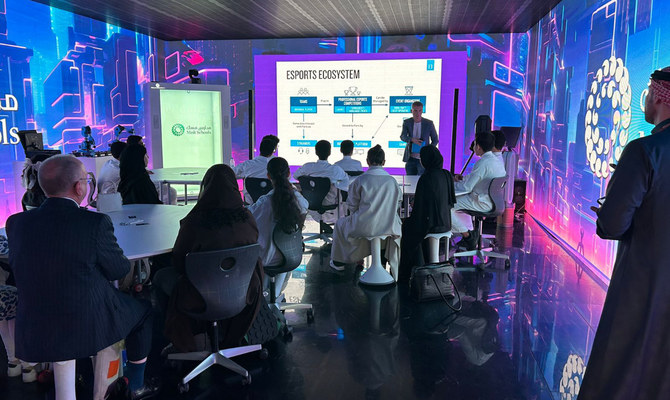
Misk Schools students enjoy ‘BTEC in Esports’ lesson

The BTEC in Esports lesson was delivered in the Riyadh Schools’ Classroom of the Future, which has been designed and built in partnership with EStars.
Short Url
Updated 29 November 2023
Follow

Misk Schools students enjoy ‘BTEC in Esports’ lesson

The Misk Global Forum in Riyadh, held from Nov. 15-17, showcased the talents and ideas of young leaders, CEOs and entrepreneurs from around the world, but one of the most exciting highlights was the inaugural “BTEC in Esports” lesson, delivered to students from Riyadh’s prestigious Misk Schools.

Esports influencer Brandon Smith flew into Riyadh especially to deliver the lesson on behalf of the region’s leaders in educational esports, EStars. Accredited in the MENA region by Pearson Education, one of the world’s top education providers, the BTEC in Esports program is designed to provide students with the expertise they need to access opportunities in the fast-growing esports sector. The esports industry saw revenues of almost $2 billion in 2022 and has been growing at more than 20 percent per year.

Fittingly, the lesson was delivered in the Riyadh Schools’ Classroom of the Future, which has been designed and built in partnership with EStars. The concept provides a template for reinventing education using the best emerging technologies and teaching practices, to empower students growing up in a very different world.

Misk Schools is the first school in the Kingdom to adopt esports as part of its curriculum, which aims to produce future leaders, ready to embrace the knowledge economy embodied in Vision 2030.

Dr. Steffen Sommer, director general of Misk Schools, said: “Esports encourages young people to work together and play together, which is culturally quite new here. In addition to educating students about a rapidly expanding global industry, the BTEC also hones strategic thinking, teamwork and entrepreneurial skills — essential capabilities for emerging leaders navigating the world.”

The inaugural BTEC in Esports lesson and the Riyadh Schools’ Classroom of the Future were the subject of huge interest at the Misk Global Forum, visited by a number of Saudi dignitaries, ministry officials and VIPs, plus stars such as two-time world champion boxer Amir Khan, professional racing driver Reema Juffali and Saudi astronauts Rayyanah Barnawi and Ali Alqarni.

EStars CEO Mags Byrne said: “We are proud to be delivering the BTEC in Esports to students at Misk Schools. EStars aims to provide a pathway to careers of the future for the students of today. Collaborating with such a pioneering partner as Misk Schools has given us a chance to showcase how the BTEC in Esports upskills students to forge careers in the growing esports sector.”

Founded in 2017 in the UK by CEO Byrne, EStars is the global leader in educational esports, providing students with the skills they need to succeed in one of the world’s fastest-growing industries. It has offices in Abu Dhabi from which it covers the Middle East and Africa region.


Jameel Research project at MIT tackles antimicrobial resistance

The ambitious project is led by Professor James J. Collins, third from left. Professor Collins and his team at MIT will develop
Updated 31 January 2026
Follow

Jameel Research project at MIT tackles antimicrobial resistance

Jameel Research, part of Abdul Latif Jameel International network, is sponsoring a research project in the Department of Biological Engineering and Institute for Medical Engineering and Science at the Massachusetts Institute of Technology, aimed at tackling the global public health crisis of antimicrobial resistance.
This ambitious, multi-disciplinary project is led by Professor James J. Collins, Termeer professor of medical engineering and science at MIT and faculty lead for life sciences at the MIT Jameel Clinic, the epicenter of artificial intelligence and health at MIT.
The project, spanning at least three years, will leverage the Collins’ lab’s cutting-edge strengths in synthetic biology and AI to create next-generation diagnostics.
The growing prevalence of antibiotic-resistant superbugs and a declining antibiotic pipeline has led to a global public health crisis. The US Centers for Disease Control and Prevention has predicted some 2 million infections and 23,000 deaths occur each year in the US alone, costing $55 billion. The World Bank predicts that up to $100 trillion of economic output may be at risk by 2050. The UK government-commissioned Review on Antimicrobial Resistance is projecting more than 10 million deaths worldwide per year by 2050 if the crisis is not addressed.
Professor Collins and his team at MIT are setting out to develop the next generation of antibacterials and rapid diagnostics to overcome AMR — using synthetic biology and advanced generative AI to deliver faster results and help control the use of antibiotics to where they can be effective.
With support from Jameel Research, the first phase of this project will develop and validate programmable antibacterials to overcome AMR in a range of bacterial pathogens. These AI-designed minibinders will be delivered by engineered microbes to neutralize key toxins and protein targets.
This directed design and engineering approach to antibiotic development technology advances a long-term vision to create programmable antibacterials to address the AMR crisis. This would then offer the potential for the more rapid development of medical countermeasures to emerging and re-emerging pathogens and a swifter response to future outbreaks and pandemics.
Mohammed Abdul Latif Jameel, KBE, chairman of Abdul Latif Jameel, said: “Antimicrobial resistance is one of the most urgent challenges we face today and addressing it will require ambitious science and sustained collaboration. We are pleased to support this new research, building on our long-standing relationship with MIT and our commitment to advancing research across the world, to strengthen global health and contribute to a more resilient future.”
“This project reflects my belief that tackling AMR requires both bold scientific ideas and a pathway to real-world impact,” Professor Collins said. “Jameel Research is keen to address this crisis by supporting innovative, translatable research at MIT.”
Jameel Research is advancing the work of pioneering pathfinders to create an extraordinary impact on a global scale.
This initial project holds the promise of rapidly developing medical countermeasures for emerging and re-emerging pathogens, offering a rapid response to future outbreaks and pandemics.
The new research project builds on the close and long-standing relationship between MIT and the Jameel family. This includes the MIT Jameel Clinic, which was co-founded in 2018 by MIT and Community Jameel, the international nonprofit organization founded by Mohammed Jameel, KBE, to advance science and learning for communities to thrive, and one of the Jameel family’s philanthropies.