

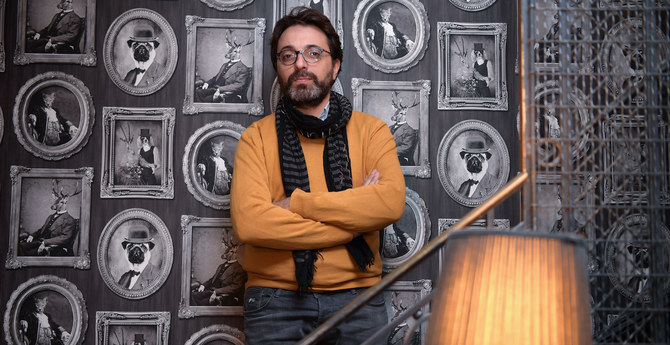

DUBAI: Years ago, Tunisian filmmaker Mohamed Ben Attia was struck by an image he couldn’t get out of his head. It was a man running towards a cliff, and when he reached the edge, he started to fly. He knew there was greatness in it — a perfect image of freedom. He felt it could perhaps be the basis for his greatest film. But as he wrote and he wrote, nothing came of it. The emotions felt flat. It wasn’t that the idea wasn’t ready — he wasn’t ready himself.
“I was maybe 20 years old at the time. I was childish and immature. Everything I wrote made little sense to me,” Ben Attia tells Arab News. “But when I finished my film ‘Hedi’ in 2016, the idea returned. Suddenly this idea of a man flying started appearing in my mind beside my own emotions — the rage I was feeling deep within myself. And then these feelings and that image started to blend.”
At the start of December, “Behind the Mountains,” the result of that renewed inspiration, will screen in competition at the 2023 Red Sea International Film Festival, after receiving support from the Red Sea Fund while in production. The film made its acclaimed debut at the Venice International Film Festival in September, and as much as Ben Attia put his all into the making of the film, seeing audiences react to such a deeply personal and multifaceted movie can sometimes be painful.

Ben Attia on set with Walid Bouchhioua, who stars as Yassine in “Behind the Mountains.” (Supplied)
“I hate this at times, to be honest. I know I’m supposed to love it, but it can be difficult when people get so confused by watching it, trying to figure out what it’s trying to tell them,” Ben Attia says. “This is part of doing cinema — a film cannot be loved by everyone. But it’s a very strange feeling with this film particularly, because it’s hard even for me to explain the meaning of the film, as well as for many to understand what drives this character to begin with.”
“Behind the Mountains” begins simply enough, at least. Rafik is released from a Tunisian prison, four years after his mental health issues manifested as a violent outburst in his former workplace. He now believes he can fly, and kidnaps his young son to take him to a special place behind the mountains to show him that his vision is real.
There are many potential interpretations of this tale, but it’s hard not to draw parallels to the story of Tunisia itself, even for Ben Attia. Almost exactly 13 years ago, the Tunisian Revolution began, culminating in the ousting of the Ben Ali government and the start of a still-ongoing redrawing of the Tunisian political landscape and a reorganization of the country’s society at large.

Ben Attia on set with Majd Mastoura, who stars as Rafik in “Behind the Mountains.” (Supplied)
In a time of great upheaval, a world of possibility emerges. Suddenly, the future feels free — enough to make a man feel that he could fly, because perhaps he can. But is the anarchy of freedom a blessing? A curse? Both? And can anything truly change if people continue to impose the same mental shackles on themselves as they did before? It’s a complicated subject that has caused more than a few headaches, to put it lightly.
“I would say that, since our revolution happened, the busiest people in our society have been the psychiatrists. Because it wasn’t just that things changed politically — it was also a revolution of the individual; a revolution of feeling,” Ben Attia explains.
“The idea that this regime could change was impossible for us to imagine. So it gave us the feeling that anything could happen, even in our own lives. That’s why people started changing professions, getting divorced… That’s exactly where this film finds its characters — in moments where they come to their own realizations of possibility, their own understandings of how things can be different, for better or for worse.”

A still from “Behind the Mountains.” (Supplied)
Ben Attia has changed a lot, too. Over the last decade, his work has captured the attention of the film community cross the world. 2016’s “Hedi” won the Best First Feature award at the 2016 Berlin International Film Festival and was co-produced by the renowned Dardenne brothers. His next film, “Dear Son,” was selected for the Directors’ Fortnight section of the 2018 Cannes Film Festival, and was the Tunisian entry for the Best International Film category of that year’s Academy Awards.
Part of what has kept him grounded as his star rises is his second career, the one he rarely talks about.
“I have a strange life, to be frank. While I’m doing all of this, I’m also a chef in my family’s Italian restaurants in Tunis. I get my ideas for films when I’m working in my kitchen. It gives me balance in my own life when I have these dual identities. It takes the pressure off. When I was just doing nothing, no ideas came. I have to work in the restaurant — I have to be making pasta fresca to get a little bit inspired. It allows me to see things I couldn’t have in any other circumstance,” says Ben Attia.
But while the kitchen is where the ideas start to flow, art is still an act of self-therapy, especially as it can often contain complex and contradictory ideas that everyday linear thought often can’t.

A still from “Behind the Mountains.” (Supplied)
“We are living in strange times, especially with what’s happening in Gaza and everywhere else,” Ben Attia says. “It’s not just our region of the world, it’s also about the identity of the Arab people and our relation to the Occident. As an artist, that fills us with contradictions — today I think something and tomorrow I think something very different. But thankfully, we are not making science, we are making cinema. We’re still discovering what the truth could be, and what our future could be.”
At each screening of “Behind the Mountains,” Ben Attia gets different interpretations from the audience of all the things it may be saying. And with every question, he has more time to consider what he thinks about both the work and the world he’s living in — and he hasn’t quite worked it out. But that’s the beauty of cinema, as he says, and when his next film idea comes to the boil back in his kitchen, he’s ready to see where his inspiration takes him next.
“I’m giving myself boundaries: first, just follow the promotion of this film just to understand better what I did and how, and why I did it. Even if that hurts, it’s good to do, and it’s good to react to what happened with this film,” he says. “Even now, I have a vague idea — I have another image I’m getting ready to pursue. But I’m in no rush. I want to take my time and see if it’s still there in a few months, and if that’s the case, then I’m ready to start for sure on the right foot.”


