

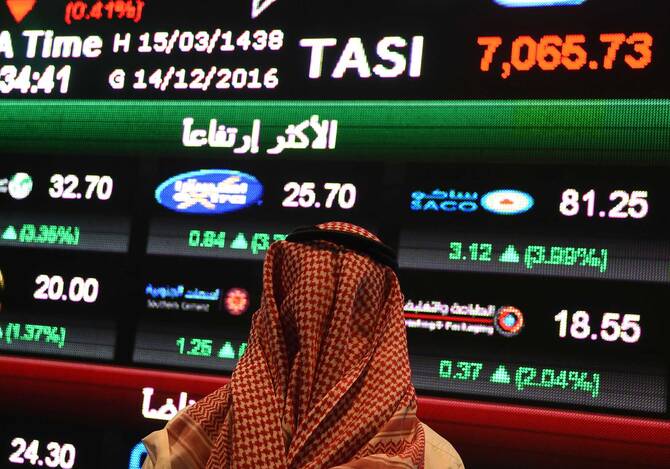
Closing Bell: Saudi main market edges up to close at 11,216.9

Trading activity was robust, with a total of 150.4 million shares changing hands and an aggregate value of SR3.3 billion ($880.2 million). AFP/File
Short Url
Updated 08 February 2026
Follow

Closing Bell: Saudi main market edges up to close at 11,216.9

RIYADH: Saudi Arabia’s Tadawul All Share Index rose on Sunday, closing at 11,216.93, up 28.20 points, or 0.25 percent.

The MSCI Tadawul 30 Index also advanced, finishing at 1,512.99, a gain of 0.29 percent, while the parallel market index, Nomu, inched up 0.09 percent to 23,887.01.

Trading activity was robust, with a total of 150.4 million shares changing hands and an aggregate value of SR3.3 billion ($880.2 million).

Among the top gainers, Zahrat Al Waha for Trading Co. surged 7.05 percent to SR2.58. The Mediterranean and Gulf Cooperative Insurance & Reinsurance Co. rose 5.26 percent to SR15.82, and Jahez International Co. for Information System Technology increased 4.68 percent to SR14.09.

Saudi Real Estate Co. added 4.47 percent to SR14.48, while Arabian Shield Cooperative Insurance Co. gained 4.3 percent to SR12.12.

On the other hand, Abdullah Saad Mohammed Abo Moati for Bookstores Co. fell 3.55 percent to SR44, and The Company for Cooperative Insurance dropped 2.92 percent to SR133.

Canadian Medical Center Co. eased 2.69 percent to SR6.15, Ataa Educational Co. declined 2.61 percent to SR52.15, and ADES Holding Co. finished 2.5 percent lower at SR18.31.

Meanwhile, Saudi Aramco Base Oil Co. announced that its board of directors has recommended distributing cash dividends for the second half of 2025.

The proposed payout is SR3.5 per share, bringing total dividends for the year to SR4.5 per share, representing around 70 percent of free cash flow in line with the company’s performance-linked dividend policy.

The total amount to be distributed for the second half stands at SR589.9 million, covering 168.2 million eligible shares.

Eligibility will be determined at the close of trading on the day of the company’s general assembly, with the distribution date to be announced later. Luberef shares last traded at SR105.5, up 3.53 percent.

Separately, the Capital Market Authority revealed that it has licensed Lesha Capital to conduct investment management and fund operations in the securities business, following the company’s completion of all required business registrations.


Saudi banking sector outlook stable on higher non-oil growth: Moody’s 

Updated 4 sec ago
Follow

Saudi banking sector outlook stable on higher non-oil growth: Moody’s 

RIYADH: Saudi Arabia’s banking sector outlook remains stable as stronger non-oil economic growth and solid capital buffers support lending and profitability, Moody’s Ratings said, forecasting continued expansion despite liquidity constraints. 

In its latest report, credit rating agency Moody’s said the Kingdom’s non-oil gross domestic product is projected to expand by 4.2 percent this year, up from 3.7 percent recorded in 2025. 

In January, S&P Global echoed a similar view, saying banks operating in Saudi Arabia are expected to sustain strong lending growth in 2026, driven by financing demand tied to Vision 2030 projects. 

Fitch Ratings also underscored the healthy state of Saudi Arabia’s banking system last month, stating that credit growth and high net interest margins are supporting bank profitability in the Kingdom. 

Commenting on the latest report, Ashraf Madani, vice president and senior credit officer at Moody’s Ratings, said: “We expect credit demand to remain robust, but tight liquidity conditions will continue to limit the sector’s lending capacity.” 

Madani added that operating conditions in Saudi Arabia will continue to support banks’ strong asset quality and profitability. 

“The operating environment for banks remains buoyant, underpinned by a forecast increase in non-oil GDP growth, robust solvency and continued progress toward the government’s economic diversification goals,” he added.  

Moody’s said authorities in the Kingdom are introducing business-friendly reforms to bolster investment and private sector activity, while implementing key development projects and preparing for major global events. 

Saudi Arabia continues to advance reforms including full foreign ownership rights, simplified capital market registration procedures and improved investor protections, which could accelerate credit growth to 8 percent this year. 

Problem loans are expected to remain near historical lows at around 1.3 percent of total loans, supported by ongoing credit growth, favorable operating conditions and lower interest rates, which collectively strengthen borrowers’ repayment capacity. 

Retail credit risk remains controlled in Saudi Arabia because most borrowers are government employees with stable income streams. 

“Concentration of single borrowers and specific sectors remains high although the growing proportion of consumer loans — now nearing 50 percent of overall sector lending — continues to reduce aggregate concentration risk,” added Moody’s.  

The report said profitability is expected to remain solid among Saudi banks, supported by sustained loan growth and fee income. 

Margins are expected to remain stable despite lower asset yields as banks take advantage of credit demand to widen loan spreads on existing and new lending. 

Moody’s expects net income to tangible assets to remain stable at 1.8 percent to 1.9 percent this year. 

The report added that Saudi banks benefit from a very high likelihood of government support in the event of any failures. 

“We assume a very high likelihood of government support in the event of a bank failure. This is based on the government’s track record of timely intervention,” Moody’s said.  

It added that Saudi Arabia remains the only G-20 country that has not adopted a banking resolution framework. However, it is the only Gulf Cooperation Council member to have introduced a law for systemically important financial institutions.