KARACHI: Four police officers were arrested in Nawab Shah, a town in southern Sindh province, on Tuesday following bribery allegations made by Pakistani cricketers with international reputations.
The development follows similar incidents, including the arrest of a senior police official who seized over Rs20 million from a trader and action against three cops for harassing Afghan refugees last week, spotlighting problems within the Sindh police force.
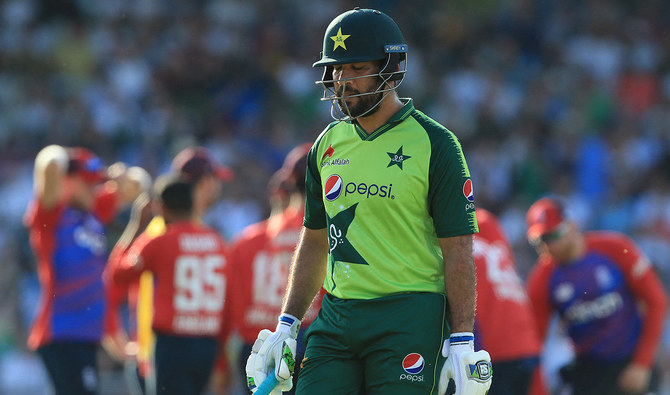
Cricketers Sohaib Maqsood and Aamir Yamin, in near-identical posts on their social media accounts, complained about extortion, expressing gratitude for living in Punjab province. Maqsood recounted being stopped every 50 kilometers for money while traveling back from Karachi to his hometown, Multan.
Last week, a senior superintendent of police in Karachi, Imran Qureshi, was removed from his post, and his deputy, Umair Tariq Bajari, was arrested after being implicated in seizing money from a trader.
In response to these incidents, a spokesperson for the Inspector General of Police’s office told Arab News the Sindh police chief, Riffat Mukhtar, had taken notice and ordered the immediate arrest of the accused in such cases.
“The IG Sindh not only immediately ordered an impartial and fair inquiry but also took immediate legal action against those found guilty,” he said.
Mukhtar and Additional Inspector General of Karachi, Khadim Hussain Rind, however, did not respond to requests for comment.
Experts believe these cases are indicative of a much larger problem deeply ingrained in the police culture and difficult to eradicate.
“There is a perception that the situation is getting worse,” Dr. Shoaib Suddle, a former police inspector general with a degree in criminology, said.
“Unfortunately, the number of police officials involved in such crimes is not released by their department,” he continued. “People don’t always report them since they believe the system will not support them no matter how grave their complaint is.”
Suddle said it was important to make merit-based recruitments and appointments.
“Proper investigation of cases against offices and setting example by punishing the cops involved in crimes can provide us the solution,” he added.
In a series of recent incidents highlighting the impediments to actual police work, three counterterrorism department officials were arrested in September for corrupt practices, a Station House Officer (SHO) was arrested in July for alleged involvement in robberies, and 28 policemen, including SHOs, were suspended in April on suspicion of involvement in smuggling.
Additionally, three officers posted in Nawab Shah were caught robbing people in Karachi in March, and three policemen were arrested in connection with a theft in Karachi in October 2020.
In May 2020, five staff members from the Malir Cantonment police, including the station head and investigation officer, were arrested after a cache of drugs and extortion money was found in their possession. A report submitted to the Supreme Court of Pakistan in 2017 by the Chief Secretary of Sindh stated that 12,000 police officers were involved in different crimes, with 184 sentenced and action recommended against 66 others.
Afzal Nadeem Dogar, a journalist reporting on crimes for over three decades, remarked that police involvement in such wrongdoings is not new, but the direct plundering of citizens in Karachi is unprecedented.
“Usually, police officials patronize criminals and get a share,” he continued. “But they mostly try to avoid targeting ordinary citizens on their own.”
Dogar said the crime culture was so deeply entrenched in the police force that its immediate eradication was not feasible.
“It’s now an integral part of the police culture, making it a major hurdle in effective policing,” he added.


![]()

Pakistan cricketers’ bribery allegations expose rampant extortion culture in Sindh Police
Short Url
https://arab.news/mpqzq
Pakistan cricketers’ bribery allegations expose rampant extortion culture in Sindh Police
- Four police officers were arrested in the province on charges of taking money from Pakistani cricketers
- Last week, a senior police official was arrested for seizing over Rs20 million from a trader in a fake raid
Latest updates


Recommended


© 2026 SAUDI RESEARCH & PUBLISHING COMPANY, All Rights Reserved And subject to Terms of Use Agreement.