

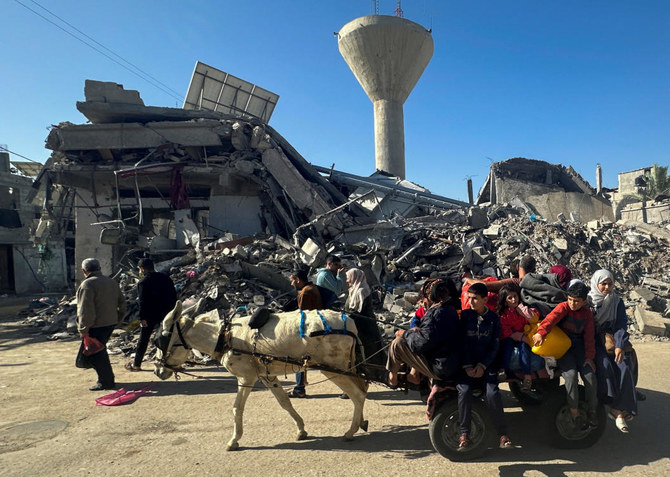


GAZA: After seven weeks of bombardment stopped in Gaza for a truce, Tahani Al-Najjar used the calm on Saturday to return to the ruins of her home, smashed by an Israeli air strike that she said killed seven of her family and forced her into a shelter.
More than 24 hours into the four-day pause in fighting, thousands of Gaza residents are making that same difficult journey from communal shelters and makeshift encampments to discover what has become of their homes.
“Where will we live? Where will we go? We are trying to collect bits of wood to build a tent to shelter us, but to no avail. There is nothing to shelter a family,” Najjar said, picking through the rubble and twisted metal of her house.
Najjar, a 58-year-old mother of five from Khan Younis in the south of the enclave, said Israel’s military had also levelled her house in two previous conflicts in 2008 and 2014.
She pulled several miraculously intact cups from the ruins, where a bicycle and dust-caked clothes lay amid the debris. “We will rebuild again,” she said.
For many of the 2.3 million people who live in the tiny Gaza Strip, the pause in the near-constant air and artillery strikes has offered a first chance to safely move around, take stock of the devastation, and seek access to aid imports.
At outdoor markets and aid depots, thousands of people stood queuing for some of the aid that began flowing into Gaza in larger quantities as part of the truce.
Since Hamas militants launched their unprecedented attack on Israeli towns on Oct. 7, killing 1,200 people, Israel’s response has been the bloodiest and most destructive offensive ever visited on the 40km-long (25 miles) Gaza enclave.
RESIDENTIAL DISTRICTS
Palestinian health officials in the Hamas-run territory say the bombardment has killed more than 14,000 people, 40 percent of them children, and levelled swathes of residential districts. They have said thousands more bodies may remain under the rubble, still unrecorded in official death tolls.
Israel’s military last month told all civilians to leave the north of the strip, where the fighting was heaviest, but it continued to bombard the south where hundreds of thousands fled and where Najjar’s home was located.
It has said civilians should not return to the north during the truce and many of those who fled south are now seeking information from those who stayed behind.
An accompanying blockade has meanwhile added to a humanitarian crisis with little electricity for hospitals, fresh water, fuel for ambulances or food and medicines.
In a street market in Khan Younis, where tomatoes, lemons, aubergines, peppers, onions and oranges sat in crates, Ayman Nofal said he was able to buy more vegetables than had been available before the truce and that they cost less.
“We hope the truce will continue and be permanent, not just four or five days. People cannot pay the cost of this war,” he said.
At a UN agency center in Khan Younis, people waited for cooking gas. Supplies had begun running short weeks ago and many people were cooking food over open fires fueled by scavenged wood salvaged from bomb sites.
Mohammed Ghandour had been waiting five hours to fill his cylindrical metal canister, after getting up at dawn in the school where he and his family shelter and making the long trip to the depot, but was still too late. “I’m now going home without gas,” he said.
However, at the Rafah crossing with Egypt, trucks could be seen early on Saturday moving slowly over the border and into Gaza bringing fresh supplies.


