RAFAH, Egypt: The Israeli government said Friday it would summon the Belgian and Spanish ambassadors following remarks by Spanish Prime Minister Pedro Sánchez and his Belgian counterpart Alexander de Croo on the war between Israel and Hamas.
The announcement came after the two leaders criticized Israel for the suffering of Palestinian civilians under Israeli military operations in Gaza. Sánchez also called for European Union recognition of a Palestinian state, saying Spain might do so on its own.
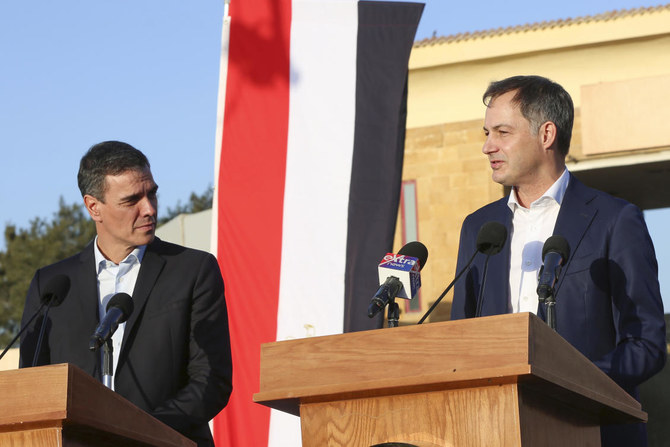
Speaking at a joint press conference on the Egyptian side of the Rafah border crossing with Gaza on Friday, Sánchez said the time had come for the international community and the European Union to once and for all recognize a Palestinian state. He said it would be better if the EU did it together, “but if this is not the case … Spain will take their own decisions.”
Sánchez was speaking at the end of a two-day visit to Israel, the Palestinian territories and Egypt with de Croo. Spain currently holds the EU’s rotational presidency and Belgium takes over in January.
Sánchez reiterated comments made Thursday to Israeli Prime Minister Benjamin Netanyahu regarding the killing of civilians.
“I also reiterate Israel’s right to defend itself, but it must do so within the parameters and limits imposed by international humanitarian law and this is not the case,” Sánchez said. “The indiscriminate killing of civilians, including thousands of boys and girls, are completely unacceptable.”
De Croo did not comment on recognition of a Palestinian state, but said, “first things first, let’s stop the violence. Let’s liberate the hostages. Let’s get the aid inside ... the first priority is help people who are suffering.”
De Croo stressed the need and hope for a permanent cease-fire, adding that this “needs to be built together. And it can only be built together if both parties understand that the solution to this conflict is never going to be violence. A solution to this conflict is that people sit around the table.”
“A military operation needs to respect international humanitarian law. The killing of civilians needs to stop now. Way too many people have died. The destruction of Gaza is unacceptable,” he said.
“We cannot accept that a society is being destroyed the way it is being destroyed,” he added.
Israel later lashed out at the two prime ministers “for not placing full responsibility for the crimes against humanity committed by Hamas, who massacred our citizens and used the Palestinians as human shields.”
Israeli Foreign Minister Eli Cohen instructed the countries’ ambassadors to be summoned for a sharp reprimand. “We condemn the false claims of the prime ministers of Spain and Belgium who give support to terrorism,” Cohen said.
“Israel is acting according to international law and fighting a murderous terrorist organization worse than (the Daesh group) that commits war crimes and crimes against humanity.”
Spanish Foreign Minister José Manuel Albares responded to the summon of Spain’s ambassador late Friday.
“The Israeli government’s accusations against the President of the Government and the Belgian Prime Minister are totally false and unacceptable,” he said in a statement. “We categorically reject them.”
Albares said the Spanish prime minister has publicly and repeatedly defended Israel’s right to self-defense and that his tour in the region this week was seeking “a path to peace.”


![]()

Israel summons Spanish, Belgian ambassadors following criticism during visit to Rafah
Short Url
https://arab.news/6jntt
Israel summons Spanish, Belgian ambassadors following criticism during visit to Rafah
- Sánchez said the time had come for the international community and the European Union to once and for all recognize a Palestinian state
- “A military operation needs to respect international humanitarian law,” De Croo said


Latest updates


© 2026 SAUDI RESEARCH & PUBLISHING COMPANY, All Rights Reserved And subject to Terms of Use Agreement.