

In unprecedented move, Pakistan charges Afghan authorities with ‘facilitating’ militants

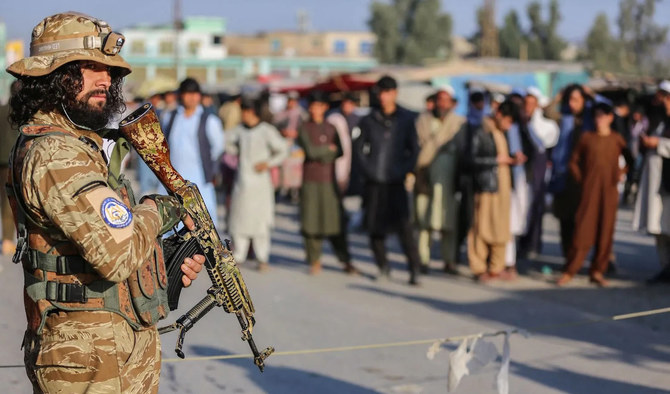
A Taliban security personnel stand guard as Afghan people wait to cross into Pakistan, near the closed Torkham gate at the Torkham border crossing between Afghanistan and Pakistan, in Nangarhar province on February 23, 2023. (AFP/File)
Short Url
Updated 08 November 2023
Follow

In unprecedented move, Pakistan charges Afghan authorities with ‘facilitating’ militants

  • Anwaar-ul-Haq Kakar says his country asked Kabul to choose between Pakistan and TTP earlier this year
  • The PM’s strongly worded statement hints at a near-collapse of cordial ties between the two countries

ISLAMABAD: In an unprecedented development, Caretaker Prime Minister Anwaar-ul-Haq Kakar on Wednesday blamed Afghanistan’s interim administration for not doing enough to address Pakistan’s security concerns by clamping down on militants operating from its territory, adding there was also some evidence of “facilitation” implicating the Taliban authorities in certain cases.

Pakistan has tried to convince the international community to constructively engage the Afghan Taliban since they swept back to power about two years ago, asking countries across the world to help ease Afghanistan’s financial constraints to prevent yet another humanitarian catastrophe in the region.

At the same time, officials in Islamabad have blamed a recent surge in militant violence in Pakistan on a proscribed network, Tehreek-e-Taliban Pakistan (TTP), whose leaders are said to be based in Afghanistan, asking the government in Kabul not to allow its soil to be used for attacks against Pakistan.

However, the Pakistani PM’s strongly worded statement is the first high-profile public display of his country’s discontent with Afghanistan, indicating a near-collapse of the previously cordial ties between the two countries.

Addressing a news conference in Islamabad, Kakar said militant violence had increased by 60 percent and suicide bombings had shot up by 500 percent since the formation of the interim Afghan administration.

“In the last two years, 2,267 innocent Pakistanis have lost their lives for which TTP terrorists are responsible who have been using the Afghan territory to launch cowardly attacks in Pakistan,” he said. “During this period, 15 Afghan nationals were found involved in suicide bombings. Apart from that, 64 Afghan citizens have also died while fighting Pakistan’s law enforcing agencies.”

The prime minister said Afghan authorities were aware of these details since his country had been sharing all this information with them since February on a fortnightly basis.
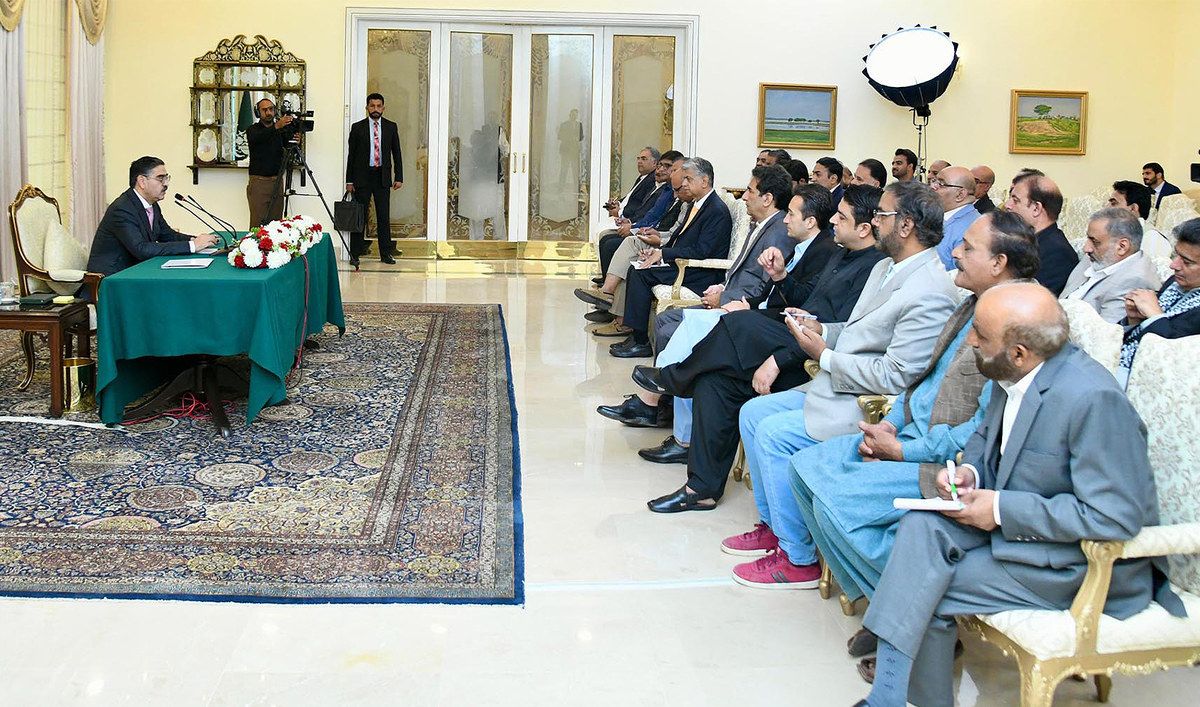


Pakistan Prime Minister Anwaar-ul-Haq (left) speaks during a press conference in Islamabad, Pakistan, on November 8, 2023. (PID)

The prime minister also made a startling revelation, saying that Pakistan gave a stark choice to officials in Kabul through a delegation led by its defense minister after a deadly suicide bombing in the country’s northwestern Khyber Pakhtunkhwa province in February that claimed more than 100 lives.

“The delegation communicated the country’s strong reservations to the Afghan authorities and clearly told them to choose between Pakistan or the TTP,” he continued.

“Despite the guarantees by the Afghan interim government, no concrete steps were taken against anti-Pakistan terrorist groups,” he added. “In fact, evidence of facilitation of terrorists emerged on certain occasions.”

The prime minister said Pakistan had decided to address its security problems on its own, many of which, he maintained, were created by illegal immigrants who had been asked by his government to leave in October.

He observed the Taliban authorities in Afghanistan had since issued misleading and hostile statements which were “regrettable.”

Kakar said the uptick in militant attacks following these assertions was “not only meaningful but also endorsed Pakistan’s suspicions.”

The prime minister’s media talk came ahead of his departure to Uzbekistan where he is scheduled to attend the 16th Economic Cooperation Organization (ECO) Summit.

Among other Central Asian nations, Afghanistan is also a member state of the regional forum.


Pakistan urges UN Security Council to sanction separatist BLA group after recent attacks

Updated 05 February 2026
Follow

Pakistan urges UN Security Council to sanction separatist BLA group after recent attacks

  • Separatist BLA launched attacks in multiple Balochistan cities last week, killing over 50 as per official figures
  • Pakistan envoy says since Taliban assumed control of Afghanistan, BLA, other militant groups have a “new lease of life“

ISLAMABAD: Pakistan’s UN Ambassador Iftikhar Ahmed this week urged the Security Council to impose sanctions against the separatist Baloch Liberation Army (BLA) militant group and designate it as a “terrorist” group, after its recent coordinated attacks in southwestern Balochistan province. 

Pakistan’s military said on Thursday it has concluded security operations in Balochistan against separatists that was launched since Jan. 29, killing 216 militants. The military launched counteroffensive operations in Balochistan after the BLA said it launched coordinated attacks in several parts of the province last Friday and Saturday. 

The attacks killed 36 civilians and 22 law enforcement and security forces personnel, Pakistan’s military said. Pakistan’s government has accused India of being involved in the attacks, charges that New Delhi has dismissed. 

“We hope the Council will act swiftly to designate BLA under the 1267 sanctions regime acceding to the listing request that is currently under consideration,” Iftikhar said on Wednesday during a UNSC briefing on the topic ‘Threats to International Peace and Security caused by Terrorist Acts.’

The 1267 sanctions regime is a UNSC program that seeks to impose sanctions on individuals and entities associated with “terrorism.”

The regime seeks to impose travel bans, freeze assets and impose an arms embargo on individuals and groups primarily associated with Al-Qaeda or the Taliban. 

Ahmad said that after the Taliban takeover of Afghanistan in 2021, “externally sponsored and foreign-funded proxy terrorist groups” such as the Tehreek-e-Taliban Pakistan and the BLA have got a “new lease of life.”

“Operating with virtual impunity from Afghan soil and with the active support of our eastern neighbor, these groups are responsible for heinous terrorist attacks inside Pakistan,” he said. 

The Pakistani envoy said it has become imperative to prevent billions of dollars of sophisticated weapons and equipment, which were left behind by foreign forces in Afghanistan, “from falling into the hands of terrorists.”

“There must be accountability of external destabilizing actors who support, finance and arm these groups, including their proxies in Afghanistan,” Ahmad said in a veiled reference to India. 

Pakistan’s largest and poorest province, mineral-rich Balochistan borders Iran and ‌Afghanistan and is home to China’s investment in the Gwadar deep-water ‍port and other projects.

Balochistan has been the site of a ‍decades-long insurgency led by ethnic Baloch separatists seeking greater autonomy and a larger share of its natural ‍resources. 

They accuse the state of denying locals a fair share of the province’s mineral wealth, charges that are denied by the Pakistani government.