

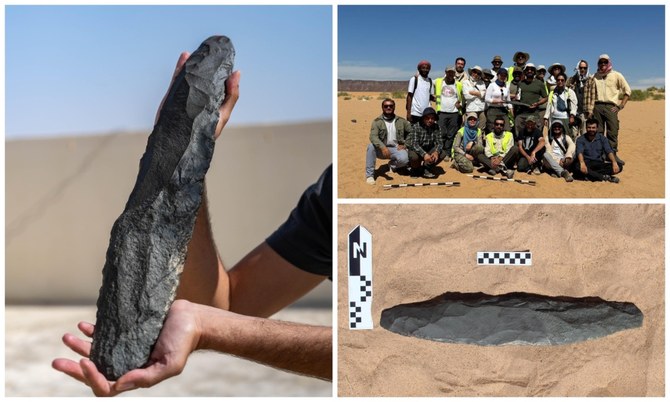
Slice of luck: 200,000-year-old ax found in AlUla

The 51.3 cm long stone tool is made of soft basalt and is estimated to date back to the Paleolithic Age. (SPA)
Short Url
Updated 05 November 2023
Follow

Slice of luck: 200,000-year-old ax found in AlUla

  • Archaeologists unearth ancient hand tool during dig in Qarah
  • Item is thought to date back to Paleolithic Age

RIYADH: Architects working at a site to the south of AlUla governorate have excavated a 200,000-year-old hand ax, the Saudi Press Agency reported on Sunday.

The discovery, announced by the Royal Commission for AlUla, was made as a team of archaeologists, led by Dr. Can and Gizem Aksoy from TEOS Heritage, were exploring the site at Qarah for evidence of ancient human life in the area.

Qarah was one of the most important residential areas in the Arabian Peninsula during the first centuries of Islam and is dotted with sites of historical and archaeological interest.

The 51-cm-long ax is made of soft basalt with a sharpened edge on each side. It is thought to date back to the Paleolithic Age, which ended about 10,000 years ago.

The TEOS team have discovered more than a dozen similar stone tools in the area and research is ongoing to find out more about how they were made and used.

The Royal Commission, which appointed TEOS, is supervising 11 other archaeological projects across AlUla and Khaybar. The work is part of a broader plan to develop the region as a cultural heritage site.


Families in Taif embrace Ramadan customs early

Updated 7 sec ago
Follow

Families in Taif embrace Ramadan customs early

TAIF: Residents of Taif are engaging in early preparations for the holy month of Ramadan, upholding deeply rooted customs that blend religious devotion with social tradition.

Families are meticulously organizing their homes and stocking up on supplies in anticipation of the communal meals and gatherings that define the month’s spirit of kinship, the Saudi Press Agency reports.

The city’s neighborhoods have taken on a festive character, adorned with traditional lanterns, crescent-shaped lights and star-shaped illuminations.

Historian Dhaifallah Al-Radwani said that these preparations — primarily led by women and children — include the use of traditional fabrics, incense burners and henna.

These rituals serve as a vital link to Saudi cultural heritage, ensuring that authentic community values and aesthetic traditions are passed down to new generations.

On Sunday, the last quarter moon of Shaban was visible across the Kingdom. Half of the moon was illuminated, while the other half remained in shadow, completing roughly three-quarters of its orbit around the Earth.

The last quarter moon draws the attention of amateur astronomers and astrophotographers, offering an ideal angle to observe surface features such as craters, volcanic plains and mountains, with shadows along the terminator enhancing their detail.

Jeddah Astronomy Society Director Majed Abu Zahra said that the last quarter moon marks a key transitional phase. Its visible light gradually decreases, becoming a waning crescent before sunrise, until the new moon on Feb. 17 signals the upcoming sighting of Ramadan’s crescent.