Pakistan launches anti-polio campaigns in KP, Balochistan and Karachi

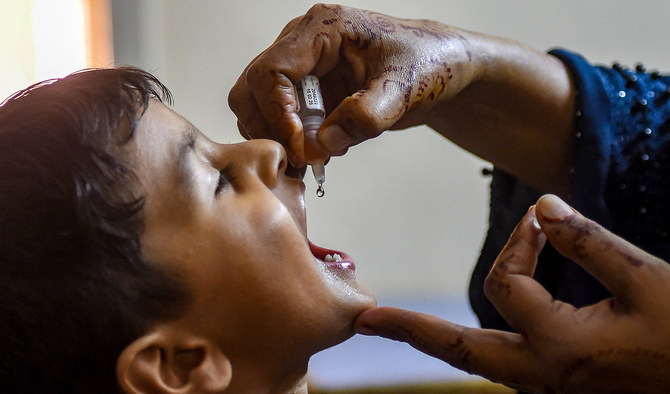
A health worker administers polio drops to a child during a door-to-door vaccination campaign in Karachi, Pakistan on October 2, 2023. (AFP)
Short Url
Updated 30 October 2023
Follow

Pakistan launches anti-polio campaigns in KP, Balochistan and Karachi

  • Polio campaign launched in three Khyber Pakhtunkhwa, 10 Balochistan districts, says state media
  • Pakistan and Afghanistan remain the only two countries in the world where polio remains endemic

ISLAMABAD: Pakistani authorities launched “special” anti-polio campaigns in the country’s southwestern Balochistan and northwestern Khyber Pakhtunkhwa (KP) provinces, and the southern port city of Karachi on Monday, the state-run Radio Pakistan said in a report.

The polio campaigns were launched in KP’s three districts and Balochistan’s 10 districts, the report said.

“According to Emergency Operation Center Khyber Pakhtunkhwa, during the 5-day campaign more than one point two million children up to five years of age will be administered anti-polio vaccine drops,” the report added.

The anti-polio campaigns were launched in Balochistan’s Awaran, Dera Bugti, Gwadar, Hub, Jafarabad, Naseerabad, Sohbat Pur, Khuzdar, Lasbela and Usta Muhammad districts on Monday, the report said.

In a separate statement, Sindh Caretaker Health Minister Dr. Saad Khalid Niaz announced that an anti-polio campaign had also kicked off in Karachi from today, Monday.

“The decision to restart the campaign was taken after the recent case of polio in Karachi,” Dr. Niaz said. “Resumption of the anti-polio campaign was inevitable after results of sewage samples from different areas were obtained.”

On Oct. 21, Pakistan’s health ministry reported Pakistan’s fourth polio case this year after a 24-year-old in the city was diagnosed with the disease.

Dr. Niaz urged people to cooperate with polio workers and get their children vaccinated against the disease.

Pakistan and Afghanistan remain the only two countries in the world where polio remains endemic. Islamabad’s efforts to eliminate the disease have been hampered by the masses’ suspicion of foreign entities who fund vaccination programs and of the government itself.

Many in Pakistan believe in the conspiracy theory that polio vaccines are part of a plot by Western outsiders to sterilize the country’s population. The masses’ doubts regarding polio campaigns were exacerbated in 2011 when the US Central Intelligence Agency set up a fake hepatitis vaccination program to gather intelligence on former Al-Qaeda chief Osama bin Laden.

Violent attacks on polio volunteers and security personnel guarding them are common in Pakistan.

Pakistan’s Caretaker Prime Minister Anwaar-ul-Haq Kakar vowed last Tuesday that the government would resist “anti-vaxxers” and realize the dream of a polio-free Pakistan. He lamented that those who resisted polio vaccines were working for the “forces of darkness.”


Pakistan’s seafood exports to China hit nearly $255 million in 2025 as market reach widens

Updated 26 January 2026
Follow

Pakistan’s seafood exports to China hit nearly $255 million in 2025 as market reach widens

  • Frozen fish and cephalopods lead exports as shipments expand beyond China’s coastal hubs
  • Growth reflects Pakistan’s push to diversify exports and tap China’s inland consumer markets

ISLAMABAD: Pakistan’s seafood exports to China rose to nearly $255 million in 2025, underscoring Beijing’s growing importance as a destination for Pakistani marine products, according to data from China’s General Administration of Customs (GACC) published by state-run APP on Monday.

The figures point to a broader geographic and product diversification of Pakistan’s seafood trade with China at a time when Islamabad is seeking to boost foreign exchange earnings and reduce reliance on a narrow set of export sectors.

“The gains were driven by sustained demand for frozen fish, cephalopods, and a growing range of processed seafood products in both coastal and inland markets,” APP said in a report, citing China Customs data.

Frozen fish remained the single largest export category, contributing about $64.6 million to Pakistan’s seafood shipments to China. Imports were concentrated in major coastal and metropolitan entry points, with Guangdong province emerging as the largest destination by value and volume, importing 8.48 million kilograms worth $15.7 million. Shandong and Beijing followed, each exceeding 7 million kilograms, while Shanghai, Tianjin and Zhejiang also recorded substantial volumes.

At the same time, smaller but notable shipments were recorded in inland provinces including Sichuan, Yunnan, Guizhou and Chongqing, suggesting a widening distribution footprint supported by expanding cold-chain logistics and growing demand away from China’s traditional port cities.

Cephalopods emerged as another key growth pillar. Exports of frozen cuttlefish and squid reached nearly $31 million, while frozen octopus rose to almost $12 million, reflecting demand from catering chains and seafood processors supplying China’s foodservice and ready-to-cook segments.

Affordable pelagic fish also performed strongly. Frozen sardines, sardinella, brisling and sprats recorded imports of around $14.9 million, supported by household consumption and mass-market food manufacturers.

In addition to core frozen categories, Pakistan exported roughly $14.4 million each in two higher-value segments classified by China Customs as “fish” and “fish products,” indicating a gradual shift toward processed and value-added seafood lines.

Analysts cited in the APP report attributed the overall growth to improved compliance with Chinese food safety standards, expanded approvals for Pakistani processing facilities and competitive pricing backed by Pakistan’s marine resource base. Investments in cold-chain logistics and streamlined customs procedures were also seen as supporting higher volumes and broader market access.