

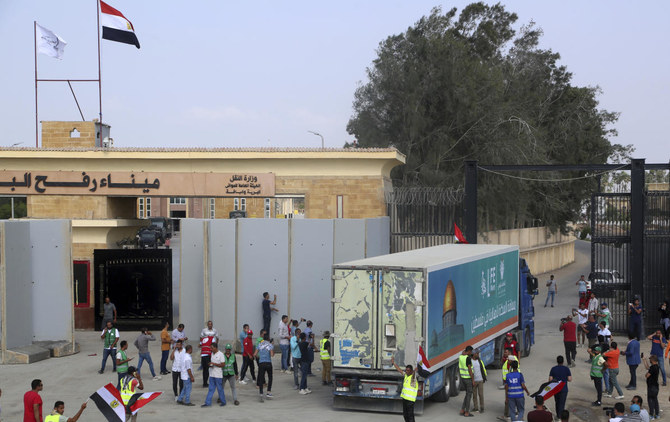

The Rafah crossing is the main entrance and exit point to the Gaza Strip from Egypt. It has become a focal point of efforts to deliver aid to Palestinians since Israel imposed a “total siege” on the enclave following a deadly incursion by Hamas militants on Oct. 7.
WHAT IS THE LATEST ON AID TO THE GAZA STRIP?
Humanitarian deliveries through Rafah began on Oct. 21. UN agencies say they are not nearly enough to meet the needs of the 2.3 million population in Gaza, where clean water, food, medicines and fuel are running low.
The Palestinian Red Crescent said it had received 74 aid trucks into the Rafah crossing so far, including 12 on Thursday. UN officials say about 100 trucks are needed each day to meet essential needs.
The trucks have been carrying water, food and medicines but not fuel, which Israel says could be used in the conflict by Hamas.
WHY IS IT DIFFICULT TO GET LARGE-SCALE AID THROUGH RAFAH?
Aid officials say Rafah’s principal role in the past had been as a civilian crossing and that it was not equipped for a large-scale aid operation.
Trucks carrying aid have been driving through the Egyptian border gate at Rafah before heading more than 40km (25 miles) to the Egyptian-Israeli crossing of Al-Awja and Nitzana, south of Egypt’s short border with Gaza, for inspection, as agreed in negotiations with Israel. Trucks return into Egypt empty, with the aid reloaded onto separate trucks for delivery into Gaza.
During past conflicts between Israel and Hamas in Gaza, aid had mainly been delivered through crossing points with Israel, and the UN aid operation for the Palestinian territories has been run through Israel since the 1950s.
WHERE IS THE RAFAH CROSSING AND WHO CONTROLS IT?
The crossing is at the south of the Gaza Strip, a narrow sliver of land wedged between Israel, Egypt and the Mediterranean Sea. It is controlled by Egypt.
WHY IS THE RAFAH CROSSING SO IMPORTANT IN THIS CONFLICT?
In response to the cross-border infiltration by Hamas fighters on Oct. 7 that killed more than 1,400 Israelis, Israel imposed a total blockade of Gaza, leaving Rafah as the only route in for humanitarian aid and the only exit point for Gaza residents seeking to flee.
More than 6,500 Palestinians have been killed, according to health authorities in the Hamas-run Gaza Strip, since Oct. 7.
WHY IS ACCESS ACROSS RAFAH RESTRICTED BY EGYPT?
Egypt is wary of insecurity near the border with Gaza in northeastern Sinai, where it faced an Islamist insurgency that peaked after 2013 and has now largely been suppressed.
Since Hamas took control in Gaza in 2007, Egypt has helped enforce a blockade of the enclave and heavily restricted the flow of people and goods.
In 2008, tens of thousands of Palestinians crossed into Sinai after Hamas blasted holes in border fortifications, prompting Egypt to build a stone and cement wall.
Egypt has acted as a mediator between Israel and Palestinian factions during past conflicts. But in those situations it has also locked down the border, allowing aid to enter and medical evacuees to leave but preventing any large-scale movement of people.
WHY ARE ARAB STATES SO RELUCTANT TO TAKE IN PALESTINIANS?
Arab countries have deep-rooted fears that Israel’s latest war with Hamas in Gaza could spark a new wave of permanent displacements.
Egypt, the only Arab state to share a border with Gaza, and Jordan, which flanks the Israeli-occupied West Bank, have both warned against Palestinians being forced off their land.
For Palestinians, the idea of leaving or being driven out of territory where they want to forge a state carries echoes of the “Nakba,” or “catastrophe,” when many fled or were forced from their homes during the 1948 war that accompanied Israel’s creation.
Israel contests the assertion it drove Palestinians out, saying it was attacked by five Arab states after its creation.


