

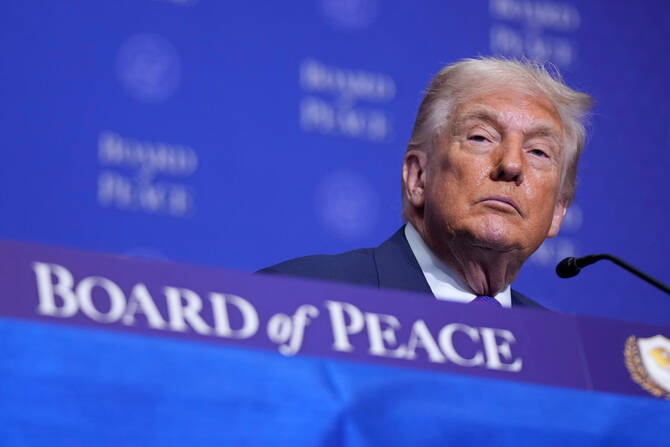


WASHINGTON: President Donald Trump announced Thursday at the inaugural Board of Peace meeting that nine members of the body have agreed to pledge $7 billion toward a Gaza relief package and that five countries have agreed to deploy troops to take part in an international stabilization force to the war-battered Palestinian territory.
Saudi Arabia confirmed it would donate $1 billion toward the package.
Meanwhile, Kazakhstan, Azerbaijan, the United Arab Emirates, Morocco, Bahrain, Qatar, Uzbekistan and Kuwait are the other countries that are making pledges, Trump said.
Indonesia, Morocco, Kazakhstan, Kosovo and Albania have pledged to send troops for Gaza stabilization force, while Egypt and Jordan have committed to train police for the efforts.
Troops will initially be deployed to Rafah, a major population center where the US administration hopes to first focus reconstruction efforts.
“Every dollar spent is an investment in stability and the hope of new and harmonious (region),” said Trump in thanking the donors. He added, “The Board of Peace is showing how a better future can be built right here in this room.”
The dollars pledged, while significant, represents a fraction of the estimated $70 billion needed to rebuild the Palestinian territory decimated after two years of war.
Trump also announced the US was pledging $10 billion for the Board of Peace, but didn’t specify what the money will be used for.
Maj. Gen. Jasper Jeffers, the leader of the newly-created International Stabilization Force said the plans call for 12,000 police and 20,000 soldiers for Gaza.
“With these first steps, we help bring the security that Gaza needs for a future of prosperity and enduring peace,” Jeffers said.
The board was initiated as part of Trump’s 20-point peace plan to end the conflict in Gaza. But since the October ceasefire, Trump’s vision for the board has morphed and he wants it to have an even more ambitious remit — one that will not only complete the Herculean task of bringing lasting peace between Israel and Hamas but will also help resolve conflicts around the globe.
But the Gaza ceasefire deal remains fragile and Trump’s expanded vision for it has triggered fears the US president is looking to create a rival to the United Nations.
Trump, pushing back against the criticism, said the creation of his board would help make the UN viable in the future.
“Someday I won’t be here. The United Nations will be,” Trump said. “I think it is going to be much stronger, and the Board of Peace is going to almost be looking over the United Nations and making sure it runs properly.”
Most countries sent high-level officials, but a few leaders— including Indonesian President Prabowo Subianto, Argentine President Javier Milei, and Hungarian President Viktor Orbán— traveled to Washington for the gathering.
SOME US ALLIES REMAIN SKEPTICAL
More than 40 countries and the European Union confirmed they were sending officials to Thursday’s meeting. Germany, Italy, Norway, Switzerland and the United Kingdom are among more than a dozen countries that have not joined the board but are taking part as observers.
“Almost everybody’s accepted, and the ones that haven’t, will be,” Trump predicted. “And some are playing a little cute — it doesn’t work. You can’t play cute with me.”
Trump also warned Iran on Thursday that it must reach a deal over its nuclear program or “bad things” will happen, and appeared to set a 10-day deadline before the US might take action
Amid a massive US military buildup in the Middle East that has fueled fears of a wider war, Trump said negotiations with Iran were going well but insisted Tehran has to reach a “meaningful” agreement.
“Otherwise bad things happen,” Trump, who has repeatedly threatened to attack Iran, told the first meeting of his Board of Peace in Washington.
Trump spoke of the US airstrikes carried out in June, saying Iran’s nuclear potential had been “decimated,” adding “we may have to take it a step further or we may not.”
“You’ll be finding out over the next probably 10 days,” he said, without elaborating.
The UN Security Council held a high-level meeting Wednesday on the ceasefire deal and Israel’s efforts to expand control in the West Bank.
The UN session in New York was originally scheduled for Thursday but was moved up after Trump announced the board’s meeting for the same date and it became clear that it would complicate travel plans for diplomats planning to attend both.
Vatican Secretary of State Cardinal Pietro Parolin told reporters earlier this week that “at the international level it should above all be the UN that manages these crisis situations.” The Trump administration on Wednesday pushed back on the Vatican’s concerns.
QUESTIONS ABOUT DISARMING HAMAS
Central to Thursday’s discussions was creating an armed international stabilization force to keep security and ensure the disarming of the militant Hamas group, a key demand of Israel and a cornerstone of the ceasefire deal.
Hamas has provided little confidence that it is willing to move forward on disarmament. The administration is “under no illusions on the challenges regarding demilitarization” but has been encouraged by what mediators have reported back, according to a US official who was not authorized to comment publicly and spoke on condition of anonymity.
“We have a long ways to go,” Secretary of State Marco Rubio said in remarks to the gathering. “There’s a lot of work that remains that will require the contribution of every nation state represented here today.”


