

Riyadh’s warehouse rents rise 20% in H1 as e-commerce strengthens: Knight Frank

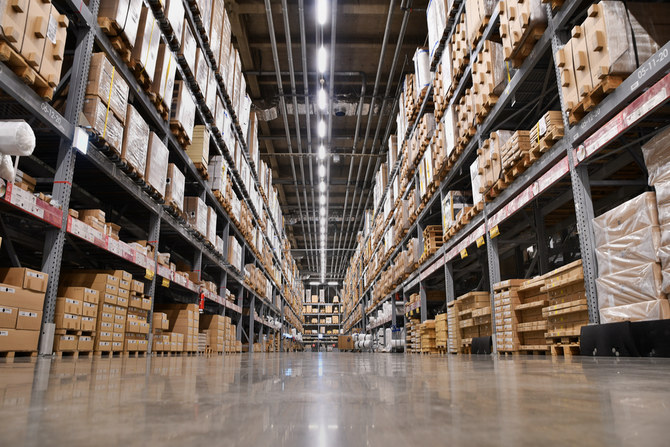
Knight Frank revealed that warehouse rents in the Kingdom remained upward as they climbed 15 percent in Jeddah and 20 percent in Riyadh over the last 12 months. Shutterstock
Short Url
Updated 23 October 2023
Follow

Riyadh’s warehouse rents rise 20% in H1 as e-commerce strengthens: Knight Frank

RIYADH: Warehouse rents in Riyadh rose by 20 percent in the first half as the city accommodated the growing demand for specialized stockrooms thanks to the e-commerce boom, according to Knight Frank. 

The London-based real estate consultancy revealed that warehouse rents in the Kingdom remained upward as they climbed 15 percent in Jeddah and 20 percent in Riyadh over the last 12 months. 

“For developers, the industrial market is their oyster given that the most sought-after stock — high quality, internationally specified warehouses — remains in short supply,” said Faisal Durrani, Knight Frank’s head of research for the Middle East and North Africa region. 

He added: “For now, the volume of planned stock is also limited. In Riyadh, for instance, the last 12 months have witnessed the completion of approximately 500,000 sq. meters. Many occupiers are now exploring build-to-suit models — notably the e-commerce and FMCG (fast-moving consumer goods) sectors.” 

Average rents for warehouses in Riyadh in the first half stood at SR190 ($50.65) per sq. meter, with Logistics Park touching SR280 per sq. meter. The place is the city’s most expensive warehousing district. 

On the other hand, the average lease rates of Jeddah and Dammam between January and June were about SR205 and SR230 per sq. meter, respectively. 

The report added that Saudi Arabia’s e-commerce sector has witnessed strong growth over the past few years, mainly due to the rise in internet penetration and network availability in the Kingdom. 

“The Kingdom’s e-commerce sector has been supercharged in the wake of the pandemic, as has been the case elsewhere in the world. The seemingly permanent shift in attitudes toward online shopping is particularly notable among Generation Z — those below 25,” the report added. 

The study also highlighted the deal signed by the Saudi Authority for Industrial Cities and Technology Zones, also known as MODON, to build 14 high-tech warehouses in Jeddah expected to be tenanted by global e-commerce companies. 

“The Kingdom is in the midst of an exciting surge in warehousing demand. This upswing can be attributed to factors like the thriving e-commerce sector and the realization of ambitious megaprojects in the region,” said Harmen De Jong, partner and head of strategy and consulting at Knight Frank for the MENA region. 

De Jong also lauded the efforts of the Saudi government to turn the Kingdom into a top-rated industrial and logistics market. 

He added: “The government’s commitment to fostering a world-class industrial and logistics market in the Kingdom is clear. The plan to construct 59 logistics centers by 2030, covering over 100 million sq. meters, for instance, will help to further support the development of the rapidly expanding e-commerce.” 


Saudi investment pipeline active as reforms advance, says Pakistan minister

Updated 08 February 2026
Follow

Saudi investment pipeline active as reforms advance, says Pakistan minister

ALULA: Pakistan’s Finance Minister Mohammed Aurangzeb described Saudi Arabia as a “longstanding partner” and emphasized the importance of sustainable, mutually beneficial cooperation, particularly in key economic sectors.

Speaking to Arab News on the sidelines of the AlUla Conference for Emerging Market Economies, Aurangzeb said the relationship between Pakistan and Saudi Arabia remains resilient despite global geopolitical tensions.

“The Kingdom has been a longstanding partner of Pakistan for the longest time, and we are very grateful for how we have been supported through thick and thin, through rough patches and, even now that we have achieved macroeconomic stability, I think we are now well positioned for growth.”

Aurangzeb said the partnership has facilitated investment across several sectors, including minerals and mining, information technology, agriculture, and tourism. He cited an active pipeline of Saudi investments, including Wafi’s entry into Pakistan’s downstream oil and gas sector.

“The Kingdom has been very public about their appetite for the country, and the sectors are minerals and mining, IT, agriculture, tourism; and there are already investments which have come in. For example, Wafi came in (in terms of downstream oil and gas stations). There’s a very active pipeline.”

He said private sector activity is driving growth in these areas, while government-to-government cooperation is focused mainly on infrastructure development.

Acknowledging longstanding investor concerns related to bureaucracy and delays, Aurangzeb said Pakistan has made progress over the past two years through structural reforms and fiscal discipline, alongside efforts to improve the business environment.

“The last two years we have worked very hard in terms of structural reforms, in terms of what I call getting the basic hygiene right, in terms of the fiscal situation, the current economic situation (…) in terms of all those areas of getting the basic hygiene in a good place.”

Aurangzeb highlighted mining and refining as key areas of engagement, including discussions around the Reko Diq project, while stressing that talks with Saudi investors extend beyond individual ventures.

“From my perspective, it’s not just about one mine, the discussions will continue with the Saudi investors on a number of these areas.”

He also pointed to growing cooperation in the IT sector, particularly in artificial intelligence, noting that several Pakistani tech firms are already in discussions with Saudi counterparts or have established offices in the Kingdom.

Referring to recent talks with Saudi Minister of Economy and Planning Faisal Alibrahim, Aurangzeb said Pakistan’s large freelance workforce presents opportunities for deeper collaboration, provided skills development keeps pace with demand.

“I was just with (Saudi) minister of economy and planning, and he was specifically referring to the Pakistani tech talent, and he is absolutely right. We have the third-largest freelancer population in the world, and what we need to do is to ensure that we upscale, rescale, upgrade them.”

Aurangzeb also cited opportunities to benefit from Saudi Arabia’s experience in the energy sector and noted continued cooperation in defense production.

Looking ahead, he said Pakistan aims to recalibrate its relationship with Saudi Arabia toward trade and investment rather than reliance on aid.

“Our prime minister has been very clear that we want to move this entire discussion as we go forward from aid and support to trade and investment.”