

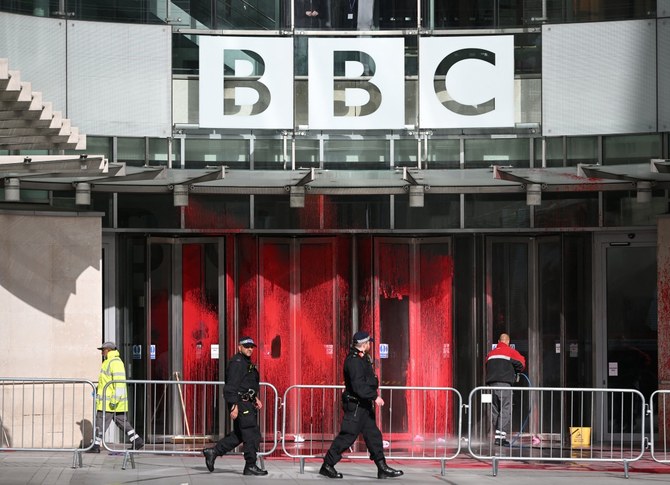
Israel describes BBC report on Gaza hospital attack as ‘modern blood libel’

The Israeli government claimed that the reporting had contributed to regional instability and the cancellation of a summit involving US President Joe Biden and leaders from Egypt and Palestine. (AFP/File)
Short Url
Updated 19 October 2023
Follow

Israel describes BBC report on Gaza hospital attack as ‘modern blood libel’

  • The Israeli government drew parallels between the report and a historical, antisemitic conspiracy theory that falsely accused Jews of using Christian blood in religious rituals
  • A reporter had said there was lack of clarity about the attack but speculated Israel might be responsible; a BBC spokesperson said ‘both sides’ competing claims’ had been set out

LONDON: The Israeli government has criticized the BBC for its coverage of the explosion at Al-Ahli Arab Hospital in Gaza, describing it as a “modern blood libel.”

It came after a BBC reporter on Tuesday night suggested, shortly after the blast, that there was a lack of clarity but it might have been the result of an attack by Israeli forces, a claim the Israeli government vehemently denies.

In a message posted by its official account on social media platform X on Thursday, the Israeli government wrote: “Hey @BBCWorld, as of this morning your modern blood libel about the hospital attack is still up. We see you, and now everyone else does too.”

The reference to a “modern blood libel” was drawing a parallel between the reporting of the hospital explosion, which was led by correspondent Jon Donnison, and a historical, antisemitic conspiracy theory in which Jews were falsely accused of using Christian blood during religious rituals.


The attack on the hospital on Tuesday was the most deadly single incident since the conflict between Hamas and Israel began on Oct. 7. The exact death toll remains uncertain but hundreds of patients and civilians who had been advised to shelter in the hospital are believed to have been killed.

It is still unclear who was responsible for the attack, with each side in the conflict blaming the other, leading to speculation and heightened tensions among politicians and the public. Israeli officials said their investigations suggest a rocket fired from Gaza had fallen short of its intended target. Hamas said an Israeli missile caused the explosion.

In his report, Donnison said that “given the scale of the explosion” Israel might have been behind it, and “the Israeli military has been contacted for comment and they say they are investigating.” The Israeli government’s strong rhetoric in response to the reporting is not the only criticism the BBC has faced over it. Concerns were also raised by some in the UK.

During an appearance on BBC Radio 4’s Today program, British Security Minister Tom Tugendhat condemned the “irresponsible speculation” as “really serious,” and suggested it had not been “the BBC’s finest hour.”

In response, Nick Robinson, the presenter of Today and a former BBC political editor, said the BBC’s international editor, Jeremy Bowen, had publicly stated that “viewers of the 10 o'clock news and people across our footage were left in no doubt that there was no clarity about who’d carried it out.”

A BBC spokesperson similarly defended the broadcaster’s coverage, saying that “anyone watching, listening to or reading our coverage can see we have set out both sides’ competing claims about the explosion, clearly showing who is saying them and what we do or don’t know.”

The Israeli government claimed that the reporting had contributed to regional instability and the cancellation of a summit involving US President Joe Biden and leaders from Egypt and Palestine.


Trending: BBC report suggests sexual abuse and torture in UAE-run Yemeni prisons

Updated 02 February 2026
Follow

Trending: BBC report suggests sexual abuse and torture in UAE-run Yemeni prisons

  • The investigation was produced by British-Yemeni BBC journalist Nawal Al-Maghafi

LONDON: A recent BBC video report diving into what it says was UAE-run prison in Yemen has drawn widespread attention online and raised fresh questions about the role of the emirates in the war-torn country.

The report, published earlier this month and recently subtitled in Arabic and shared on social media, alleged that the prison — located inside a former UAE military base — was used to detain and torture detainees during interrogations, including using sexual abuse as a method.

The investigation was produced by British-Yemeni BBC journalist Nawal Al-Maghafi, who toured the site, looking into cells and what appear to be interrogation rooms.

Al-Maghafi said the Yemeni government invited the BBC team to document the facilities for the first time.

A former detainee, speaking anonymously, described severe abuse by UAE soldiers: “When we were interrogated, it was the worst. They even sexually abused us and say they will bring in the doctor. The ‘so-called’ doctor was an Emirati soldier. He beat us and ordered the soldiers to beat us too. I tried to kill myself multiple times to make it end.”

Yemeni information minister, Moammar al Eryani also appears in the report, clarifying that his government was unable to verify what occurred within sites that were under Emirati control.

“We weren’t able to access locations that were under UAE control until now,” he said, adding that “When we liberated it (Southern Yemen), we discovered these prisons, even though we were told by many victims that these prisons exist, but we didn't believe it was true.”

The BBC says it approached the UAE government for comment, however Abu Dhabi did not respond to its inquiries.

Allegations of secret detention sites in southern Yemen are not new. The BBC report echoes earlier reporting by the Associated Press (AP), which cited hundreds of men detained during counterterrorism operations that disappeared into a network of secret prisons where abuse was routine and torture severe.

In a 2017 investigation, the AP documented at least 18 alleged clandestine detention sites — inside military bases, ports, an airport, private villas and even a nightclub — either run by the UAE or Yemeni forces trained and backed by Abu Dhabi.

The report cited accounts from former detainees, relatives, civil rights lawyers and Yemeni military officials.

Following the investigation, Yemen’s then-interior minister called on the UAE to shut down the facilities or hand them over, and said that detainees were freed in the weeks following the allegations.

The renewed attention comes amid online speculation about strains between Saudi Arabia and the UAE over Yemen.