

Pakistani, Chinese firms sign MoU for $1.5 billion investment in petroleum sector

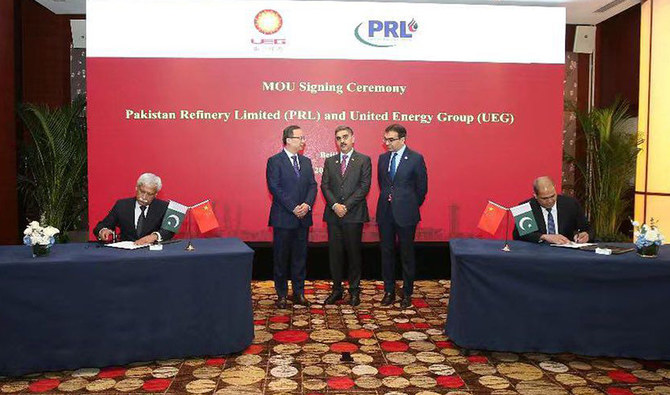
Caretaker Prime Minister Anwaar-ul-Haq Kakar (center) and Caretaker Minister for Energy Muhammad Ali (second right) witness the signing ceremony of MoU between United Energy Group of China and Pakistan Refinery Limited in Beijing, China, on October 18, 2023. (Photo courtesy: Prime Minister's Office)
Short Url
Updated 18 October 2023
Follow

Pakistani, Chinese firms sign MoU for $1.5 billion investment in petroleum sector

  • Pakistan Refinery Limited, United Energy Group of China sign MoU during the 3rd Belt and Road Forum in Beijing 
  • Agreement to increase Pakistani refinery’s petrol production capacity from 250,000 metric tons to 1.6 million metric tons

ISLAMABAD: The Pakistan Refinery Limited (PRL) and the United Energy Group of China (UEG) on Wednesday signed a memorandum of understanding (MoU) for investment worth $1.5 billion in Pakistan’s petroleum sector, the Prime Minister’s Office (PMO) said, as Islamabad attempts to cut its reliance on costly imported fuel to ward off its energy crisis. 

The MoU was signed between the two firms during the ongoing 3rd Belt and Road Forum in Beijing. Pakistan’s Caretaker Prime Minister Anwaar-ul-Haq Kakar and representatives from many developing countries, notably from Latin America and Africa, are in China to attend the two-day conference which concludes today, Wednesday. 

Kakar and Pakistan’s Caretaker Energy Minister Muhammad Ali witnessed the signing ceremony of the agreement between the two firms, according to the PMO’s statement. 

“Petrol and high-speed diesel obtained from the refinery will not only replace expensive imported fuel, but the refinery’s petrol production capacity would increase from 250,000 metric tons to 1.6 million metric tons,” statement said. It added the agreement would also help to increase high speed diesel’s production capacity from 0.6 million metric tons to 2 million metric tons. 

Pakistan lacks adequate resources to run its oil- and gas-powered plants and energy imports make up the majority of the country’s external payments as it faces an economic crisis with an acute balance of payments problem.

With a September inflation rate of 31.4 percent mainly driven by fuel and energy prices, millions of Pakistanis face a cost-of-living crisis and are struggling to survive. Pakistan’s poverty rate has risen from 34.2 percent to 39.4 percent in the last one year, according to the World Bank.

Energy-deficient Pakistan has recently moved to improve ties with Russia and received its first deliveries of Russian crude under a deal struck between the two countries earlier this year. The South Asian country’s energy crisis has forced Islamabad to explore the diversification of its energy imports at cheaper rates. Last month, Pakistan also received its first shipment of liquified petroleum gas from Moscow.


Pakistan vaccinates over 44.6 million in final anti-polio drive of 2025

Updated 5 sec ago
Follow

Pakistan vaccinates over 44.6 million in final anti-polio drive of 2025

  • Pakistan has reported 30 polio cases so far this year, underscoring fragile progress against virus
  • Pakistan and Afghanistan are the only two countries in the world where polio remains endemic

ISLAMABAD: Pakistan has vaccinated 44.6 million children against poliovirus in the last nationwide immunization campaign of the year, health authorities said on Monday.

The seven-day anti-polio campaign was launched on Dec. 15, targeting children under the age of five. It was conducted simultaneously in Pakistan and Afghanistan, according to Pakistan’s National Emergency Operations Center (NEOC), which oversees eradication efforts.

Pakistan and neighboring Afghanistan are the only two countries where transmission of the wild poliovirus has never been interrupted, posing a risk to global eradication efforts. The virus, which can cause irreversible paralysis, has no cure and can only be prevented through repeated oral vaccination.

“The final National Polio Eradication Campaign of 2025 has been successfully concluded,” the EOC said in a statement. “During the national polio campaign, vaccination of more than 44.6 million children was successfully completed.”

Giving a breakdown of the numbers, the EOC said approximately 22.9 million children have received polio drops in Pakistan’s eastern Punjab province, around 10.6 million in Sindh, more than 7.1 million in the northwestern Khyber Pakhtunkhwa (KP) province and more than 2.54 million children in Balochistan. 

In Pakistan’s capital Islamabad, over 450,000 children received polio drops while in the northern Gilgit-Baltistan region, approximately 274,000 children have been vaccinated, the NEOC said. 

In Azad Jammu & Kashmir, over 714,000 children received polio drops.

Pakistan has reported 30 polio cases so far in 2025, underscoring the fragility of progress against the virus. The country recorded 74 cases in 2024, a sharp increase from six cases in 2023, reflecting setbacks linked to vaccine hesitancy, misinformation and access challenges in high-risk areas.

Health officials say insecurity remains a major obstacle. Polio workers and their security escorts have repeatedly been targeted in militant attacks, particularly in parts of Khyber Pakhtunkhwa and Balochistan, complicating efforts to reach every child.

A gun attack targeting a polio vaccination team in Pakistan’s northwestern Bajaur district on Dec. 16 left one police constableand a civilian dead. 

Natural disasters, including flooding, have also disrupted vaccination campaigns in recent years.

“Polio workers and security personnel who served during the national campaign are the true heroes of the nation,” the EOC said.