Pakistan approves compensation as rescue ends 10 days after deadly Karachi plaza fire

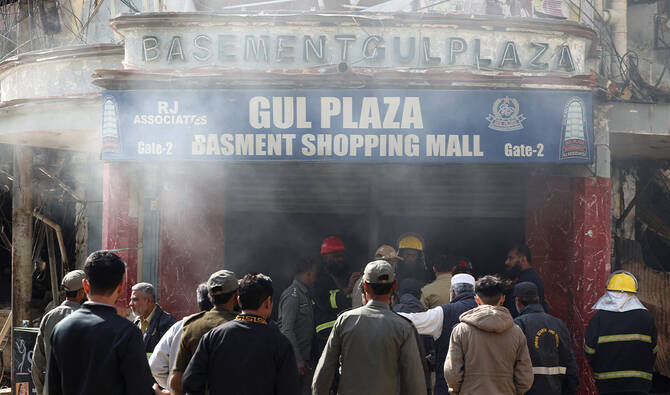
Rescue and emergency team members gather at the entrance, following a massive fire that broke out in the Gul Plaza Shopping Mall in Karachi, Pakistan, January 23, 2026. (Reuters/File)
Short Url
Updated 27 January 2026
Follow

Pakistan approves compensation as rescue ends 10 days after deadly Karachi plaza fire

  • 73 people killed in one of Karachi’s deadliest fires, which exposed gaps in fire safety enforcement
  • Forensic teams to inspect sealed Gul Plaza building to determine cause of blaze, officials say

ISLAMABAD: The Sindh cabinet on Tuesday approved a major compensation and rehabilitation package for victims of a fire at a shopping plaza in Karachi, as authorities formally concluded search and rescue operations more than 10 days after one of the city’s deadliest commercial blazes.

The fire, which broke out on Jan. 17 at the multi-story shopping complex in Karachi’s congested Saddar area, killed more than 70 people and took three days to extinguish. Rescue and relief efforts continued for over a week amid unstable debris and severely damaged structures, before the scorched building was sealed by the district administration on Tuesday.

Under the cabinet-approved package, families of those who died will receive Rs10 million ($35,800) each in compensation, while affected shopkeepers will be provided interest-free loans of Rs10 million per unit, with the provincial government bearing the cost of interest. An additional Rs500,000 ($1,790) per shopkeeper has been approved as immediate subsistence support.

“There can be no compromise on human life,” Chief Minister Syed Murad Ali Shah said during a cabinet meeting, adding that the government’s priority was to support affected families while ensuring accountability.

“Relief, justice and prevention must go hand in hand,” he added.

The cabinet also constituted a high-level subcommittee, headed by the chief minister, to review the findings of an inquiry committee tasked with determining responsibility for the incident and recommending further action.

Meanwhile, the district administration said rescue operations had officially ended and the Gul Plaza building had been sealed after being declared unsafe and dilapidated. 

“Gul Plaza has been sealed after the search was completed today [Jan.27], following 10 days of operation. Experts from the Lahore Forensic Laboratory and the Pakistan Engineering Council (PEC) will inspect the building. They will share the cause of the fire once the structure’s inspection is completed,” Javed Nabi Khoso, Deputy Commissioner of District South, where the plaza is located, told Arab News.

Dr. Summaiya, police surgeon in Karachi, told Arab News 73 sets of remains had been processed so far, of which 27 had been identified and one unknown profile had been generated. 

“Fifty-six family reference samples have been collected in connection with 65 missing persons,” she added. 

Fires have become an increasingly frequent occurrence in Karachi, a megacity of more than 20 million people, where fire services remain severely overstretched and under-resourced relative to population density and the scale of commercial activity.

Successive deadly incidents have drawn criticism of the provincial Sindh administration over lax enforcement of building codes, inadequate inspections and limited emergency response capacity.


Pakistan says defense pact with Saudi Arabia elevated brotherly ties to ‘new heights’

Updated 25 February 2026
Follow

Pakistan says defense pact with Saudi Arabia elevated brotherly ties to ‘new heights’

  • Pakistan, Saudi Arabia signed strategic defense pact last year pledging aggression against one will be treated as attack on both
  • Deputy PM Ishaq Dar says enduring bonds with Islamic and Arab nations form vital pillar of Pakistan’s foreign policy 

ISLAMABAD: Deputy Prime Minister Ishaq Dar said on Wednesday that Pakistan’s defense pact with Saudi Arabia elevated its brotherly ties with the Kingdom to “new heights,” stressing that close ties with Arab and Islamic nations form a key pillar of Islamabad’s foreign policy. 

Pakistan and Saudi Arabia signed a Strategic Mutual Defense Agreement on Sept. 17 last year, pledging that aggression against one country would be treated as an attack on both, enhancing joint deterrence and formalizing decades of military and security cooperation.

Both nations agreed in October 2025 to launch an economic cooperation framework to strengthen trade and investment ties. 

“In the Middle East, our landmark Strategic Mutual Defense Agreement with Saudi Arabia has elevated our brotherly ties to new heights,” Dar said while speaking at the Pakistan Governance Forum 2026 event in Islamabad. 

The Pakistani deputy prime minister was speaking on the topic “Navigating International Relations Amidst Changing Geo-Politics.”

Dar noted that Pakistan has reinforced partnerships with other Middle Eastern nations such as the UAE, Qatar, Jordan, Oman, Egypt and Bahrain. He said these partnerships have yielded “concrete agreements” in investment, agriculture, infrastructure, and energy sectors. 

“Our enduring bonds with Islamic and Arab nations form a vital pillar of our foreign policy, and we will continue to expand our partnerships across Asia, Latin America, and Africa,” he said. 

Dar pointed out that the presidents of Kazakhstan, Uzbekistan and Kyrgyzstan have undertaken visits to Pakistan in recent months, reflecting Central Asian nations’ desire to boost cooperation with Islamabad.

On South Asia, the Pakistani deputy PM said Pakistan has successfully transformed its fraternal ties with Bangladesh into “a substantive partnership.”

“Similarly, the trilateral mechanism involving China, Pakistan, and Bangladesh has been launched with a view to expanding and deepening regional cooperation and synergy,” the Pakistani minister said. 

He said Islamabad has strengthened its “all-weather” partnership with China via the second phase of the multi-billion-dollar China-Pakistan Economic Corridor agreement and “unwavering support” from both sides for each other’s core interests. 

Dar said Pakistan had also reinvigorated its partnership with the US, advancing cooperation in trade, technology, investment, and regional stability. 

“This calibrated approach has enhanced our ability to navigate complexity with skill and confidence, ensuring that our national interests are served without compromising our core foreign policy principles,” he said.