

Saudi FM joins Arab counterparts in talks with Slovenia on Gaza, regional stability

1 / 4
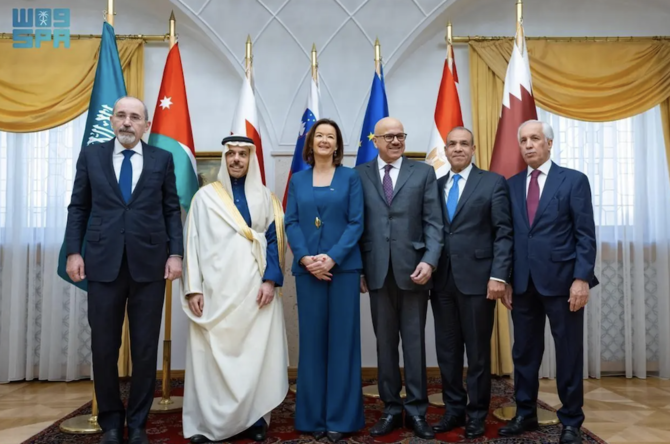
Saudi Foreign Minister Prince Faisal bin Farhan held talks with Slovenia’s Deputy Prime Minister and Minister of Foreign and European Affairs Tanja Fajon in Ljubljana on Friday, as he joined Arab counterparts for an expanded meeting focused on Gaza and wider regional developments. (SPA)
2 / 4
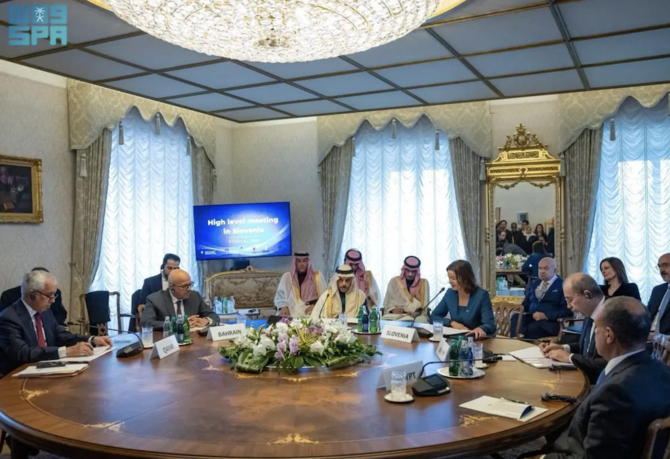
Saudi Foreign Minister Prince Faisal bin Farhan held talks with Slovenia’s Deputy Prime Minister and Minister of Foreign and European Affairs Tanja Fajon in Ljubljana on Friday, as he joined Arab counterparts for an expanded meeting focused on Gaza and wider regional developments. (SPA)
3 / 4
Prince Faisal met Fajon separately to review Saudi-Slovenian relations and explore ways to strengthen cooperation across various fields. (SPA)
4 / 4
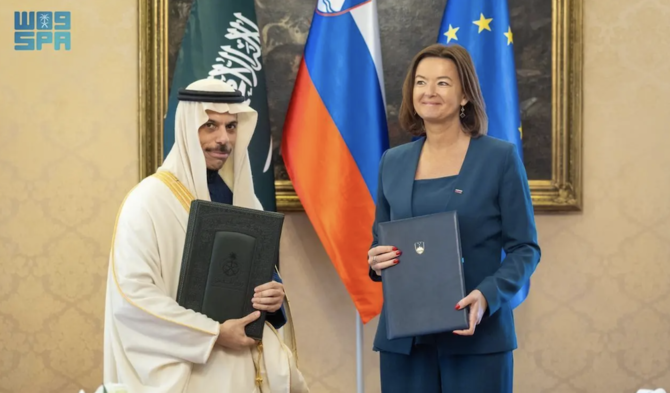
Prince Faisal met Fajon separately to review Saudi-Slovenian relations and explore ways to strengthen cooperation across various fields. (SPA)
Short Url
Updated 06 February 2026
Follow

Saudi FM joins Arab counterparts in talks with Slovenia on Gaza, regional stability

  • Prince Faisal and Tanja Fajon later signed general cooperation agreement aimed at enhancing ties between Kingdom and Slovenia

LJUBLJANA: Saudi Foreign Minister Prince Faisal bin Farhan held talks with Slovenia’s Deputy Prime Minister and Minister of Foreign and European Affairs Tanja Fajon in Ljubljana on Friday, as he joined Arab counterparts for an expanded meeting focused on Gaza and wider regional developments.

Prince Faisal met Fajon separately to review Saudi-Slovenian relations and explore ways to strengthen cooperation across various fields, the Saudi Press Agency reported.

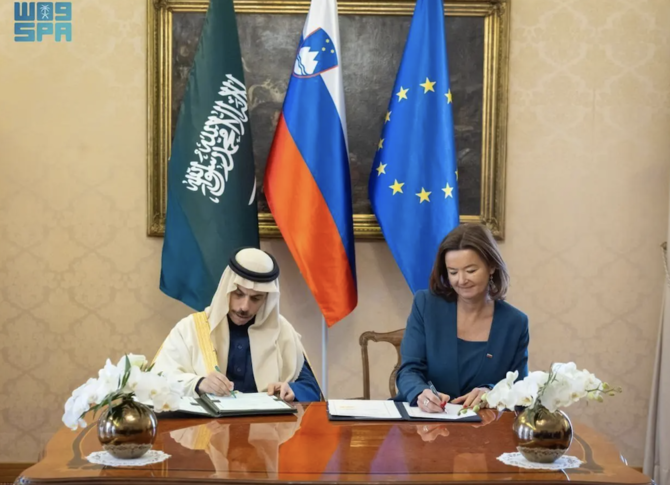
The two sides later signed a general cooperation agreement aimed at enhancing ties between the Kingdom and Slovenia and intensifying joint efforts to support further progress and prosperity for both countries, SPA added.

The expanded ministerial meeting also brought together Jordanian Deputy Prime Minister and Foreign Minister Ayman Safadi, Egyptian Foreign Minister Badr Abdelatty, Bahraini Foreign Minister Abdullatif Al-Zayani and Qatar’s Minister of State for Foreign Affairs Sultan Al-Muraikhi.

During the talks, ministers discussed ways to bolster regional and international security and stability, with a focus on the situation in Gaza.

They stressed the need to uphold the ceasefire agreement between Israel and Hamas, ensure its full implementation and deliver sufficient and sustainable humanitarian aid to the enclave.

The officials also reviewed efforts to advance US President Donald Trump’s peace plan and reiterated the importance of achieving a clear political horizon leading to an independent and sovereign Palestinian state along the 1967 borders, with East Jerusalem as its capital, based on the two-state solution.

They addressed developments in the occupied West Bank, calling for an end to illegal, unilateral Israeli measures and violations against Islamic and Christian holy sites in occupied Jerusalem, warning that such actions undermined de-escalation efforts.

The ministers praised Slovenia’s support for Palestinian rights and its recognition of a Palestinian state, and also discussed broader regional developments, ways to reduce escalation through dialogue, and efforts to resolve the Russia-Ukraine crisis.


Iran will be the ‘biggest loser’ from escalation: Riyadh

Updated 09 March 2026
Follow

Iran will be the ‘biggest loser’ from escalation: Riyadh

  • Attacks on neighbors violates international law, threatens region
  • KSA rejects claims it allowed use of airspace for assaults on Iran

RIYADH: Saudi Arabia has condemned what it describes as Iran’s sustained campaign of aggression against the Kingdom, fellow GCC and other nations, cautioning that continued escalation would ultimately devastate Iran itself.

In a statement issued on Monday, Saudi Arabia’s Ministry of Foreign Affairs said that if Iran presses ahead with its attacks, it would bear the heaviest diplomatic, economic, and strategic consequences, and be “the biggest loser.”

The ministry stated that the attacks were “unacceptable under any circumstances,” and reaffirmed the Kingdom’s right to take measures to protect its people, territory, and sovereignty.

Riyadh condemned Iran’s attacks on civilian airports and oil infrastructure, calling them a violation of international law and a deliberate attempt to destabilize the region.

“The targeting of civilian airports and oil facilities is nothing but a demonstration of determination to threaten security and stability and a flagrant violation of international covenants and international law,” the statement said.

The ministry also pushed back against recent remarks by Iran’s President Masoud Pezeshkian, who had publicly stated that Tehran had no intention of attacking neighboring countries.

The ministry rejected that assurance as hollow, arguing that Iran’s strikes had continued unabated both during and after the speech, driven by what Riyadh called “flimsy pretexts.”

Saudi Arabia rejected Iran’s allegation that the Kingdom had allowed fighter jets and refueling aircraft to launch from Saudi territory to participate in hostilities against Iran.

“The reality is that those aircraft are conducting air patrols to monitor and protect the airspace of the Kingdom and the GCC states from Iranian missiles and drones,” the ministry stated.