

About 500 Palestinians killed in Israeli air strike on Gaza hospital – health authorities

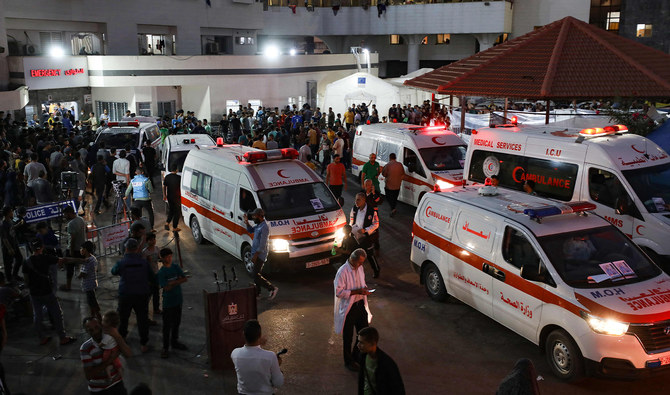
Ambulances carrying victims of Israeli strikes crowd the entrance to the emergency ward of the Al-Shifa hospital in Gaza City on October 15, 2023. (AFP)
Short Url
Updated 18 October 2023
Follow

About 500 Palestinians killed in Israeli air strike on Gaza hospital – health authorities

  • The media office of Gaza’s Hamas government described the attack as a “war crime”
  • Thousands of families have flocked to Gaza’s hospitals seeking refuge from Israeli airstrikes

GAZA: An Israeli air strike on Tuesday killed about 500 Palestinians at a Gaza City hospital crammed with patients and displaced people, health authorities in the besieged enclave said.

The strike was the bloodiest single incident in Gaza since Israel launched an unrelenting bombing campaign against the densely populated territory in retaliation for a deadly cross-border Hamas assault on southern Israeli communities on Oct. 7.

It took place on the eve of a visit by US President Joe Biden to Israel to show support for the country in its war with Hamas, which rules the Gaza Strip.

Arab countries, Iran and Turkiye swiftly condemned the attack. The Palestinian prime minister called it “a horrific crime, genocide” and said countries backing Israel also bore responsibility.

Sources at the Gaza Ministry of Health told Reuters that around 500 Palestinians were killed in the air strike on Al-Ahli Al-Arabi hospital.

Hamas said the bombing mostly killed people left homeless by Israel bombardments, and that the dead included patients, women and children.

“There are scores of dismembered and crushed bodies, baths of blood,” said Izzat El-Reshiq, a senior Hamas member.

Video obtained by Reuters showed several full ambulances arriving at another Gaza hospital carrying people injured at Al-Ahli Al-Arabi hospital. One man was staggering, bleeding heavily from the head. A boy was being carried on a stretcher.

The Israeli military said it did not have any details about the reported bombing, but was checking. It has previously accused Hamas of using Palestinian civilians as human shields.

In Washington, the Pentagon said it was aware of the reports about the hospital being hit but had no details. The Pentagon, which has sent five C-17 aircraft with military assistance to Israel so far, reiterated that there were no preconditions on the aid being provided and added: “We expect all democracies like Israel to uphold the law of war.”

Earlier on Tuesday, the United Nations Palestinian refugee agency UNRWA said an Israeli air strike had killed at least six people at one of its schools that has been functioning as a shelter for displaced people.

“This is outrageous and again it shows a flagrant disregard for the lives of civilians,” UNRWA said in a social media post. “No place is safe in Gaza anymore, not even UN facilities.”

Health authorities in Gaza say at least 3,000 people have been killed in Israel’s 11-day bombardment since Hamas militants rampaged into Israeli towns and kibbutzes on Oct. 7, killing more than 1,300 people, mainly civilians.

Israel has flattened parts of heavily urbanized Gaza with air strikes, driven around half of its 2.3 million population from their homes and imposed a total blockade on the enclave, halting food, fuel and medical supplies.

Amid the death and destruction, the humanitarian crisis in the enclave worsened as Israeli troops and tanks massed on the border for an expected ground invasion.

Scores of trucks carrying vital supplies for Gaza headed toward the Rafah crossing in Egypt on Tuesday, the only access point to the coastal enclave outside Israeli control, but there was no clear indication that they would be able to enter.


Virtual museum preserves Sudan’s plundered heritage

Updated 6 sec ago
Follow

Virtual museum preserves Sudan’s plundered heritage

CAIRO: Destroyed and looted in the early months of Sudan’s war, the national museum in Khartoum is now welcoming visitors virtually after months of painstaking effort to digitally recreate its collection.
At the museum itself, almost nothing remains of the 100,000 artefacts it had stored since its construction in the 1950s. Only the pieces too heavy for looters to haul off, like the massive granite statue of the Kush Pharaoh Taharqa and frescoes relocated from temples during the building of the Aswan Dam, are still present on site.
“The virtual museum is the only viable option to ensure continuity,” government antiquities official Ikhlass Abdel Latif said during a recent presentation of the project, carried out by the French Archaeological Unit for Sudanese Antiquities (SFDAS) with support from the Louvre and Britain’s Durham University.
When the museum was plundered following the outbreak of the war between the regular army and the paramilitary Rapid Support Forces (RSF) in April 2023, satellite images showed trucks loaded with relics heading toward Darfur, the western region now totally controlled by the RSF.
Since then, searches for the missing artefacts aided by Interpol have only yielded meagre results.
“The Khartoum museum was the cornerstone of Sudanese cultural preservation — the damage is astronomical,” said SFDAS researcher Faiza Drici, but “the virtual version lets us recreate the lost collections and keep a clear record.”
Drici worked for more than a year to reconstruct the lost holdings in a database, working from fragments of official lists, studies published by researchers and photos taken during excavation missions.
Then graphic designer Marcel Perrin created a computer model that mimicked the museum’s atmosphere — its architecture, its lighting and the arrangement of its displays.
Online since January 1, the virtual museum now gives visitors a facsimile of the experience of walking through the institution’s galleries — reconstructed from photographs and the original plans — and viewing more than 1,000 pieces inherited from the ancient Kingdom of Kush.
It will take until the end of 2026, however, for the project to upload its recreation of the museum’s famed “Gold Room,” which had housed solid-gold royal jewelry, figurines and ceremonial objects stolen by looters.
In addition to the virtual museum’s documentary value, the catalogue reconstructed by SFDAS is expected to bolster Interpol’s efforts to thwart the trafficking of Sudan’s stolen heritage.