

Polish opposition leader Tusk declares win after exit poll shows ruling conservatives lose majority

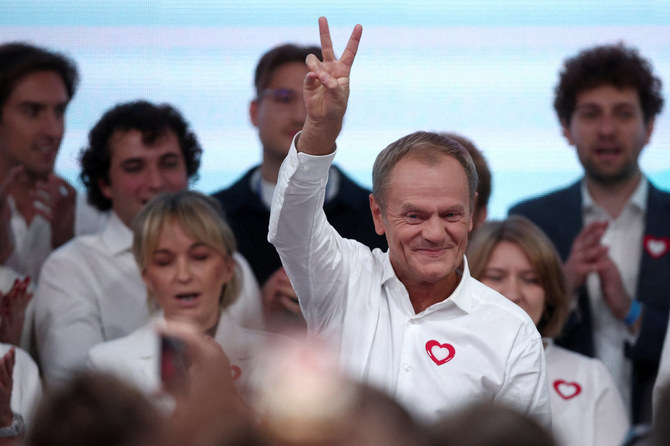
Donald Tusk, leader of Poland's largest opposition grouping Civic Coalition (KO), gestures after the exit poll results are announced in Warsaw on October 15, 2023. (REUTERS)
Short Url
Updated 16 October 2023
Follow

Polish opposition leader Tusk declares win after exit poll shows ruling conservatives lose majority

  • Exit poll shows ruling Law and Justice party still got the most number of votes, obtaining 200 out of the 460-seat lower house of parliament
  • Poll also showed that three opposition parties, including Tusk's Civic Coalition, have likely won a combined 248 seats

WARSAW, Poland: Polish opposition leader Donald Tusk declared the beginning of a new era for his country after opposition parties appeared to have won enough votes in Sunday’s parliamentary election to oust the governing nationalist conservative party.

That party, Law and Justice, has bickered with allies and faced accusations of eroding rule of law at home in its eight years in power. It appeared that voters were mobilized like never before, voting in even greater numbers than when the nation ousted the communist authorities in 1989. Exit poll results pegged it at a record 72.9 percent. In some places people were still in line when polling officially closed, but all were allowed to vote.
If the result predicted by the exit poll holds, Law and Justice won but also lost. It got more seats than any other party but fewer than in the previous election and not enough to be able to lead a government that can pass laws in the legislature.
The Ipsos exit poll suggested that Law and Justice obtained 200 seats. Its potential partner, the far-right Confederation got 12 seats, a showing the party acknowledged was a defeat.
It also showed that three opposition parties have likely won a combined 248 seats in the 460-seat lower house of parliament, the Sejm. The largest of the groups is Civic Coalition, led by Tusk, a former prime minister and former European Union president. It won 31.6 percent of votes, the exit poll said.
“I have been a politician for many years. I’m an athlete. Never in my life have I been so happy about taking seemingly second place. Poland won. Democracy has won. We have removed them from power,” Tusk told his cheering supporters.
“This result might still be better, but already today we can say this is the end of the bad time, this is end of Law and Justice rule,” Tusk added.
Law and Justice leader Jaroslaw Kaczynski acknowledged the ambiguous result. He told supporters at his headquarters that his party’s result, at nearly 37 percent of the vote, according to the exit poll, was a success, making it the party to win the most votes for three parliamentary elections in a row.
“We must have hope and we must also know that regardless of whether we are in power or in the opposition, we will implement this (political) project in various ways and we will not allow Poland to be betrayed,” Kaczynski said.
If the result holds, and Law and Justice is the single party with the most seats, then it would most likely get the first chance to try to build a government.
It falls to President Andrzej Duda, who is an ally of Law and Justice, to tap a party to try to form a government.
Prime Minister Mateusz Morawiecki said on Polsat News that Duda “will entrust the mission of forming the government to the winning party and in this first step we will certainly try to build a parliamentary majority.”
The question arose whether it would obtain the new parliament’s approval.
Three opposition parties, Tusk’s Civic Coalition, Third Way and the New Left, ran on separate tickets but with the same promises of seeking to oust Law and Justice and restore good ties with the European Union.
Wlodzimierz Czarzasty, a leader of the Left party, vowed to work with the others to “create a democratic, strong, reasonable and predictable government.”
Katarzyna Pelczynska-Nalecz, the head of election campaign for Third Way, called it a “huge day for our democracy.”
Votes were still being counted and the state electoral commission says it expects to have final results by Tuesday morning.
The high turnout also extended the count of Ipsos’ late poll, based on findings from 50 percent of the voting stations, which was still not published in the early hours of Monday.
At stake in the election were the health of the nation’s constitutional order, its legal stance on LGBTQ+ rights and abortion, and the foreign alliances of a country that has been a crucial ally to Ukraine after Russia launched its full-scale invasion.
LGBTQ+ rights activist Bart Staszewski called it the end of a “nightmare” for himself as a gay man and others.
“This is just the beginning of reclaiming of our country. The fight is ahead but we are breathing fresh air today,” Staszewski said.
Environmental activist Dominika Lasota was emotional with relief, saying “we have our future.”
Law and Justice has eroded checks and balances to gain more control over state institutions, including the courts, public media and the electoral process itself.
During the campaign many Poles described the vote as the most important one since 1989, when a new democracy was born after decades of communism. Turnout then was 63 percent.
Despite many uncertainties ahead, what appeared certain was that support for the governing party has shrunk since the last election in 2019 when it won nearly 44 percent of the vote, its popularity dented by high inflation, allegations of cronyism and bickering with European allies.
There is a high level of state ownership in the Polish economy, and the governing party has built up a system of patronage, handing out thousands of jobs and contracts to its loyalists.
A political change could open the way for the EU to release billions of euros in funding that has been withheld over what the EU viewed as democratic erosion.
Piotr Buras, of the European Council of Foreign Relations, said the opposition had gained from “growing fatigue” with the government among Poles, “beyond the groups usually supporting the liberals.”
The fate of Poland’s relationship with Ukraine was also at stake. The Confederation party campaigned on an anti-Ukraine message, accusing the country of lacking gratitude to Poland for its help in Russia’s war. Its poor showing will be a relief for Kyiv.
A referendum on migration, the retirement age and other issues was held simultaneously. Some government opponents called on voters to boycott the referendum, saying it was an attempt by the government to galvanize its supporters. Many voters were seen refusing to take part in the referendum and the exit poll pegged participation at 40 percent, which meant the results would not be legally binding.


Congress taking first votes on Iran war as debate rages about US goals

Updated 6 sec ago
Follow

Congress taking first votes on Iran war as debate rages about US goals

  • The US Senate is headed toward a vote on President Donald Trump’s decision to embark on a war against Iran
  • It’s an extraordinary test in Congress for a conflict that has rapidly spread across the Middle East with no clear US exit strategy
WASHINGTON: The US Senate is headed toward a vote Wednesday on President Donald Trump’s decision to embark on a war against Iran, an extraordinary test in Congress for a conflict that has rapidly spread across the Middle East with no clear US exit strategy.
The legislation, known as a war powers resolution, gives lawmakers an opportunity to demand congressional approval before any further attacks are carried out. The Senate resolution and a similar bill being voted on in the House later this week face unlikely paths through the Republican-controlled Congress and would almost certainly be vetoed by Trump even if they were to pass.
Nonetheless, the votes marked a weighty moment for lawmakers. Their decisions on the five-day-old war — which Trump entered without congressional approval — could determine the fates of US military members, countless other lives and the future of the region.
“Wars without clear objectives do not remain small. They get bigger, bloodier, longer and more expensive,” said Senate Democratic leader Chuck Schumer at a news conference Tuesday. “This is not a necessary war. It’s a war of choice.”
Trump administration scrambles for congressional support
After launching a surprise attack against Iran on Saturday, Trump has scrambled to win support for a conflict that Americans of all political persuasions were already wary of entering. Trump administration officials have been a frequent presence on Capitol Hill this week as they try to reassure lawmakers that they have the situation under control.
“We are not going to put American troops in harm’s way,” Secretary of State Marco Rubio told reporters in a raucous news conference at the Capitol Tuesday.
But six US military members were killed over the weekend in a drone strike in Kuwait.
Trump has also not ruled out deploying US ground troops. He has said he is hoping to end the bombing campaign within a few weeks, but his goals for the war have shifted from regime change to stopping Iran from developing nuclear capabilities to crippling its navy and missile programs.
“I think they are achieving great success with what they’ve done so far,” Senate Majority Leader John Thune said Tuesday, adding that what happens next in the country will be “largely up to the Iranian people.”
Almost all Republican senators were readying to vote Wednesday against the war powers resolution to halt military action, but a number still expressed hesitation at the idea of deploying troops on the ground in Iran.
“I don’t think the American people want to see troops on the ground,” said Sen. Bill Cassidy, R-Louisiana, as he exited a classified briefing Tuesday. He added that Trump administration officials “left open that possibility,” but it wasn’t an option they were emphasizing.
Lawmakers to go on record
The votes in Congress this week represented potentially consequential markers of just where lawmakers stand on the war as they look ahead to midterm elections and the consequences of the conflict.
“Nobody gets to hide and give the president an easy pass or an end-run around the Constitution,” said Sen. Tim Kaine, the Virginia Democrat leading the war powers resolution. “Everybody’s got to declare whether they’re for this war or against it.”
Republican leaders have successfully, though narrowly, defeated a series of war powers resolutions pertaining to several other conflicts that Trump has entered or threatened to enter. This one, however, is different.
Unlike Trump’s military campaigns against alleged drug boats or even Venezuelan leader Nicolás Maduro, the attack on Iran represents an open-ended conflict that is already ricocheting across the region. For Republicans who are used to operating in a political party dominated by Trump and his promises of keeping the US out of foreign entanglements, the moment represented a bit of whiplash.
“War is ugly, it always has been ugly, but we’re taking out a regime that has been trying to attack us for quite some time,” said Sen. Markwayne Mullin, an Oklahoma Republican.
Meanwhile, Sen. Lindsey Graham, a South Carolina Republican who has long pushed Trump to engage overseas, argued that the widening conflict represented an opportunity for Arab and European countries to join in the fight against Iran and the militant groups it supports.
“I don’t mind people being on record as to whether or not they think this is a good idea,” he told reporters, but also argued that too much power over the military was ceded to Congress in the War Powers Act, which mandates that presidents must withdraw troops from a conflict within 90 days if there is no congressional authorization.
House vote looms
On the other side of the Capitol, House leaders were also readying for an intense debate over the war followed by a vote Thursday.
“I do believe we have the votes to defeat it, I certainly hope we do,” House Speaker Mike Johnson said after an all-member briefing on Tuesday night.
Meanwhile, House Democratic leader Hakeem Jeffries said he expected a strong showing from Democrats in favor of the war powers resolution.
As lawmakers emerged from a closed-door briefing Tuesday night, Rep. Gregory Meeks, the top Democrat on the House Foreign Affairs Committee, implored the Trump administration to “come to Congress” and speak directly to the American people about the rationale for the war.
His voice filled with emotion as he said, “Our young men and women’s lives are on the line.”