ARRAS, France: A man of Chechen origin who was under surveillance by French security services over suspected Islamic radicalization stabbed a teacher to death at his former high school and critically wounded three other people Friday in northern France, authorities said.
The attack was being investigated by anti-terror prosecutors amid soaring global tensions over the war between Israel and Hamas. It also happened almost three years after another teacher, Samuel Paty, was beheaded by a radicalized Chechen near a Paris area school.
The man arrested as the main suspect in Friday’s stabbings had been under surveillance since the summer on suspicion of Islamic radicalization, French intelligence services told The Associated Press. He was detained Thursday for questioning based on the monitoring of his phone calls in recent days, but investigators found no weapon or threat or indication that he was preparing an attack, Interior Minister Gerald Darmanin said.
’’There was a race against the clock. But there was no threat, no weapon, no indication. We did our our job seriously,″ Darmanin said on TF1 television.
The suspect was reportedly refusing to speak to investigators. Several others also were in custody Friday, national counterterrorism prosecutor Jean-Francois Ricard said. Police said the suspect’s younger brother was held for questioning.
President Emmanuel Macron said France had been “hit once again by the barbarity of Islamist terrorism.”
“Nearly three years to the day after the assassination of Samuel Paty, terrorism has hit a school again and in a context that we’re all aware of,” Macron said at the site of the attack in Arras, a city 115 miles (185 kilometers) north of Paris.
A colleague and a fellow teacher identified the dead educator as Dominique Bernard, a French language teacher at the Gambetta-Carnot school, which enrolls students ages 11-18. The victim “stepped in and probably saved many lives” but two of the wounded — another teacher and a security guard — were fighting for theirs, according to Macron.
Sliman Hamzi, a police officer who was one of the first on the scene, said the suspected attacker, a former student at the school, shouted “Allahu akbar,” or “God is great” in Arabic.
Hamzi said he was alerted by another officer, rushed to the school and saw a male victim lying on the ground outside the school and the attacker being taken away. He said the victim had his throat slit.
“I’m extremely shocked by what I saw,” the officer said. “It was a horrible thing to see this poor man who was killed on the job by a lunatic.”
The National Police force identified the suspect in the attack as a Russian national of Chechen origin who was born in 2003. The French intelligence services told the AP he had been closely watched since the summer with tails and telephone surveillance and was stopped as recently as Thursday for a police check that found no wrongdoing.
Friday’s attack had echoes of Paty’s slaying on Oct 16, 2020 — also a Friday — by an 18-year-old who had become radicalized. Like the suspect in Friday’s stabbings, the earlier attacker had a Chechen background; police shot and killed him.
Martin Doussau, a philosophy teacher at Gambetta-Carnot, said the assailant was armed with two knives and appeared to be hunting specifically for a history teacher. Paty taught history and geography.
“I was chased by the attacker, who ... asked me if I teach history. (He said), ‘Are you a history teacher, are you a history teacher?’” said Doussau, who recounted how he barricaded himself behind a door until police used a stun gun to subdue the attacker.
“When he turned around and asked me if I am a history teacher, I immediately thought of Samuel Paty,” Doussau told reporters.
Prosecutors said they were considering charges of terror-related murder and attempted murder against the suspect.
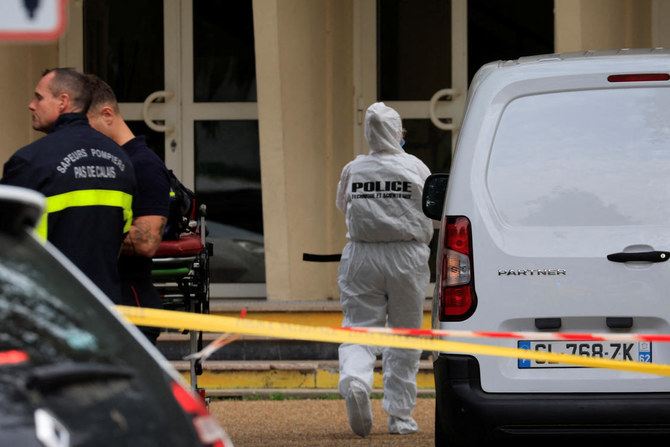
Macron traveled to Arras along with the interior and education ministers. He stopped for a moment before the blanket-covered body of the teacher, which was in the parking lot in front of the school. A puddle of blood was visible as forensic experts worked around the body.
The president then went to see students from the school in an adjacent building.
He said police thwarted an “attempted attack” in another region of France after the teacher’s fatal stabbing. He did not provide details, but police said a man armed with a knife was arrested coming out of a prayer hall in the Yvelines region west of Paris. The man’s motives weren’t immediately clear, police said.
School attacks are rare in France, and the government asked authorities to heighten vigilance at all schools across the country. The government also increased its threat alert level Friday, allowing for larger police and military deployments to protect the country.
Darmanin said there was no specific threat that prompted the move to a higher security posture, but ‘’an extremely negative atmosphere’’ notably because of calls by extremists to attack amid the Mideast war.
He said authorities have detained 12 people near schools or places of worship since the Hamas attack on Israel last Saturday, some of whom were armed and were preparing to attack. France has heightened security at hundreds of Jewish sites around the country this week.
Julie Duhamel, an official with the the Unsa teachers’ union in the Pas-de-Calais region that includes Arras, told radio network Franceinfo that teachers had flagged the suspect’s radicalization “a few years ago.”
The suspect’s telephone conversations in recent days gave no indication of an impending attack, leading intelligence officers to conclude that the assailant decided suddenly on Friday to act, intelligence services told the AP.
An older brother was arrested in the summer of 2019 by the DGSI — France’s counter-terrorism intelligence service — on suspicion of being involved in the planning of an attack that was thwarted, and is in jail, French intelligence said.
The older brother also was a former pupil at the high school targeted Friday, according to legal records from his trial earlier this year on terror-related charges. Investigation records show that during a school class in 2016 about freedom of expression, the older brother defended a terror attack in 2015 that killed 12 cartoonists at the French satirical newspaper Charlie Hebdo.
The older brother is serving a 5-year prison term for terror offenses. He was convicted this year of involvement in a plot for an armed attack around the presidential Elysee Palace in Paris that was thwarted by the intelligence services. Other members of the radical Islamist group were also jailed for up to 15 years. He was the group’s only Chechen.
Friday’s attack came amid heightened tensions around the world over Hamas’ attack on southern Israel and Israel’s blistering military response, which have killed hundreds of civilians on both sides.
Darmanin on Thursday ordered local authorities to ban all pro-Palestinian demonstrations amid a rise in antisemitic acts.
France is estimated to have the world’s third-largest Jewish population after Israel and the US, as well as the largest Muslim population in Western Europe.
A moment of silence was held at the opening of a France-Netherlands soccer match Friday night to honor the slain teacher. France’s National Assembly, the lower house of Parliament, held a minute of silence for the victims at the opening of its Friday session.
Macron said the school in Arras would reopen as soon as Saturday morning, and he urged the people of France to “stay united.”
“The choice has been made not to give in to terror,” he said. “We must not let anything divide us, and we must remember that schools and the transmission of knowledge are at the heart of this fight against ignorance.”


![]()


Suspect in French teacher's slaying was held for questioning the day before attack, minister says
Short Url
https://arab.news/yhsct
Suspect in French teacher's slaying was held for questioning the day before attack, minister says
- Suspected assailant was arrested
- Suspect was a Russian-born Chechen and former student of the high school where the attack happened


AI reshaping the battle over the narrative of Maduro’s US capture
- Since the US captured Venezuelan leader Nicolas Maduro in early January, pictures and videos chronicling the events have been crowded out by those generated with artificial intelligence
CARACAS: Since the US captured Venezuelan leader Nicolas Maduro in early January, pictures and videos chronicling the events have been crowded out by those generated with artificial intelligence, blurring the lines between fiction and reality.
The endless stream of content ranges from comedic memes to dramatic retellings.
In one, a courtroom illustration of Maduro in a New York courthouse springs to life and announces: “I consider myself a prisoner of war.”
In another, an AI-generated Maduro attempts to escape a US prison through an air duct, only to find himself in a courtroom with US President Donald Trump, where they dance with a judge and an FBI agent to a song by American rapper Ice Spice.
Maduro was captured alongside his wife Cilia Flores during US strikes in the Venezuelan capital of Caracas on January 3.
They have since been taken to a prison in New York where they are being held on drug trafficking charges.
While some have celebrated Maduro’s ouster, the “Chavismo” movement he leads — named after his predecessor Hugo Chavez — has worked to reframe what his fall means for Venezuela’s future.
- ‘ Confuse, combat, and silence’ -
Leon Hernandez, a researcher at Andres Bello Catholic University, told AFP that with AI’s rapid creation of content, we see development of “disinformation labs” that flood social media platforms.
“There were things that circulated that were not real during the capture (of Maduro), and things that circulated which were real that generated doubt,” Hernandez said.
“That was the idea: to create confusion and generate skepticism at the base level by distorting certain elements of real things.”
The goal, he added, is for the content to overwhelm audiences so they cannot follow it.
Even legacy media such as the Venezuelan VTV television channel are in on it, with the broadcaster playing an AI-animated video narrated by a child recounting Maduro’s capture.
“AI has become the new instrument of power for autocrats to confuse, combat, and silence dissent,” said Elena Block, a professor of political communication and strategy at the University of Queensland in Australia.
- ‘Greatest threat to democracy’ -
Block pointed out the use of cartoons, specifically, had been a medium of propaganda used in both authoritarian and democratic states.
Long before his arrest, Maduro was depicted as the illustrated superhero “Super Bigote” or “Super Mustache,” donning a Superman-like suit and fighting monsters like “extremists” and the “North American empire.”
The cartoon’s popularity spawned toys that have been carried by Maduro’s supporters during rallies advocating for his return.
And much like his predecessor, Maduro continued a practice of “media domination” to stave off traditional media outlets from airing criticism of Chavismo.
“With censorship and the disappearance or weakening of news media, social media has emerged as one of the only spaces for information,” Block said.
Maduro is not the only leader to use AI propaganda — Trump has frequently posted AI-generated pictures and videos of himself with “antagonistic, aggressive, and divisive language.”
“These digital and AI tools end up trivializing politics: you don’t explain it, you diminish it,” Block said. “AI today is the greatest threat to democracy.”
The endless stream of content ranges from comedic memes to dramatic retellings.
In one, a courtroom illustration of Maduro in a New York courthouse springs to life and announces: “I consider myself a prisoner of war.”
In another, an AI-generated Maduro attempts to escape a US prison through an air duct, only to find himself in a courtroom with US President Donald Trump, where they dance with a judge and an FBI agent to a song by American rapper Ice Spice.
Maduro was captured alongside his wife Cilia Flores during US strikes in the Venezuelan capital of Caracas on January 3.
They have since been taken to a prison in New York where they are being held on drug trafficking charges.
While some have celebrated Maduro’s ouster, the “Chavismo” movement he leads — named after his predecessor Hugo Chavez — has worked to reframe what his fall means for Venezuela’s future.
- ‘ Confuse, combat, and silence’ -
Leon Hernandez, a researcher at Andres Bello Catholic University, told AFP that with AI’s rapid creation of content, we see development of “disinformation labs” that flood social media platforms.
“There were things that circulated that were not real during the capture (of Maduro), and things that circulated which were real that generated doubt,” Hernandez said.
“That was the idea: to create confusion and generate skepticism at the base level by distorting certain elements of real things.”
The goal, he added, is for the content to overwhelm audiences so they cannot follow it.
Even legacy media such as the Venezuelan VTV television channel are in on it, with the broadcaster playing an AI-animated video narrated by a child recounting Maduro’s capture.
“AI has become the new instrument of power for autocrats to confuse, combat, and silence dissent,” said Elena Block, a professor of political communication and strategy at the University of Queensland in Australia.
- ‘Greatest threat to democracy’ -
Block pointed out the use of cartoons, specifically, had been a medium of propaganda used in both authoritarian and democratic states.
Long before his arrest, Maduro was depicted as the illustrated superhero “Super Bigote” or “Super Mustache,” donning a Superman-like suit and fighting monsters like “extremists” and the “North American empire.”
The cartoon’s popularity spawned toys that have been carried by Maduro’s supporters during rallies advocating for his return.
And much like his predecessor, Maduro continued a practice of “media domination” to stave off traditional media outlets from airing criticism of Chavismo.
“With censorship and the disappearance or weakening of news media, social media has emerged as one of the only spaces for information,” Block said.
Maduro is not the only leader to use AI propaganda — Trump has frequently posted AI-generated pictures and videos of himself with “antagonistic, aggressive, and divisive language.”
“These digital and AI tools end up trivializing politics: you don’t explain it, you diminish it,” Block said. “AI today is the greatest threat to democracy.”
Latest updates


© 2026 SAUDI RESEARCH & PUBLISHING COMPANY, All Rights Reserved And subject to Terms of Use Agreement.