

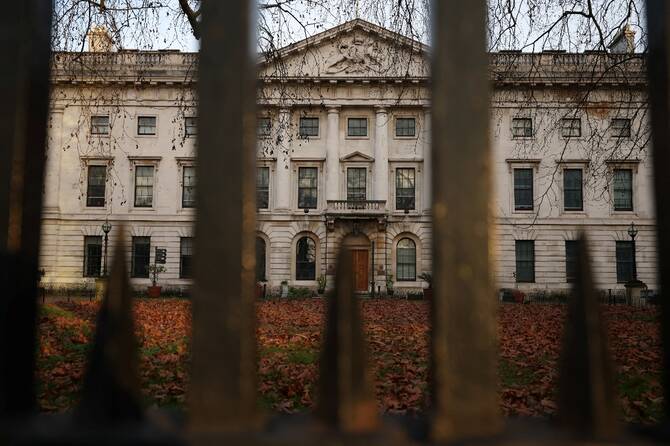

LONDON: Britain's government gave approval on Tuesday for China to build its largest embassy in Europe in London, hoping to improve ties with Beijing despite British and U.S. politicians' warnings that it could be used as a base for spying.
The approval was subject to some conditions.
China's plans to build a new embassy on the site of the two-century-old Royal Mint Court near the Tower of London have stalled for three years over opposition from local residents, lawmakers and Hong Kong pro-democracy campaigners in Britain.
The decision was announced before an expected visit to China by Prime Minister Keir Starmer this month, the first by a British leader since 2018. Some British and Chinese officials said the trip was dependent on the embassy being approved.
EMBASSY APPROVAL HIGHLIGHTS UK'S CHINA DILEMMA
The Chinese government purchased Royal Mint Court in 2018 but its requests for planning permission to build a new embassy on the site were rejected by the local council in 2022. Chinese President Xi Jinping asked Starmer last year to intervene.
The government took control of the planning decision last year and an inquiry was held last February to hear arguments about whether the embassy should be approved.
Some politicians in Britain and the United States have said China should be barred from building on the site near London's historic financial district because it might enable Beijing to eavesdrop on fibre-optic cables that are used by finance firms and travel underneath the area.
British security officials have also warned that allowing China to build a much larger embassy would mean more Chinese spies in Britain as well as more diplomats, an assertion dismissed by the Chinese embassy in London.
The head of Britain's MI5 domestic spy agency said in October his spy agency had more than a century of experience dealing with foreign embassies, suggesting any security risks could be managed.
But MI5 has also warned of a threat posed by attempts by China to recruit and cultivate people with access to the British government.
The agency issued a warning to lawmakers in November about Beijing trying to interfere in British politics, and the collapse of a trial of two British men charged with spying on members of parliament for China led to criticism the government was prioritising better relations over national security.
The government has approved the new embassy - after years of diplomatic pressure from China - as Starmer tries to reset relations with Beijing, which is one of his foreign policy priorities.
Britain has in the past decade moved from saying it wanted to be China's biggest supporter in Europe to being one of its fiercest critics, and is now trying to improve relations again. Starmer said last month closer business ties were in the national interest.
DIPLOMATIC TENSIONS
Some local residents who oppose China building a large embassy in the area are considering whether to ask for a judicial review against the decision.
The new embassy would be one of the largest diplomatic outposts in the world with a footprint of about 55,000 square metres (600,000 square feet), according to the planning application.
That is almost 10 times the size of China's current embassy in central London and considerably bigger than its embassy in the United States.
Before Tuesday's decision, China had blocked plans by Britain to expand its embassy in Beijing, officials involved in the talks said.
Chinese officials say that when Beijing purchased the site for 255 million pounds ($343.54 million), it received assurances from the then Conservative government that it could build its embassy.
Royal Mint Court was from the early 19th century until 1967 the site of the Royal Mint, where coins are produced.


