CARACAS: Since the US captured Venezuelan leader Nicolas Maduro in early January, pictures and videos chronicling the events have been crowded out by those generated with artificial intelligence, blurring the lines between fiction and reality.
The endless stream of content ranges from comedic memes to dramatic retellings.
In one, a courtroom illustration of Maduro in a New York courthouse springs to life and announces: “I consider myself a prisoner of war.”
In another, an AI-generated Maduro attempts to escape a US prison through an air duct, only to find himself in a courtroom with US President Donald Trump, where they dance with a judge and an FBI agent to a song by American rapper Ice Spice.
Maduro was captured alongside his wife Cilia Flores during US strikes in the Venezuelan capital of Caracas on January 3.
They have since been taken to a prison in New York where they are being held on drug trafficking charges.
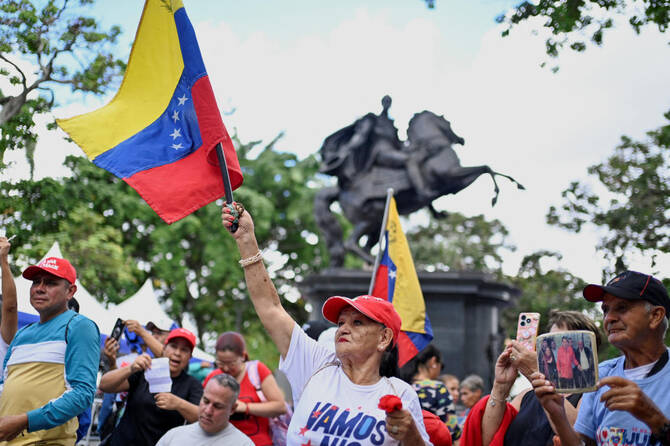
While some have celebrated Maduro’s ouster, the “Chavismo” movement he leads — named after his predecessor Hugo Chavez — has worked to reframe what his fall means for Venezuela’s future.
- ‘ Confuse, combat, and silence’ -
Leon Hernandez, a researcher at Andres Bello Catholic University, told AFP that with AI’s rapid creation of content, we see development of “disinformation labs” that flood social media platforms.
“There were things that circulated that were not real during the capture (of Maduro), and things that circulated which were real that generated doubt,” Hernandez said.
“That was the idea: to create confusion and generate skepticism at the base level by distorting certain elements of real things.”
The goal, he added, is for the content to overwhelm audiences so they cannot follow it.
Even legacy media such as the Venezuelan VTV television channel are in on it, with the broadcaster playing an AI-animated video narrated by a child recounting Maduro’s capture.
“AI has become the new instrument of power for autocrats to confuse, combat, and silence dissent,” said Elena Block, a professor of political communication and strategy at the University of Queensland in Australia.
- ‘Greatest threat to democracy’ -
Block pointed out the use of cartoons, specifically, had been a medium of propaganda used in both authoritarian and democratic states.
Long before his arrest, Maduro was depicted as the illustrated superhero “Super Bigote” or “Super Mustache,” donning a Superman-like suit and fighting monsters like “extremists” and the “North American empire.”
The cartoon’s popularity spawned toys that have been carried by Maduro’s supporters during rallies advocating for his return.
And much like his predecessor, Maduro continued a practice of “media domination” to stave off traditional media outlets from airing criticism of Chavismo.
“With censorship and the disappearance or weakening of news media, social media has emerged as one of the only spaces for information,” Block said.
Maduro is not the only leader to use AI propaganda — Trump has frequently posted AI-generated pictures and videos of himself with “antagonistic, aggressive, and divisive language.”
“These digital and AI tools end up trivializing politics: you don’t explain it, you diminish it,” Block said. “AI today is the greatest threat to democracy.”

AI reshaping the battle over the narrative of Maduro’s US capture
Short Url
https://arab.news/2t882
AI reshaping the battle over the narrative of Maduro’s US capture
- Since the US captured Venezuelan leader Nicolas Maduro in early January, pictures and videos chronicling the events have been crowded out by those generated with artificial intelligence
Karachi mall inferno came after ignored warnings, delayed response
KARACHI: Muhammad Imran did not take the fire seriously at first, thinking it was another small spark at the Karachi mall that would be quickly extinguished by fellow shop owners.
But smoke seeped through ducts and blackened the air in seconds. The lights went out soon after and phone flashlights turned useless, people could no longer see their own hands, he said.
Imran, who has diabetes and has undergone heart surgery, managed only a few steps before nearly giving up. “It felt like doomsday,” he said. “You couldn’t see the person next to you.”
The blaze would rage for nearly two days and reduce Gul Plaza, a multi-story complex of 1,200 family-run shops selling children’s clothes, toys, crockery and household goods, to ash.
At least 67 people were killed, with 15 still missing and feared dead, police official Asad Ali Raza said, in the January 17 blaze, the Pakistani port city’s largest in over a decade.
Imran’s escape from the inferno, along with more than a dozen others who spoke to Reuters, was hampered by locked doors, poor ventilation, and crowded corridors. When they eventually got out, the survivors watched Gul Plaza crumble as rescue efforts faced delays and poor resources.
Police said the fire appeared to have started at an artificial flower shop and may have been caused by children playing with matches. They added that all but three of the 16 exits were locked, which was routine practice after 10 p.m.
Documents reviewed by Reuters showed Gul Plaza, located on a major artery in Karachi’s historic city center and built in the early 1980s, had violated building regulatory standards for over a decade, with authorities warning the situation was dire in the last review two years ago.
Gul Plaza’s management did not respond to repeated requests for comment.
LONG PAPER TRAIL
Records from the provincial Sindh Building Control Authority showed court cases filed over Gul Plaza’s lack of safety compliance in 1992, 2015 and 2021, as well as records of unauthorized construction.
The files reviewed by Reuters do not detail the outcomes of those cases, including whether fines were imposed or whether violations were fully remedied. SBCA did not respond to queries on enforcement action taken.
A Nov. 27, 2023, survey by the fire department, covering more than 40 commercial buildings in the area, cited inadequate firefighting equipment, blocked escape routes, faulty alarms, poor emergency lighting and a lack of fire safety training for occupants and staff.
A follow-up audit by the fire department in January 2024 placed Gul Plaza among buildings that failed to meet regulations, with inspectors marking key safety categories, including access to firefighting equipment, alarm systems and electrical wiring conditions, as “unsatisfactory.”
Separately, documents describing inspections by Karachi’s Urban Search and Rescue teams in late 2023 and early 2024 that were reviewed by Reuters also showed Gul Plaza was among several markets and commercial buildings flagged for deficiencies in one or more fire safety categories.
’PEOPLE WERE PANICKING’
“Young boys were crying. People were panicking,” Imran said, when they were confronted by locked exits.
Others smashed doors and locks as they moved through the darkness, holding hands and forming human chains to avoid getting lost.
With no way down, they ran to the roof, where 70 people, including families and children, were trapped for nearly an hour, survivors said. The smoke was even worse there, funnelled upward by the building’s design, making it impossible to see even the neighboring buildings.
Then the wind changed.
A sudden gust pushed the smoke aside, revealing Rimpa Plaza next door. Young men crossed first, found a broken ladder and began ferrying people across one by one.
“I was the last to leave. I wanted to make sure everyone was safe,” Imran said. An ambulance from the Edhi Foundation charity was waiting on the other side.
WATCHED IT BURN
Many survivors said the response by the fire brigade was delayed and inadequate. Imran and other shop owners said they had escaped from the building and watched Gul Plaza turn into a molten inferno as the first firefighters arrived.
The first emergency call came at 10:26 p.m. from a teenager, with two fire vehicles reaching the site within 10 minutes and classifying the blaze as a Grade 3 fire, “the highest category for an urban area,” said a provincial government spokesperson Sukhdev Assardas Hemnani.
A citywide emergency was declared by 10:45 p.m., triggering the mobilization of resources from across Karachi, he said.
Shopkeepers said the first engine soon ran out of water and left to refill but Hemnani said those allegations were inaccurate.
Firefighters used “water, foam, chemicals and sand,” he said, adding the blaze was difficult to control because the building contained more than 50 gas cylinders and flammable material such as perfumes, generator fuel and car batteries.
Many of the shops were stocked to the brim because of the holy month of Ramadan in February-March, Pakistan’s biggest shopping season.
The first fire truck was not delayed, Hemnani said, but later arrivals were slowed by heavy traffic on a busy Saturday night and a crowd of over 3,000 people that had gathered outside the mall.
The fire department did not respond to requests for comment.
’NO LONGER AMONG US’
Survivors said many of the missing were shop employees and traders who tried to help others escape — or went back inside looking for family members.
Abdul Ghaffar, a toy store employee who had worked in Gul Plaza for two decades, said one of his cousins was among those still unaccounted for after helping others flee.
His cousin’s mobile phone voice message, in which he can be heard apologizing to his family, was circulated widely on social media.
“He was helping people escape,” Ghaffar said. “That’s how he died.” Three other relatives remain missing, he said, with the family still waiting for identification through DNA testing.
Several shopkeepers said the losses have scarred the market’s tightly knit community.
“All of this keeps replaying in front of my eyes. People we saw daily are no longer among us. God was kind to us — our lives were saved — but I still cannot understand what kind of fire this was,” said Imran.
But smoke seeped through ducts and blackened the air in seconds. The lights went out soon after and phone flashlights turned useless, people could no longer see their own hands, he said.
Imran, who has diabetes and has undergone heart surgery, managed only a few steps before nearly giving up. “It felt like doomsday,” he said. “You couldn’t see the person next to you.”
The blaze would rage for nearly two days and reduce Gul Plaza, a multi-story complex of 1,200 family-run shops selling children’s clothes, toys, crockery and household goods, to ash.
At least 67 people were killed, with 15 still missing and feared dead, police official Asad Ali Raza said, in the January 17 blaze, the Pakistani port city’s largest in over a decade.
Imran’s escape from the inferno, along with more than a dozen others who spoke to Reuters, was hampered by locked doors, poor ventilation, and crowded corridors. When they eventually got out, the survivors watched Gul Plaza crumble as rescue efforts faced delays and poor resources.
Police said the fire appeared to have started at an artificial flower shop and may have been caused by children playing with matches. They added that all but three of the 16 exits were locked, which was routine practice after 10 p.m.
Documents reviewed by Reuters showed Gul Plaza, located on a major artery in Karachi’s historic city center and built in the early 1980s, had violated building regulatory standards for over a decade, with authorities warning the situation was dire in the last review two years ago.
Gul Plaza’s management did not respond to repeated requests for comment.
LONG PAPER TRAIL
Records from the provincial Sindh Building Control Authority showed court cases filed over Gul Plaza’s lack of safety compliance in 1992, 2015 and 2021, as well as records of unauthorized construction.
The files reviewed by Reuters do not detail the outcomes of those cases, including whether fines were imposed or whether violations were fully remedied. SBCA did not respond to queries on enforcement action taken.
A Nov. 27, 2023, survey by the fire department, covering more than 40 commercial buildings in the area, cited inadequate firefighting equipment, blocked escape routes, faulty alarms, poor emergency lighting and a lack of fire safety training for occupants and staff.
A follow-up audit by the fire department in January 2024 placed Gul Plaza among buildings that failed to meet regulations, with inspectors marking key safety categories, including access to firefighting equipment, alarm systems and electrical wiring conditions, as “unsatisfactory.”
Separately, documents describing inspections by Karachi’s Urban Search and Rescue teams in late 2023 and early 2024 that were reviewed by Reuters also showed Gul Plaza was among several markets and commercial buildings flagged for deficiencies in one or more fire safety categories.
’PEOPLE WERE PANICKING’
“Young boys were crying. People were panicking,” Imran said, when they were confronted by locked exits.
Others smashed doors and locks as they moved through the darkness, holding hands and forming human chains to avoid getting lost.
With no way down, they ran to the roof, where 70 people, including families and children, were trapped for nearly an hour, survivors said. The smoke was even worse there, funnelled upward by the building’s design, making it impossible to see even the neighboring buildings.
Then the wind changed.
A sudden gust pushed the smoke aside, revealing Rimpa Plaza next door. Young men crossed first, found a broken ladder and began ferrying people across one by one.
“I was the last to leave. I wanted to make sure everyone was safe,” Imran said. An ambulance from the Edhi Foundation charity was waiting on the other side.
WATCHED IT BURN
Many survivors said the response by the fire brigade was delayed and inadequate. Imran and other shop owners said they had escaped from the building and watched Gul Plaza turn into a molten inferno as the first firefighters arrived.
The first emergency call came at 10:26 p.m. from a teenager, with two fire vehicles reaching the site within 10 minutes and classifying the blaze as a Grade 3 fire, “the highest category for an urban area,” said a provincial government spokesperson Sukhdev Assardas Hemnani.
A citywide emergency was declared by 10:45 p.m., triggering the mobilization of resources from across Karachi, he said.
Shopkeepers said the first engine soon ran out of water and left to refill but Hemnani said those allegations were inaccurate.
Firefighters used “water, foam, chemicals and sand,” he said, adding the blaze was difficult to control because the building contained more than 50 gas cylinders and flammable material such as perfumes, generator fuel and car batteries.
Many of the shops were stocked to the brim because of the holy month of Ramadan in February-March, Pakistan’s biggest shopping season.
The first fire truck was not delayed, Hemnani said, but later arrivals were slowed by heavy traffic on a busy Saturday night and a crowd of over 3,000 people that had gathered outside the mall.
The fire department did not respond to requests for comment.
’NO LONGER AMONG US’
Survivors said many of the missing were shop employees and traders who tried to help others escape — or went back inside looking for family members.
Abdul Ghaffar, a toy store employee who had worked in Gul Plaza for two decades, said one of his cousins was among those still unaccounted for after helping others flee.
His cousin’s mobile phone voice message, in which he can be heard apologizing to his family, was circulated widely on social media.
“He was helping people escape,” Ghaffar said. “That’s how he died.” Three other relatives remain missing, he said, with the family still waiting for identification through DNA testing.
Several shopkeepers said the losses have scarred the market’s tightly knit community.
“All of this keeps replaying in front of my eyes. People we saw daily are no longer among us. God was kind to us — our lives were saved — but I still cannot understand what kind of fire this was,” said Imran.
© 2026 SAUDI RESEARCH & PUBLISHING COMPANY, All Rights Reserved And subject to Terms of Use Agreement.


