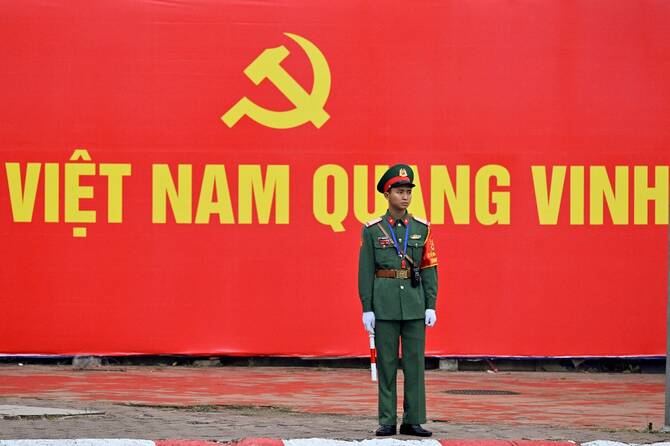

HANOI: Vietnam’s top leader promised to fight corruption in an address Tuesday to a twice-a-decade congress of the Communist Party, where he is seeking expanded powers similar to China’s political structure.
In just 17 months as general secretary, To Lam has swept aside rivals and centralized authority in an aggressive reform drive officials describe as a “revolution.”
He accelerated a sweeping anti-corruption campaign that ensnared thousands of officials, thinned and streamlined bureaucracy, and pushed infrastructure investment.
The party is “determined to fight corruption” as it spurs private-sector growth, he said, adding it would tackle “wastefulness and negativity.”
“All wrongdoings must be dealt with,” he told the meeting, standing before a giant statue of party founder Ho Chi Minh.
The Southeast Asian nation of 100 million people is both a repressive one-party state and a regional economic bright spot, where the Communist Party has sought to deliver rapid development to bolster its legitimacy.
In a series of closed-door meetings this week nearly 1,600 party delegates will finalize the country’s leadership roster for the next five years and set key policies.
Lam will remain the party’s top leader, according to sources briefed on key internal deliberations.
But he is seeking the presidency as well — a dual role similar to Xi Jinping in neighboring China.
Xi himself led an extensive anti-corruption drive, promising to target both “tigers and flies” — big and small alike — which analysts say was also used for political purposes, taking down internal opponents within his ruling party.
Experts say if Lam secures both roles it will signal the supremacy of his security-dominated faction.
If so, he will have “the strongest mandate for the Vietnamese leadership since the end of the Vietnam war,” said Nguyen Khac Giang of Singapore’s ISEAS-Yusof Ishak Institute.
Analysts say Lam’s reach will depend on who else secures top posts and politburo positions during the week-long conclave, particularly from the more conservative military faction that opposes him.
One source briefed on party deliberations told AFP that Lam’s bid for expanded powers had been provisionally approved.
But some reports suggested he had to shelve his presidential ambitions to secure support for his reform agenda.
- Collective leadership -
Elevated to party chief after general secretary Nguyen Phu Trong’s death in 2024, Lam has shocked the country with the pace of his changes.
He has eliminated whole layers of government, abolishing eight ministries or agencies and cutting nearly 150,000 jobs from the state payroll, while pushing ambitious rail and power projects.
The fight against corruption had appeared to slow — in part because of concerns it could hinder economic expansion, analysts say — but Lam’s speech suggests it is not finished.
“Science, technology, innovation and digital transformation must really become the key drivers of growth,” said Lam, who cited “fierce strategic competition” and supply chain disruptions as headwinds.
Vietnam has proved surprisingly resilient in the face of new 20 percent tariffs imposed by Donald Trump, clocking 8.0 percent growth last year, among the fastest in Asia.
But the balancing act between its main export market, the US, and China — its largest supplier — has grown tougher.
That underscores the need to become more than an assembly shop for garments and electronics bound for western shelves as it aims for upper-middle-income status by the end of the decade.
The ruling party tolerates little dissent and regularly jails critics, more than 160 of whom are behind bars, according to Human Rights Watch.
But unlike in present-day China or North Korea, political power in Vietnam has not been concentrated in one paramount leader.
Its collective system of government rests on four pillars: the party chief, president, prime minister and the chairman of the National Assembly. An internal Communist Party position was added as a fifth pillar last year.
If he gets the presidency, Lam would be the first person to be named to the top two jobs simultaneously by a party congress, rather than stepping in following a holder’s death.
Regardless, former US ambassador to Vietnam Daniel Kritenbrink expects the party to reaffirm Lam’s “leading if not dominant role” and the “pretty striking policy vision that he’s outlined over the last year.”