

Panic-buying hits Malaysia after Indian curbs on rice exports

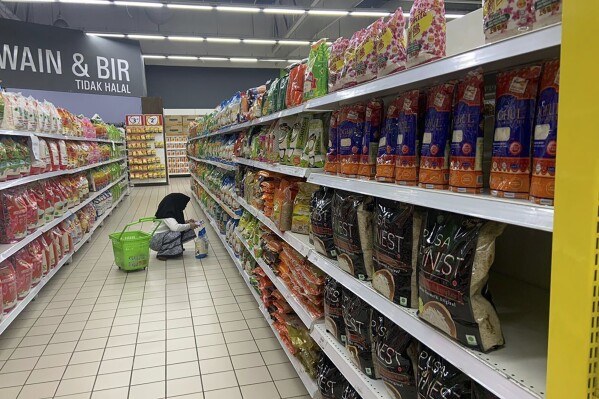
A customer looks at products along a row with imported rice in a supermarket in Kuala Lumpur, Malaysia on Oct. 3, 2023. (AP/File)
Short Url
Updated 04 October 2023
Follow

Panic-buying hits Malaysia after Indian curbs on rice exports

  • Price of imports rose by over 30 percent last month
  • Sellers say they are facing shortage in supply of local grain

KUALA LUMPUR: Malaysian shoppers are emptying rice shelves as panic-buying spreads across a country that is grappling with rising prices following India’s decision to ban exports of the food staple.
International rice supply has been squeezed after the world’s biggest rice exporter banned shipments of the grain in July. This has led to rising costs and concerns over supply shortages in Asia, which accounts for about 90 percent of global rice consumption.
The ban’s impacts are being felt particularly keenly in Malaysia, a country of more than 32 million people that imports about a third of its rice needs.
With the retail price of imported white rice estimated to have risen by more than 30 percent last month, retailers in Kuala Lumpur have cited a shortage of local rice supply. This followed people seeking out cheaper options and panic-buying in different parts of the country.
“We don’t have the stock for local rice, and it has been like that for quite some time,” Sin, a clerk at Usaha Jaya wholesaler in Kuala Lumpur, told Arab News on Wednesday.
Most consumers now have to opt for the more expensive imported rice due to a shortage of local grain, said Sin, whose shop mainly supplies smaller stores in the capital.
“Nowadays, most people are buying imported rice because there is no supply of local rice. The cost of rice has increased a lot,” he said.
Malaysia this week introduced a subsidy and other measures to lower rice prices amid the crisis, including a task force to inspect local supply chains. Prime Minister Anwar Ibrahim has even warned of legal action against anyone found hoarding rice.
The government maintains that enough rice is available, with Agriculture and Food Security Minister Mohamad Sabu reportedly saying on Monday that there was no shortage of rice in the country and urging people not to panic-buy.
But Khor Cheng Hai, who sells rice at Kindness Enterprise, said he has been unable to secure stock of locally produced rice.
“Before this, there was panic-buying among our customers. But now, not anymore … We sell imported rice here, we tried to order local rice, but (wholesalers) said there is no stock,” Khor told Arab News.
“It’s not just my shop, my customers went to (other shops) and they complained that there is no local rice too. The government always said in the media that there were enough stocks of local rice.
“But when we ordered (these), there was no local rice available. What can we do?”
Malaysia’s rice crisis highlights faults within an industry that has been “trending downward,” said Prof. Fatimah Mohamed Arshad, a senior fellow at the Institute for Democracy and Economic Affairs.
“As production declines, the dependency on imports increases together with imported inflation,” Arshad said in a statement.
“India’s export-ban shock plunged the country into ‘rice shortage and price crises’, which is avoidable if Malaysia had been able to ensure rice supply security through higher productivity and production and a more competitive industry.”
The government has said it wants to urge rice supplier nations in the Association of Southeast Asian Nations, such as Thailand and Vietnam, to prioritize exports of the grain to fellow member states.

ASEAN is a gateway for Kuala Lumpur to easily source rice from abroad, said Dr. Larry Wong, a senior visiting fellow at the Institute of Strategic & International Studies in Malaysia.
“A lot of this settlement is bilateral, Peninsular Malaysia is very connected to the ASEAN continent and rice can come through by sea, by rail and road. There shouldn’t be a problem,” Wong told Arab News.
“Malaysia is very lucky as we are a small, open economy but a big trading nation,” he said. “Don’t source from the same country, but source from different countries. Disruption like this will never stop.
“Disruption like this also cannot stay for long.”


Afghan returnees in Bamiyan struggle despite new homes

Updated 01 February 2026
Follow

Afghan returnees in Bamiyan struggle despite new homes

  • More than five million Afghans have returned home since September 2023, according to the International Organization for Migration

BAMIYAN, Afghanistan: Sitting in his modest home beneath snow-dusted hills in Afghanistan’s Bamiyan province, Nimatullah Rahesh expressed relief to have found somewhere to “live peacefully” after months of uncertainty.
Rahesh is one of millions of Afghans pushed out of Iran and Pakistan, but despite being given a brand new home in his native country, he and many of his recently returned compatriots are lacking even basic services.
“We no longer have the end-of-month stress about the rent,” he said after getting his house, which was financed by the UN refugee agency on land provided by the Taliban authorities.
Originally from a poor and mountainous district of Bamiyan, Rahesh worked for five years in construction in Iran, where his wife Marzia was a seamstress.
“The Iranians forced us to leave” in 2024 by “refusing to admit our son to school and asking us to pay an impossible sum to extend our documents,” he said.
More than five million Afghans have returned home since September 2023, according to the International Organization for Migration (IOM), as neighboring Iran and Pakistan stepped up deportations.
The Rahesh family is among 30 to be given a 50-square-meter (540-square-foot) home in Bamiyan, with each household in the nascent community participating in the construction and being paid by UNHCR for their work.
The families, most of whom had lived in Iran, own the building and the land.
“That was crucial for us, because property rights give these people security,” said the UNHCR’s Amaia Lezertua.
Waiting for water
Despite the homes lacking running water and being far from shops, schools or hospitals, new resident Arefa Ibrahimi said she was happy “because this house is mine, even if all the basic facilities aren’t there.”
Ibrahimi, whose four children huddled around the stove in her spartan living room, is one of 10 single mothers living in the new community.
The 45-year-old said she feared ending up on the street after her husband left her.
She showed AFP journalists her two just-finished rooms and an empty hallway with a counter intended to serve as a kitchen.
“But there’s no bathroom,” she said. These new houses have only basic outdoor toilets, too small to add even a simple shower.
Ajay Singh, the UNHCR project manager, said the home design came from the local authorities, and families could build a bathroom themselves.
There is currently no piped water nor wells in the area, which is dubbed “the dry slope” (Jar-e-Khushk).
Ten liters of drinking water bought when a tanker truck passes every three days costs more than in the capital Kabul, residents said.
Fazil Omar Rahmani, the provincial head of the Ministry of Refugees and Repatriation Affairs, said there were plans to expand the water supply network.
“But for now these families must secure their own supply,” he said.
Two hours on foot
The plots allocated by the government for the new neighborhood lie far from Bamiyan city, which is home to more than 70,000 people.
The city grabbed international attention in 2001, when the Sunni Pashtun Taliban authorities destroyed two large Buddha statues cherished by the predominantly Shia Hazara community in the region.
Since the Taliban government came back to power in 2021, around 7,000 Afghans have returned to Bamiyan according to Rahmani.
The new project provides housing for 174 of them. At its inauguration, resident Rahesh stood before his new neighbors and addressed their supporters.
“Thank you for the homes, we are grateful, but please don’t forget us for water, a school, clinics, the mobile network,” which is currently nonexistent, he said.
Rahmani, the ministry official, insisted there were plans to build schools and clinics.
“There is a direct order from our supreme leader,” Hibatullah Akhundzada, he said, without specifying when these projects will start.
In the meantime, to get to work at the market, Rahesh must walk for two hours along a rutted dirt road between barren mountains before he can catch a ride.
Only 11 percent of adults found full-time work after returning to Afghanistan, according to an IOM survey.
Ibrahimi, meanwhile, is contending with a four-kilometer (2.5-mile) walk to the nearest school when the winter break ends.
“I will have to wake my children very early, in the cold. I am worried,” she said.