Tunisia detains Abir Moussi, prominent opponent of president

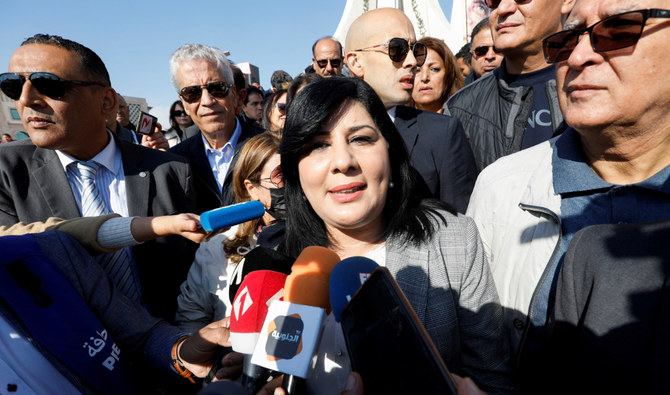
Abir Moussi speaks to the media during a protest demanding the dissolution of parliament and asking for early legislative elections, in Tunis, Tunisia November 20, 2021. (Reuters/File)
Short Url
Updated 04 October 2023
Follow

Tunisia detains Abir Moussi, prominent opponent of president

TUNIS: Tunisia’s public prosecutor detained Abir Moussi, a prominent opponent of President Kais Saied, after she was arrested at the entrance to the presidential palace on Tuesday, lawyers said, the latest arrest targeting Saied’s political rivals.

“Moussi was detained for 48 hours in charges of processing personal data, obstructing the right to work, and assault intended to cause chaos,” lawyer Aroussi Zgir said.

Authorities were not immediately available to comment.

Police this year have detained more than 20 leading political figures, accusing some of plotting against state security. Saied has described those detained as “terrorists, traitors and criminals.”

An assistant of Moussi said in a video on Facebook that Moussi was “kidnapped” in front of the Carthage Palace.

Moussi leads the Free Constitutional Party and is a supporter of late president Zine El Abidine ben Ali who was toppled by mass protests in 2011.

In recent months, the party has organized protests against Saied. Moussi accuses Saied of ruling outside the law, and said that she is ready to make personal sacrifices to save Tunisia.

In front of the La Goulette police station, dozens of angry Moussi supporters protested, shouting slogans against Saied amid a heavy police contingent who cordoned off the building.

Earlier on Tuesday, Moussi said in a video that she went to the presidential reception office to file an appeal in local elections expected at the end of the year. She said that this step was necessary so that she could later file an appeal in the Administrative Court.

Saied, a retired law professor who was elected president in 2019, shut down the elected parliament in 2021 and moved to rule by decree, actions his opponents described as a coup. Saied has said he needed to save Tunisia from years of chaos, denying his actions were a coup.

On Friday, jailed opposition leader Rached Ghannouchi, another critic of Saied, began a three-day hunger strike. Later five other prominent opposition figures also went on hunger strike in prison.


Lebanon PM says IMF wants rescue plan changes as crisis deepens

Updated 23 January 2026
Follow

Lebanon PM says IMF wants rescue plan changes as crisis deepens

  • “We want to engage with the IMF. We want to improve. This is a draft law,” Salam said
  • “They wanted the hierarchy of claims to be clearer. The talks are all positive”

DAVOS, Switzerland: The International Monetary Fund has demanded amendments to a draft rescue law aimed at hauling Lebanon out of its worst financial crisis on record and giving depositors access to savings frozen for six years, Prime Minister Nawaf Salam said.
The “financial gap” law is part of a series of reform measures required by the IMF in order to access its funding and aims to allocate the losses from Lebanon’s 2019 crash between the state, the central bank, commercial banks and depositors.
Salam told Reuters the IMF wants clearer provisions in the hierarchy of claims, which is a core element of the draft legislation designed to determine how losses are allocated.
“We want to engage with the IMF. We want to improve. This is a draft law,” Salam said in an interview at the World Economic Forum annual meeting in ⁠the Swiss mountain resort of Davos.
“They wanted the hierarchy of claims to be clearer. The talks are all positive,” Salam added.
In 2022, the government put losses from the financial crisis at about $70 billion, a figure that analysts and economists forecast is now likely to be higher.
Salam stressed that Lebanon is still pushing for a long-delayed IMF program, but warned the clock is ticking as the country has already been placed on a financial ‘grey list’ and risks falling onto the ‘blacklist’ if reforms stall further.
“We want an IMF program and we want to continue our discussions until we get there,” he said, adding: “International pressure is real ... The longer we delay, the more people’s money will evaporate.”
The draft law, which was passed by Salam’s government in December, is under parliamentary review. It aims to give depositors a guaranteed path to recovering their funds, restart bank lending, and end a financial crisis that has left nearly a million accounts frozen and confidence in the system shattered.
The roadmap would repay depositors up to $100,000 over four years, starting with smaller accounts, while launching forensic audits to determine losses and responsibility.
Lebanon’s Finance Minister Yassine Jaber, who is driving the reform push with Salam, told Reuters it was ⁠essential to salvage a hollowed-out banking system, and to stop the country from sliding deeper into its cash-only, paralyzed economy.
The aim, Jaber said, is to give depositors clarity after years of uncertainty and to end a system that has crippled Lebanon’s international standing.
He framed the law as part of a broader reckoning: the first time a Lebanese government has confronted a combined collapse of the banking sector, the central bank and the state treasury.
Financial reforms have been repeatedly derailed by political and private vested interests over the last six years and Jaber said the responsibility now lies with lawmakers.
Failure to act, he said, would leave Lebanon trapped in “a deep, dark tunnel” with no way back to a functioning system.
“Lebanon has become a cash economy, and the real question is whether we want to stay on the grey list, or sleepwalk into a blacklist,” Jaber added.