

US says will work to ensure it can ‘better assist’ Pakistan’s counter-terrorism efforts

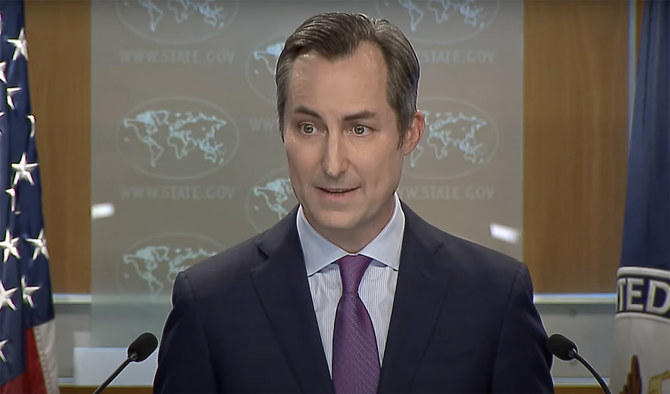
State Department spokesperson Matthew Miller during a press briefing at the Department of State, on October 2, 2023. (Photo courtesy: @StateDept/YouTube)
Short Url
Updated 03 October 2023
Follow

US says will work to ensure it can ‘better assist’ Pakistan’s counter-terrorism efforts

  • Suicide bombings ripped through two mosques last week, killing over 60 people
  • Surge in militant attacks in recent months has cast shadow on election preparations

ISLAMABAD: The US State Department said on Monday Washington would continue to ensure it “better assists” Pakistan’s effort to counter militant attacks, days after suicide attacks ripped through two mosques last week, killing over 60 people.

Pakistan’s security situation has deteriorated since late last year when the Pakistani Taliban called off a tenuous truce with the government and vowed to launch more attacks. Pakistan says the Pakistani Taliban, or TTP, have become emboldened since the Afghan Taliban seized power in Afghanistan in August 2021 as US and NATO troops were in the final stages of their pullout from the country after 20 years of war. Authorities say TTP insurgents, who are allied but separate from the Afghan Taliban, have found sanctuaries and have even been living openly in Afghanistan since the Taliban takeover.

The Afghan government says it does not permit its soil to be used by armed groups against other nations. 

When questioned about why the US did not assist Pakistan by targeting TTP and Daesh hideouts in Afghanistan, State Department spokesperson Matthew Miller said the US cooperated with Pakistan in a range of multilateral fora on issues including terrorist designations and global strategies to defeat terror groups. 

“Earlier this year we held a high-level counterterrorism dialogue to discuss the shared terrorist threats facing our two countries and to work on strategies to cooperate in areas such as border security, terrorist financing,” Miller told reporters. 

“And we will continue to work with Pakistan to ensure that we can better assist Pakistan’s effort to counter all forms of violent extremism.”

A surge in militant attacks in Pakistan’s western provinces has cast a shadow on election preparations and public campaigning in the run-up to January’s national vote, but until now the attacks had mostly targeted security forces.

The Pakistani Taliban, responsible for some of the bloodiest attacks in Pakistan since the group’s formation in 2007, denied responsibility for Friday’s two blasts. No other group has claimed responsibility either.


Pakistan nears $1.5 billion deal to supply weapons, jets to Sudan

Updated 9 sec ago
Follow

Pakistan nears $1.5 billion deal to supply weapons, jets to Sudan

  • Deal may include drones, air defense systems and Karakoram-8 aircraft, with possible JF-17 fighters
  • The sale is expected to bolster Sudan’s army in the ongoing civil war with the Rapid Support Forces

ISLAMABAD: Pakistan is in the final phases of striking a $1.5-billion deal to supply weapons and jets to Sudan, a former top air force official and three sources said, promising a major boost for Sudan’s army, battling the paramilitary Rapid Support Forces.

Their conflict has stoked the world’s worst humanitarian crisis for more than 2-1/2 years, drawing in myriad foreign interests, and threatening to fragment the strategic Red Sea country, a major gold producer.

The deal with Pakistan encompasses 10 Karakoram-8 light attack aircraft, more than 200 drones for scouting and kamikaze attacks, and advanced air defense systems, said two of the three sources with knowledge of the matter, who all sought anonymity.

It was a “done deal,” said Aamir Masood, a retired Pakistani air marshal who continues to be briefed on air force matters.

Besides the Karakoram-8 jets, it includes Super Mushshak training aircraft, and perhaps ‌some coveted JF-17 ‌fighters developed jointly with China and produced in Pakistan, he added, without giving figures ‌or ⁠a delivery ‌schedule.

Pakistan’s military and its defense ministry did not immediately respond to requests for comment.

A spokesman for Sudan’s army did not immediately respond to a message requesting comment.

Assistance from Pakistan, especially drones and jets, could help Sudan’s army regain the air supremacy it had toward the start of its war with the RSF, which has increasingly used drones to gain territory, eroding the army’s position.

PAKISTAN’S DEFENSE AMBITIONS

The deal is another feather in the cap for Pakistan’s growing defense sector, which has drawn growing interest and investment, particularly since its jets were deployed in a conflict with India last year.

Last month, Islamabad struck a weapons deal worth more than $4 billion with the Libyan National Army, officials said, for one of the South Asian nation’s largest arms sales, which includes JF-17 fighter jets and training aircraft.

Pakistan has also held talks with Bangladesh on a defense deal that could includes the Super Mushshak training jets and JF-17s, as ties improve ties with Dhaka.

The government sees Pakistan’s burgeoning industry as a catalyst to secure long-term economic stability.

Pakistan is now in a $7-billion IMF program, following a short-term ‌deal to avert a sovereign default in 2023. It won IMF support after Saudi Arabia and other Gulf allies provided financial and deposit rollovers.