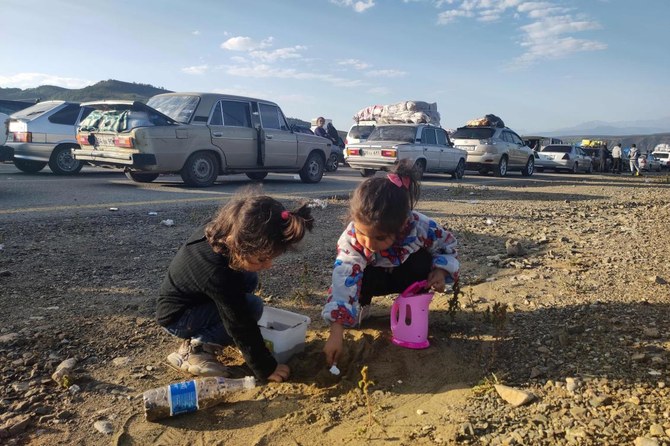
The last bus carrying ethnic Armenians from Nagorno-Karabakh left the region Monday, completing a grueling weeklong exodus of over 100,000 people – more than 80 percent of its residents – after Azerbaijan reclaimed the area in a lightning military operation.
The bus that entered Armenia carried 15 passengers with serious illnesses and mobility problems, said Gegham Stepanyan, Nagorno-Karabakh’s human rights ombudsman. He called for information about any other residents who want to leave but have had trouble doing so.
In a 24-hour military campaign that began on Sept. 19, the Azerbaijani army routed the region’s undermanned and outgunned Armenian forces, forcing them to capitulate. Separatist authorities then agreed to dissolve their government by the end of this year.
While Baku has pledged to respect the rights of ethnic Armenians in Nagorno-Karabakh, most of them hastily fled the region, fearing reprisals or losing the freedom to use their language and practice their religion and customs.
The Armenian government said Monday that 100,514 of the region’s estimated 120,000 residents have crossed into Armenia.
Armenian Health Minister Anahit Avanesyan said some people had died during the exhausting and slow journey over the single mountain road into Armenia that took as long as 40 hours. The exodus followed a nine-month Azerbaijani blockade of the region that left many suffering from malnutrition and lack of medicines.
Sergey Astsetryan, 40, one of the last Nagorno-Karabakh residents to leave the region in his own vehicle Sunday, said some elderly people have decided to stay, adding that others might return if they see it’s safe for ethnic Armenians to live under Azerbaijani rule.
“My father told me that he will return when he has the opportunity,” Astsetryan told reporters at a checkpoint on the Armenian border.
Azerbaijani authorities moved quickly to reaffirm control of the region, arresting several former members of its separatist government and encouraging ethnic Azerbaijani residents who fled the area amid a separatist war three decades ago to start moving back.
On Sunday, Azerbaijan prosecutors issued an arrest warrant for former Nagorno-Karabakh leader Arayik Harutyunyan, who led the region before stepping down at the beginning of September. Azerbaijani police arrested one of Harutyunyan’s former prime ministers, Ruben Vardanyan, on Wednesday as he tried to cross into Armenia.
“We put an end to the conflict,” Azerbaijani President Ilham Aliyev said in a speech Monday. “We protected our dignity, we restored justice and international law.”
He added that “our agenda is peace in the Caucasus, peace in the region, cooperation, shared benefits, and today, we demonstrate that.”
After six years of separatist fighting ended in 1994 following the collapse of the Soviet Union, Nagorno-Karabakh came under the control of ethnic Armenian forces, backed by Armenia. After a six-week war in 2020, Azerbaijan took back back parts of the region in the south Caucasus Mountains along with surrounding territory that Armenian forces had captured earlier.
Armenian authorities have accused Russian peacekeepers, who were deployed to Nagorno-Karabakh after the 2020 war, of standing idle and failing to stop the Azerbaijani onslaught. The accusations were rejected by Moscow, which argued that its troops didn’t have a mandate to intervene.
The mutual accusations have further strained the relations between Armenia and its longtime ally Russia, which has accused the Armenian government of a pro-Western tilt.
Armenian Prime Minister Nikol Pashinyan alleged Thursday that the exodus of ethnic Armenians from Nagorno-Karabakh amounted to “a direct act of ethnic cleansing and depriving people of their motherland.”
Azerbaijan’s Foreign Ministry strongly rejected Pashinyan’s accusations, arguing their departure was “their personal and individual decision and has nothing to do with forced relocation.”
A United Nations delegation arrived Sunday in Nagorno-Karabakh to monitor the situation. The mission is the organization’s first to the region for three decades, due to the “very complicated and delicate geopolitical situation” there, UN spokesperson Stephane Dujarric said Friday.
Local officials dismissed the visit as a formality. Hunan Tadevosyan, spokesperson for Nagorno-Karabakh’s emergency services, said the UN representatives had come too late and the number of civilians left in the regional capital of Stepanakert could be “counted on one hand.”
“We walked around the whole city but found no one. There is no general population left,” he said.


![]()

Armenian exodus from Nagorno-Karabakh ebbs as Azerbaijan moves to reaffirm control
Short Url
https://arab.news/2d429
Armenian exodus from Nagorno-Karabakh ebbs as Azerbaijan moves to reaffirm control
- The Armenian government said Monday that 100,514 of the region’s estimated 120,000 residents have crossed into Armenia


Latest updates


© 2026 SAUDI RESEARCH & PUBLISHING COMPANY, All Rights Reserved And subject to Terms of Use Agreement.