
ISLAMABAD: Caretaker Interior Minister Sarfraz Ahmed Bugti on Saturday vowed to pursue militant groups operating in Pakistan and eliminate their safe havens, as he accused India’s premier spy agency, Research and Analysis Wing (RAW), of orchestrating recent suicide bombings in Balochistan and Khyber Pakhtunkhwa provinces which claimed 65 lives.
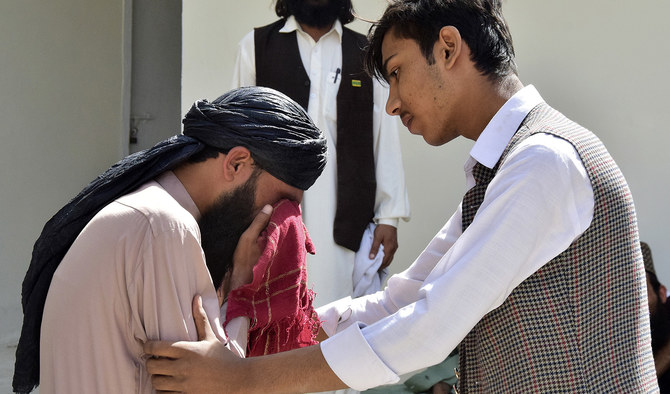
Bugti’s statement came just a day after a suicide explosion took place near a gathering to mark the birth anniversary of Prophet Muhammad (PBUH) in Balochistan's Mastung area, killing at least 60 people.

People gather at the site of a suicide bomb attack that targeted a procession marking Prophet Muhammad's (PBUH) birthday in Mastung district on September 29, 2023. (AFP)
In another attack that took place later in the day, militants targeted a mosque at a police station in Khyber Pakhtunkhwa’s Hangu district to kill five more people.
No group claimed responsibility for the attacks, though the proscribed Tehreek-e-Taliban Pakistan (TTP) network distanced itself from the Friday attacks and denied involvement by issuing a public statement.
“Whether it is Daesh or TTP or anyone else, anyone committing violence under any banner, violence will only be exercised by the state,” the minister told a news conference in Quetta after attending a security meeting.
“All major incidents that occurred in Balochistan were not without RAW’s involvement along with the forces that seek to destabilize Pakistan,” he continued.
Bugti did not provide any evidence of Indian involvement in the recent attacks in Pakistan, though officials in Islamabad have always suspected New Delhi of orchestrating such incidents in the country.
“We will go after the terrorists and eliminate all their dens ... We know who is handling all these terrorists,” he said. “We have decidedly that there will be zero tolerance for these terrorists.”

People being treated in a hospital after getting wounded in an explosion during procession in Mastung town of Pakistan's Balochistan province on Sept. 29, 2023. (Photo courtesy: Edhi Foundation)
Pakistan has witnessed a surge in the militant attacks in the two western provinces located near Afghanistan following the 2021 Taliban return to power in Kabul.
According to the statistics compiled by the Pakistan Institute for Conflict and Security Studies, the first half of the ongoing year saw about 80 percent increase in attacks compared to the corresponding period in 2022.
Security analysts said the country lacked a coherent policy to eradicate the menace of militancy and deal with armed groups like TTP and Daesh.
“The state is facing a difficult situation in dealing with these terrorist outfits, but this is all due to a lack of a coherent and well-defined policy of how to go after them,” Zahid Hussain, a security analyst, told Arab News.
He urged the government to formulate a “holistic policy” to deal with the problem, adding it would otherwise continue to destabilize Pakistan.
“When we see a lull in the terrorist activities, they reorganize themselves and start targeting civilians and security forces again,” he continued.
Ismail Khan, a senior journalist and expert on militancy, said the ongoing struggle against militants was complex since they were operating from their hideouts to target people.
“They are operating from the shadows and it becomes difficult for the security forces to locate and eliminate them all in one go,” he explained, urging the authorities to reinforce intelligence-based operations to eliminate them.
Asked about TTP’s denial of involvement in the attacks, he said that only a thorough investigation into Friday’s bombings would unveil the forces behind the deadly strikes.
“The TTP sometimes deny their involvement in a terrorist attack as part of their strategy to avoid public rebuke,” he added.