


Shutdown looms as US Senate, House advance separate spending plans

1 / 2
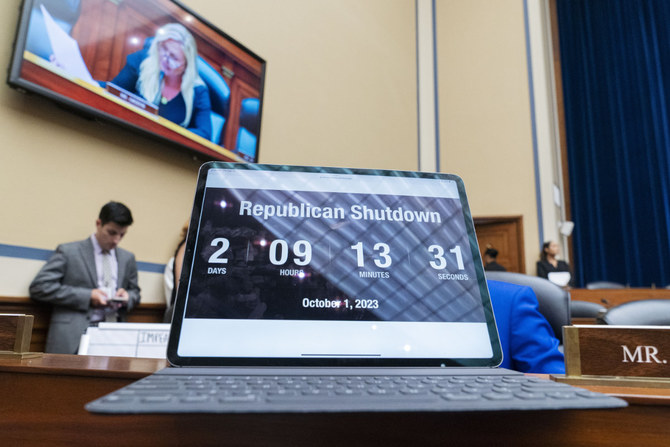
A countdown clock about the time left before a government shutdown is seen in the foreground as Rep. Marjorie Taylor Greene is seen on a screen during a House Oversight Committee impeachment inquiry into President Joe Biden on Sept. 28, 2023, in Washington. (AP)
2 / 2
Rep. Marjorie Taylor Greene stages a protest on the steps of the US Capitol building as the deadline to avert a government shutdown approaches in Washington on September 26, 2023. (Reuters)
Short Url
Updated 29 September 2023
Follow

Shutdown looms as US Senate, House advance separate spending plans

  • House Republicans are demanding a $120 billion cuts in an earlier agreed $1.59 trillion in discretionary spending in fiscal 2024
  • They also want tougher legislation that would stop the flow of immigrants at the US southern border with Mexico

WASHINGTON: The Democratic-led US Senate forged ahead on Thursday with a bipartisan stopgap funding bill aimed at averting a fourth partial government shutdown in a decade, while the House began voting on partisan Republican spending bills with no chance of becoming law.

The divergent paths of the two chambers appeared to increase the odds that federal agencies will run out of money on Sunday, furloughing hundreds of thousands of federal workers and halting a wide range of services from economic data releases to nutrition benefits.
The House of Representatives voted 216-212 on a bill funding the State Department and other aspects of foreign affairs, the first in a series of four partisan appropriations bills that would not alone prevent a shutdown, even if they could overcome strong opposition from Senate Democrats and become law.
The Senate earlier in the day had voted 76-22 to open debate on a stopgap bill known as a continuing resolution, or CR, which would extend federal spending until Nov. 17, and authorize roughly $6 billion each for domestic disaster response funding and aid to Ukraine to defend itself against Russia.
The Senate measure has already been rejected by Republicans, who control the House.
House Republicans, led by a small faction of hard-line conservatives in the chamber they control by a 221-212 margin, have rejected spending levels for fiscal year 2024 set in a deal Speaker Kevin McCarthy negotiated with Biden in May.
The agreement included $1.59 trillion in discretionary spending in fiscal 2024. House Republicans are demanding another $120 billion in cuts, plus tougher legislation that would stop the flow of immigrants at the US southern border with Mexico.
The funding fight focuses on a relatively small slice of the $6.4 trillion US budget for this fiscal year. Lawmakers are not considering cuts to popular benefit programs such as Social Security and Medicare.
McCarthy is facing intense pressure from his caucus to achieve their goals. Several hard-liners have threatened to oust him from his leadership role if he passes a spending bill that requires any Democratic votes to pass.
Former President Donald Trump has taken to social media to push his congressional allies toward a shutdown.
McCarthy, for his part, suggested on Thursday that a shutdown could be avoided if Senate Democrats agreed to address border issues in their stopgap measure.
“I talked this morning to some Democratic senators over there that are more aligned with what we want to do. They want to do something about the border,” McCarthy told reporters in the US Capitol.
“We’re trying to work to see, could we put some border provisions in that current Senate bill that would actually make things a lot better,” he said.
The House Freedom Caucus, home to the hard-liners forcing McCarthy’s hand, in an open letter to him on Thursday demanded a timeline for passing the seven remaining appropriations bills and a plan to further reduce the top-line discretionary spending figure, among other questions.

The Senate measure has passed two procedural hurdles this week with strong bipartisan support.
“Congress has only one option — one option — to avoid a shutdown: bipartisanship,” Senate Majority Leader Chuck Schumer said on Thursday. “With bipartisanship, we can responsibly fund the government and avoid the sharp and unnecessary pain for the American people and the economy that a shutdown will bring.”
Credit agencies have warned that brinkmanship and political polarization are harming the US financial outlook. Moody’s, the last major ratings agency to rate the US government “Aaa” with a stable outlook, said on Monday that a shutdown would harm the country’s credit rating.
Fitch, another major ratings agency, already downgraded the US government to “AA+” after Congress flirted with defaulting on the nation’s debt earlier this year.


Epstein scandal deals new blow to Norway crown princess

Updated 6 sec ago
Follow

Epstein scandal deals new blow to Norway crown princess

  • Her name appears at least 1,000 times in the millions of new Epstein documents
  • Mette-Marit had ceased contact with late US sex offender in 2014

OSLO: Norway’s crown princess, whose son goes on trial Tuesday on rape charges, found herself embroiled in another scandal this weekend after newly unsealed files revealed her unexpected friendship with late US sex offender Jeffrey Epstein.
The latest scandal has even raised questions about whether Mette-Marit, a commoner who married Crown Prince Haakon in 2001, could still become queen one day.
Her name appears at least 1,000 times in the millions of new Epstein documents released by the US Department of Justice on Friday, according to Norwegian daily VG.
Messages between the two published in Norwegian media date from 2011 to 2014.
In one email, Mette-Marit asked Epstein if it was “inappropriate for a mother to suggest two naked women carrying a surfboard for my 15 yr old son’s wallpaper.”
In another, she told him he was “very charming.”
When Epstein told her he was in Paris “on (a) wife hunt” in 2012, she replied saying the French capital is “good for adultery” and “Scandis (are) better wife material.”
Epstein had at that point already pleaded guilty in 2008 to soliciting a minor for prostitution.
The files show she also stayed at his house in Florida for four days in 2013.
On Saturday, Mette-Marit addressed her “embarrassing” friendship with the disgraced financier, who died in 2019 by suicide in jail as he awaited trial for sex crimes against minors.
“I showed poor judgment and I deeply regret having had any contact with Epstein. It is simply embarrassing,” she said in a statement sent to AFP by the royal palace.
The 52-year-old said she was responsible “for not having checked Epstein’s background more closely and not understanding quickly enough what kind of person he was.”
Yet in 2011, Mette-Marit wrote to Epstein that she had “googled” him, adding “it didn’t look too good” and ending the sentence with a smiling emoji.
She did not specify exactly what she was referring to.
According to the palace, Mette-Marit had ceased contact with Epstein in 2014 because she felt he was “trying to use his relationship with the crown princess as leverage with other people.”
- Terrible timing -
“It almost gives the impression that they were close friends,” historian and royal expert Ole-Jorgen Schulsrud-Hansen said.
He noted however the broader context of the messages was unknown.
“A crown princess is never a private person,” he noted.
“This shows in any case a lack of judgment and that all the ‘safety catches’ around her also failed.”
On Sunday, Norwegian Prime Minister Jonas Gahr Store said he “agreed” that Mette-Marit had made an error in judgment.
“Can Mette-Marit become queen after this?” Kjetil Alstadheim, chief political editor of Norway’s paper of reference Aftenposten, asked in an op-ed piece, leaving the question unanswered.
The timing could not be worse for Mette-Marit.
On Tuesday, her 29-year-old son Marius Borg Hoiby, born from a relationship before her marriage to Crown Prince Haakon, goes on trial at Oslo’s district court.
He is accused of allegedly committing 38 crimes, including the rape of four women as well as assault and drug offenses. He could face up to 16 years in jail if found guilty.
Hoiby denies the most serious charges.
The royal couple will not attend the seven-week trial, and Crown Prince Haakon told reporters that Mette-Marit would be away on a private trip during that period.
These woes come on top of her own health issues.
She suffers from an incurable lung illness, a rare form of pulmonary fibrosis that makes it difficult for her to breathe.
In December, the palace announced that she would likely have to undergo a lung transplant, a risky operation generally considered a last resort.
“She is someone who is under much pressure. But that should not stop any criticism, if it is factual,” said Schulsrud-Hansen.