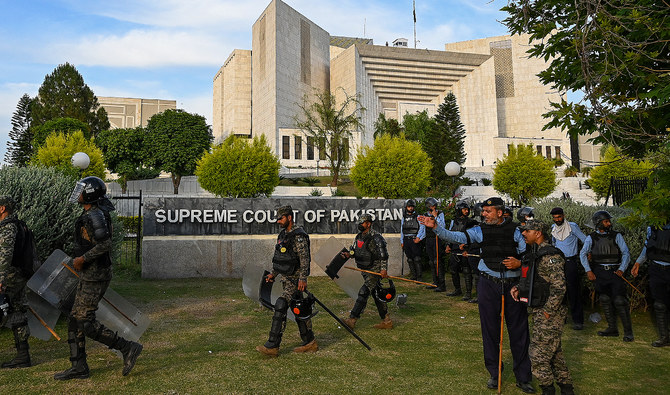
ISLAMABAD: Pakistan Chief Justice Qazi Faez Isa on Thursday sought explanations from multiple litigants who are seeking to withdraw review petitions filed against a 2019 Supreme Court judgment that questioned the role of state agencies in failing to counter the threat of extremist groups and urged the all-powerful army to stay out of politics.
In the landmark 2019 verdict, the court had warned the military and intelligence agencies they must not exceed their constitutional mandate and meddle in politics in a rebuke over their handling of the so-called “Faizabad sit-in” in 2017 in which the hard-line religious political party, the Tehreek-e-Labbaik Pakistan (TLP), paralyzed the capital with protests over the issue of blasphemy.
The verdict was a rare public calling out of the powerful army, which has ruled for nearly half of Pakistan’s history and has in recent years been criticized for resuming a more active role in politics. The military denies it interferes in political affairs.
After the verdict, pleas were filed against it by the Ministry of Defense, the Intelligence Bureau, the Pakistan Tehreek-e-Insaf party, the Pakistan Electronic Media Regulatory Authority, the Election Commission of Pakistan (ECP), the Muttahida Qaumi Movement (MQM) party and others.
“Why is everyone so afraid to speak the truth,” the chief justice remarked after multiple petitioners, including the federal government, PTI and PEMRA, informed the court they were withdrawing their pleas.
The CJ is part of a three-member bench that resumed hearing the petitions after four years and ordered all the parties seeking to withdraw their petitions to submit their explanations for doing so in writing by October 27. The hearing was adjourned till November 1.
“OPEN ANOTHER CAN OF WORMS”
“They all [petitioners] filed review petitions in the Supreme Court hoping to get the adverse observations in the verdict set aside by a larger bench, but the matter was not heard for four years,” advocate Col. (retired) Inamur Rahim told Arab News, explaining why the petitioners were now withdrawing their appeals.
“Now they all, including the federal government, are withdrawing their petitions because they know they will have to point out flaws in the judgment as mentioned in their petitions, and will have to justify the military personnel’s involvement in the sit-in,” Rahim said.
“The court proceedings would open another can of worms, especially for the army and intelligence agencies, therefore they are withdrawing their petitions, saying they don’t want to point out any flaws in the judgment.”
The lawyer said the court was now expected to give a final judgment in the case directing the federal government to implement it:
“The army may want to close the case once and for all now, saying since all those officers pointed out in the judgment have retired from service, therefore this matter is closed … This seems to be a win-win for both the Supreme Court and the army.”
The 2019 judgment came after a Supreme Court inquiry that looked at the role of security agencies in the Faizabad sit-in, including ending the standoff through mediation.
Seven people were killed and nearly 200 wounded when police initially tried but failed to remove protesters.
The military is widely seen to have disagreed with civilian authorities over how to handle the protests. The unrest had weakened the then previous Pakistan Muslim League-Nawaz (PML-N) government, which had fallen out with the armed forces.
“UNLAWFUL ACTIVITIES”
The army’s role came under criticism after video footage shared on social media showed a senior officer from the military-run Inter-Services Intelligence (ISI) spy agency distributing cash to protesters after a deal was struck to end the blockade.
“The involvement of ISI and of the members of the Armed Forces in politics, media and other ‘unlawful activities’ should have stopped,” Supreme Court Justices Mushir Alam and Qazi Faez Isa, who was not yet chief justice, said in their verdict.
“Instead, when (protest) participants received cash handouts from men in uniform, the perception of their involvement gained traction.”
The Supreme Court also criticized the military’s influential media wing, the Inter-Services Public Relations (ISPR), for commenting on political matters such as the contested 2018 election, where the military was accused of helping Prime Minister Imran Khan into power.
“The Constitution emphatically prohibits members of the Armed Forces from engaging in any kind of political activity, which includes supporting a political party, faction or individual,” the justices said.
“All intelligence agencies ... and the ISPR must not exceed their respective mandates.”
The 43-page judgment added:
“The constitution emphatically prohibits members of the armed forces from engaging in any kind of political activity, which includes supporting a political party, faction or individual … The Government of Pakistan through the Ministry of Defense and the respective Chiefs of the Army, the Navy and the Air Force are directed to initiate action against the personnel under their command who are found to have violated their oath.”
The judgment also directed all intelligence agencies not to exceed their respective mandates or limit free speech by putting pressure on media houses during such protests.
“They [the agencies] cannot curtail the freedom of speech and expression and do not have the authority to interfere with broadcasts and publications, in the management of broadcasters/publishers and in the distribution of newspapers.”


![]()

Court verdict rebuking Pakistan army’s ‘political activities’ in spotlight as chief justice hears appeals
Short Url
https://arab.news/nh8x6
Court verdict rebuking Pakistan army’s ‘political activities’ in spotlight as chief justice hears appeals
- 2019 judgment came after court investigated “Faizabad protest” in which Tehreek-e-Labbaik Pakistan paralyze the capital
- Inquiry also looked at the role of the army and security agencies in the sit-in, including ending the standoff through mediation
Latest updates


© 2026 SAUDI RESEARCH & PUBLISHING COMPANY, All Rights Reserved And subject to Terms of Use Agreement.