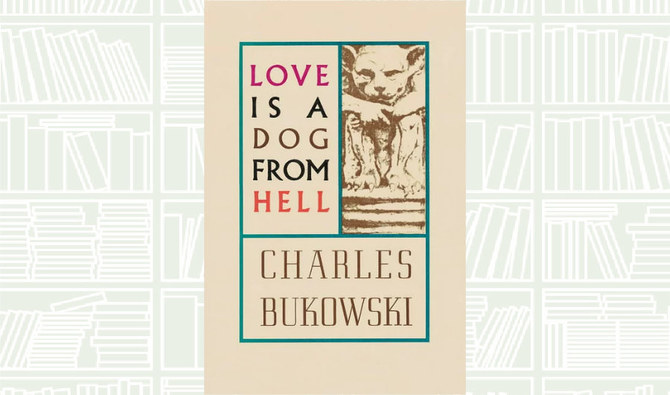
What We Are Reading Today: Love is a Dog From Hell by Charles Bukowski

Short Url
Updated 26 September 2023
Follow

What We Are Reading Today: Love is a Dog From Hell by Charles Bukowski

The poetry collection, “Love is a Dog From Hell” by Charles Bukowski, published in 1977, explores love, relationships, loneliness, and the dark side of human existence.

Bukowski examines the ups and downs of romantic relationships, often presenting a bleak and disillusioned perspective. He delves into topics such as heartbreak, longing, desire, and the pain that can arise from love.

The title reflects Bukowski’s view that love as a force can both uplift and destroy, much like a wild and unruly dog.

Bukowski reflects on his own experiences and observations of the human condition. He draws from personal encounters with the seedy underbelly of society, and moments of introspection, to craft his poetic narratives.

Two of his most captivating lines are: “There is a loneliness in this world so great that you can see it in the slow movement of the hands of a clock. People so tired mutilated either by love or no love.”

Bukowski was an American poet and writer known for his raw, gritty, brutally honest and cynical depictions of life.

He was born in Germany and moved to the US with his family when he was a child.

After completing high school, he attended Los Angeles City College for two years and took courses in art, journalism and literature.

Throughout his life, Bukowski continued to educate himself through extensive reading, exploring a wide range of literary works from both classic and contemporary authors.

He immersed himself in the works of writers including Fyodor Dostoevsky, Ernest Hemingway, John Fante and Louis-Ferdinand Celine.

As reflected in his works, Bukowski had a difficult childhood and adolescence, marked by poverty, abuse and alienation.


‘Maghras’ carries Al-Ahsa’s experimental farm from oasis to page

Updated 19 February 2026
Follow

‘Maghras’ carries Al-Ahsa’s experimental farm from oasis to page

AL-AHSA: Beneath a full moon and swaying palm trees, “Maghras: A Farm for Experimentation” was launched this month in Al-Ahsa, drawing a full crowd to Al-Sbakh Farm — the very landscape that inspired it.

Al-Ahsa, in Saudi Arabia’s Eastern Province, is home to 2.5 million date palms and is officially the largest palm oasis in the world, according to the Guinness Book of Records.

That agricultural abundance forms the foundation of Maghras, a project founded in 2024 by longtime friends Lulu Almana and Sara Al-Omran, who both grew up in the Eastern Province. Conceived as a space for experimentation, research and dialogue, Maghras centers on Al-Ahsa’s agricultural and cultural heritage.

The farm that hosts the project, Al-Sbakh, was established by the late Noura Al-Mousa, who worked alongside farmers and craftspeople for decades. Today, it is managed by her son’s Abdulmohsen Al-Rashed Humanitarian Foundation, alongside Dar Noura Al-Mousa for Culture and Arts, housed in her former home.

Earlier this year, Maghras traveled beyond the oasis. Curated by Almana and Al-Omran with US-based creative director Alejandro Stein, the project was presented at the Triennale di Milano from May 13 to Nov. 9, 2025 — marking the Kingdom’s inaugural participation. Commissioned by the Architecture and Design Commission under the Ministry of Culture, the pavilion took the form of a transplanted maghras, a traditional land unit defined by four palm trees.

The newly launched book, edited by Almana and Al-Omran alongside longtime collaborator Latifa Al-Khayat, extends that journey. Divided into five chapters — Water, Land, Infrastructure, Proximities and Lineages — it weaves imagery and text to document the farm’s evolving agro-ecosystems and seasonal harvest.

Featuring illustrations by Nada Al-Mulla and maps by Hayes Buchanan, and printed by Grafiche Mariano, Italy, and published by Kaph Books, the bilingual volume can be read in English or Arabic with identical wording.

Prince Nawaf bin Ayyaf, CEO of the Architecture and Design Commission, delivered opening remarks at the launch and is featured throughout the publication and the project’s journey.

The book is not a catalogue of the Milan activation. Instead, it captures the spirit of the experimental farm, including commissioned works by Leen Ajlan, Sawtasura (Tara Al-Dughaither), and Mohammad Al-Faraj. Developed through research and workshops circling the central maghras, the publication brings together insights, origin stories and first-person essays.

With attendees crossing from neighboring Bahrain and generations of Hasawi elders and emerging voices gathered under the palms, the launch underscored Maghras’s central premise: rooted in Al-Ahsa, yet reaching far beyond it.