

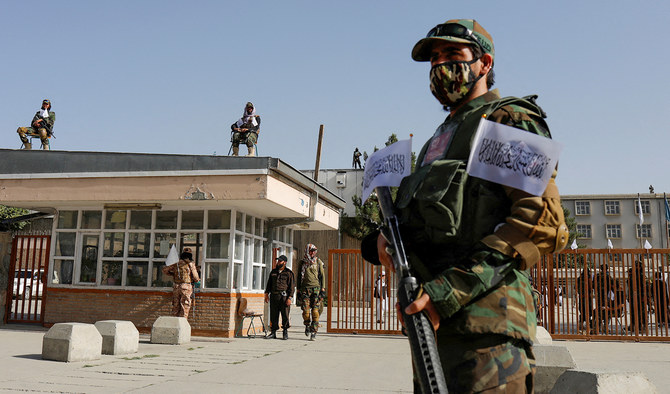

KABUL: The Taliban are creating a large-scale camera surveillance network for Afghan cities that could involve repurposing a plan crafted by the Americans before their 2021 pullout, an interior ministry spokesman told Reuters, as authorities seek to supplement thousands of cameras already across the capital, Kabul.
The Taliban administration — which has publicly said it is focused on restoring security and clamping down on Daesh, which has claimed many major attacks in Afghan cities — has also consulted with Chinese telecoms equipment maker Huawei about potential cooperation, the spokesman said.
Preventing attacks by international militant groups — including prominent organizations such as Daesh — is at the heart of the interaction between the Taliban and many foreign nations, including the US and China, according to readouts from those meetings. But some analysts question the cash-strapped regime’s ability to fund the program, and rights groups have expressed concern that any resources will be used to crackdown on protesters.
Details of how the Taliban intend to expand and manage mass surveillance, including obtaining the US plan, have not been previously reported.
The mass camera rollout, which will involve a focus on “important points” in Kabul and elsewhere, is part of a new security strategy that will take four years to be fully implemented, Ministry of Interior spokesman Abdul Mateen Qani told Reuters.
“At the present we are working on a Kabul security map, which is (being completed) by security experts and (is taking) lots of time,” he said. “We already have two maps, one which was made by USA for the previous government and second by Turkiye.”
He did not detail when the Turkish plan was made.
A US State Department spokesperson said Washington was not “partnering” with the Taliban and has “made clear to the Taliban that it is their responsibility to ensure that they give no safe haven to terrorists.”
A Turkish government spokesperson didn’t return a request for comment.
Qani said the Taliban had a “simple chat” about the potential network with Huawei in August, but no contracts or firm plans had been reached.
Bloomberg News reported in August that Huawei had reached “verbal agreement” with the Taliban about a contract to install a surveillance system, citing a person familiar with the discussions.
Huawei told Reuters in September that “no plan was discussed” during the meeting.
A Chinese Foreign Ministry spokeswoman said she was not aware of specific discussions but added: “China has always supported the peace and reconstruction process in Afghanistan and supported Chinese enterprises to carry out relevant practical cooperation.”
ELECTRICITY CUTS, RIGHTS CONCERNS
There are over 62,000 cameras in Kabul and other cities that are monitored from a central control room, according to the Taliban. The last major update to Kabul’s camera system occurred in 2008, according to the former government, which relied heavily on Western-led international forces for security.
When NATO-led international forces were gradually withdrawing in January 2021, then-vice president Amrullah Saleh said his government would roll out a huge upgrade of Kabul’s camera surveillance system. He told reporters the $100 million plan was backed by the NATO coalition.
“The arrangement we had planned in early 2021 was different,” Saleh told Reuters in September, adding that the “infrastructure” for the 2021 plan had been destroyed.
It was not clear if the plan Saleh referenced was similar to the ones that the Taliban say they have obtained, nor if the administration would modify them.
Jonathan Schroden, an expert on Afghanistan with the Center for Naval Analyzes, said a surveillance system would be “useful for the Taliban as it seeks to prevent groups like the Islamic State ... from attacking Taliban members or government positions in Kabul.”
The Taliban already closely monitor urban centers with security force vehicles and regular checkpoints.
Rights advocates and opponents of the regime are concerned enhanced surveillance might target civil society members and protesters.
Though the Taliban rarely confirm arrests, the Committee to Protect Journalists says at least 64 journalists have been detained since the takeover. Protests against restrictions on women in Kabul have been broken up forcefully by security forces, according to protesters, videos and Reuters witnesses.
Implementing a mass surveillance system “under the guise of ‘national security’ sets a template for the Taliban to continue its draconian policies that violate fundamental rights,” said Matt Mahmoudi from Amnesty International.
The Taliban strongly denies that an upgraded surveillance system would breach the rights of Afghans. Qani said the system was comparable with what other major cities utilize and that it would be operated in line with Islamic Sharia law, which prevents recording in private spaces.
The plan faces practical challenges, security analysts say.
Intermittent daily power cuts in Afghanistan mean cameras connected to the central grid are unlikely to provide consistent feeds. Only 40 percent of Afghans have access to electricity, according to the state-owned power provider.
The Taliban also have to find funding after a massive economic contraction and the withdrawal of much aid following their takeover.
The administration said in 2022 that it has an annual budget of over $2 billion, of which defense spending is the largest component, according to the Taliban army chief.
MILITANCY RISKS
The discussion with Huawei occurred several months after China met with Pakistan and the Taliban’s acting foreign minister, after which the parties stressed cooperation on counter-terrorism. Tackling militancy is also a key aspect of the 2020 troop-withdrawal deal the United States struck with the Taliban.
China has publicly declared its concern over the East Turkestan Islamic Movement (ETIM), an armed separatist organization in its western Xinjiang region. Security officials and UN reports say ETIM likely has a small number of fighters in Afghanistan. ETIM couldn’t be reached for comment.
Daesh has also threatened foreigners in Afghanistan. Its fighters attacked a hotel popular with Chinese businesspeople last year, which left several Chinese citizens wounded. A Russian diplomat was also killed in one of its attacks.
The Taliban denies that militancy threatens their rule and say Afghan soil will not be used to launch attacks elsewhere. They have publicly announced raids on Daesh cells in Kabul.
“Since early 2023, Taliban raids in Afghanistan have removed at least eight key (Islamic State in Afghanistan) leaders, some responsible for external plotting,” said US Special Representative for Afghanistan Thomas West at a Sept. 12 public seminar.
A July UN monitoring report said there were up to 6,000 Daesh fighters and their family members in Afghanistan. Analysts say urban surveillance will not fully address their presence.
The Afghan “home base” locations of Daesh fighters are in the eastern mountainous areas, said Schroden. “So, while cameras in the cities may help prevent attacks ... they’re unlikely to contribute much to their ultimate defeat.”


