

Pakistan’s commerce minister to invite top 100 global brands in bid to boost exports

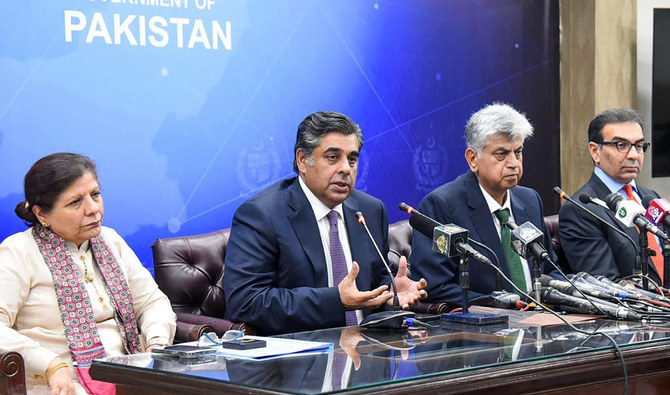
In this file photo, taken on September 8, 2023, Pakistan’s interim commerce minister Dr. Gohar Ejaz (2nd left) speaks during a joint press conference along with other members of the caretaker cabinet in Islamabad. (APP)
Short Url
Updated 23 September 2023
Follow

Pakistan’s commerce minister to invite top 100 global brands in bid to boost exports

  • Dr. Gohar Ejaz announces state-guest protocol and free office space for invited international brand representatives
  • Government may allow local industrialists to purchase electricity directly from producers at competitive regional rates

KARACHI: Pakistan’s interim commerce minister Dr. Gohar Ejaz announced his decision on Friday to invite 100 top global brands to attend a conference with the aim of increasing exports from the country to $100 billion within the next five years.

Addressing the Karachi Chamber of Commerce and Industry (KCCI), the minister did not divulge when he was planning to hold the conference. However, he assured everyone it would take place within the tenure of the caretaker government.

“We are going to hold the conference within 90 days and approach the top 100 brands and request them to come to Pakistan as our state guest,” he said.

Ejaz said the government would provide these companies space to set up their offices free of cost and declare the area an “export zone” with complete protocol. He noted the country had more remittance inflows than export revenue, which was only limited to about $27 billion.

The minister said the government’s decision to launch a crackdown against the smugglers of dollars had led to the appreciation of the Pakistani rupee.

“The rupee that was trading at around Rs350 has come down to Rs290,” he said, adding that the real effective rate should be Rs260 and, according to inflation figures, it should be somewhere around Rs200.

Ejaz said the government had also decided to act against gas thieves since that raised the production costs of many industries.

“UFG [Unaccounted for Gas] is much higher than the benchmark,” he added. “Therefore, the cabinet has granted approval in principle for action against gas thieves, and a grand operation against them will be conducted by next week.”

The minister said the government imposed some import restrictions in the past to reduce pressure on the external account, but it had proved counterproductive.

“By imposing restrictions, imports were curtailed but smuggling from Afghanistan and Iran surged by $5 billion,” he informed.

The minister said it was not possible to offer subsidies to local industries, though an alternative proposal to provide them cheaper electricity was under consideration that would allow industrialists in Sindh and Punjab provinces to purchase power directly from producers at regionally competitive rates.

Responding to a question about the closure of markets earlier than usual, he said the deadline for that had been extended. The government had asked stakeholders to submit proposals along with hourly sales trends to make an informed decision on the matter.

Saudi stock market opens its doors to foreign investors

Updated 06 January 2026
Follow

Saudi stock market opens its doors to foreign investors

RIYADH: Foreigners will be able to invest directly in Saudi Arabia’s stock market from Feb. 1, the Kingdom’s Capital Market Authority has announced.

The CMA’s board has approved a regulatory change which will mean the capital market, across all its segments, will be accessible to investors from around the world for direct participation.

According to a statement, the approved amendments aim to expand and diversify the base of those permitted to invest in the Main Market, thereby supporting investment inflows and enhancing market liquidity.

International investors' ownership in the capital market exceeded SR590 billion ($157.32 billion) by the end of the third quarter of 2025, while international investments in the main market reached approximately SR519 billion during the same period — an annual rise of 4 percent.

“The approved amendments eliminated the concept of the Qualified Foreign Investor in the Main Market, thereby allowing all categories of foreign investors to access the market without the need to meet qualification requirements,” said the CMA, adding: “It also eliminated the regulatory framework governing swap agreements, which were used as an option to enable non-resident foreign investors to obtain economic benefits only from listed securities, and the allowance of direct investment in shares listed on the Main Market.”

In July, the CMA approved measures to simplify the procedures for opening and operating investment accounts for certain categories of investors. These included natural foreign investors residing in one of the Gulf Cooperation Council countries, as well as those who had previously resided in the Kingdom or in any GCC country. 

This step represented an interim phase leading up to the decision announced today, with the aim of increasing confidence among participants in the Main Market and supporting the local economy.

Saudi Arabia, which ‌is more than halfway ‍through an economic plan ‍to reduce its dependence on oil, ‍has been trying to attract foreign investors, including by establishing exchange-traded funds with Asian partners in Japan and Hong Kong.