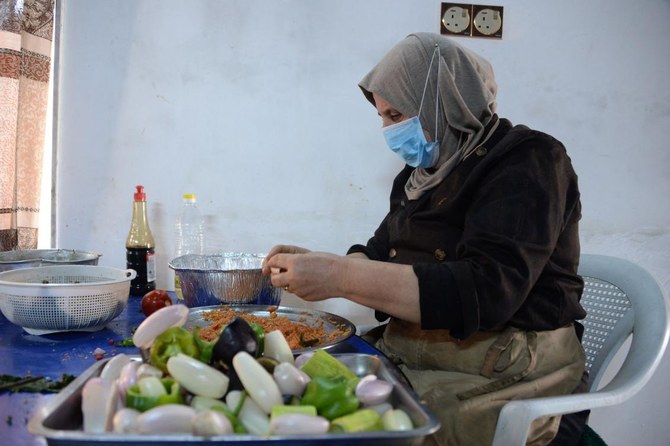
Mosul: Abir Jassem is busy preparing stuffed vegetables at a kitchen in Iraq’s Mosul, where after years of unrest a women-run catering service has helped single mothers like her achieve financial security.
The 37-year-old, who lost her husband while the city was under the control of the Islamic State (IS) group, said she had to get a job to put food on the table for her and her children.
“If I didn’t work, we wouldn’t have anything to eat,” said Jassem.
She is now one of some 30 employees of “Taste of Mosul,” which celebrates local delicacies and was founded in 2017 after the northern Iraqi metropolis was liberated from IS jihadists.
Most of the workers — cooks as well as two deliverywomen — are widowed or divorced.
Mosul residents are all reeling from the brutal IS rule and the war to defeat it, but for women in Iraq’s largely conservative and patriarchal society, the challenges are often compounded.
For Jassem, whose husband died of hepatitis, the catering business has offered a lifeline.
Her family had refused for her to work in any mixed-gender spaces, “but I wanted to work so I would not have to depend on anybody,” she said.
Now she earns 15,000 dinars ($11) a day cooking meals that are then delivered to clients.
Her speciality is Mosul-style kibbeh, a minced meat dish.
“Neither Syrians nor Lebanese can make” some of the recipes her Iraqi city is known for, Jassem boasted, as other women sat beside her at a large blue table were preparing the day’s menu.
One cook rolled vine leaves. Another copiously stuffed hollowed-out peppers with orange-colored rice, and a third made meat fritters.
Only slightly more than 10 percent of Iraq’s 13 million women of working age are in the job market, according to a July 2022 report issued by the International Labour Organization.
When the war in Mosul ended in the summer of 2017, the United Nations refugee agency UNHCR estimated the number of “war widows” in the thousands.
“Their husbands were often the families’ sole breadwinners,” the UN agency said.
“Without an income and often with children to support, Mosul’s war widows are among the most vulnerable to have been displaced during months of fighting for the once thriving city.”
Mahiya Youssef, 58, started “Taste of Mosul” to allow women to enter the labor market in the battered city.
“We have to be realistic,” she said. “If even people with university degrees are unemployed, I wondered what kind of work” would “let them cover their children’s needs and be strong women.”
Launched with just two cooks, the initiative has since grown and now also provides employment for young graduates, said Youssef, a married mother of five.
Appetisers and main dishes on the menu go for the equivalent of $1-10, and monthly profits top $3,000, according to Youssef, who plans to expand.
She said she hopes to open a restaurant or create similar projects in other parts of Iraq.
Youssef said her passion was “old recipes that restaurants don’t make,” like hindiya, a spicy zucchini stew with kibbeh, or ouroug, fried balls of flour, meat and vegetables.
One of her employees, Makarem Abdel Rahman, lost her husband in 2004 when he was kidnapped by Al-Qaeda militants.
The mother of two, now in her 50s, delivers food in her car, which she said has drawn some criticism.
“My children support me, but certain relatives are opposed” to her working, she said.
But Abdel Rahman hasn’t let that stop her, and said she has found in “Taste of Mosul” a “second home.”
Many clients order again, but some have become particularly loyal.
For more than two years, Taha Ghanem has ordered his lunch from “Taste of Mosul” two or three times a week.
“Because of our work, we are far from home,” said the 28-year-old cafe owner.
“Sometimes we miss our home cooking, but we have this service,” he said, hailing “the unique flavours” of Mosul’s cuisine.


In war-scarred Iraqi city, food business gives women independence
In war-scarred Iraqi city, food business gives women independence

- Only slightly more than 10 percent of Iraq’s 13 million women of working age are in the job market, according to a July 2022 report
- Most of the workers — cooks as well as two deliverywomen — are widowed or divorced

Lebanon PM says IMF wants rescue plan changes as crisis deepens
- “We want to engage with the IMF. We want to improve. This is a draft law,” Salam said
- “They wanted the hierarchy of claims to be clearer. The talks are all positive”
DAVOS, Switzerland: The International Monetary Fund has demanded amendments to a draft rescue law aimed at hauling Lebanon out of its worst financial crisis on record and giving depositors access to savings frozen for six years, Prime Minister Nawaf Salam said.
The “financial gap” law is part of a series of reform measures required by the IMF in order to access its funding and aims to allocate the losses from Lebanon’s 2019 crash between the state, the central bank, commercial banks and depositors.
Salam told Reuters the IMF wants clearer provisions in the hierarchy of claims, which is a core element of the draft legislation designed to determine how losses are allocated.
“We want to engage with the IMF. We want to improve. This is a draft law,” Salam said in an interview at the World Economic Forum annual meeting in the Swiss mountain resort of Davos.
“They wanted the hierarchy of claims to be clearer. The talks are all positive,” Salam added.
In 2022, the government put losses from the financial crisis at about $70 billion, a figure that analysts and economists forecast is now likely to be higher.
Salam stressed that Lebanon is still pushing for a long-delayed IMF program, but warned the clock is ticking as the country has already been placed on a financial ‘grey list’ and risks falling onto the ‘blacklist’ if reforms stall further.
“We want an IMF program and we want to continue our discussions until we get there,” he said, adding: “International pressure is real ... The longer we delay, the more people’s money will evaporate.”
The draft law, which was passed by Salam’s government in December, is under parliamentary review. It aims to give depositors a guaranteed path to recovering their funds, restart bank lending, and end a financial crisis that has left nearly a million accounts frozen and confidence in the system shattered.
The roadmap would repay depositors up to $100,000 over four years, starting with smaller accounts, while launching forensic audits to determine losses and responsibility.
Lebanon’s Finance Minister Yassine Jaber, who is driving the reform push with Salam, told Reuters it was essential to salvage a hollowed-out banking system, and to stop the country from sliding deeper into its cash-only, paralyzed economy.
The aim, Jaber said, is to give depositors clarity after years of uncertainty and to end a system that has crippled Lebanon’s international standing.
He framed the law as part of a broader reckoning: the first time a Lebanese government has confronted a combined collapse of the banking sector, the central bank and the state treasury.
Financial reforms have been repeatedly derailed by political and private vested interests over the last six years and Jaber said the responsibility now lies with lawmakers.
Failure to act, he said, would leave Lebanon trapped in “a deep, dark tunnel” with no way back to a functioning system.
“Lebanon has become a cash economy, and the real question is whether we want to stay on the grey list, or sleepwalk into a blacklist,” Jaber added.


