

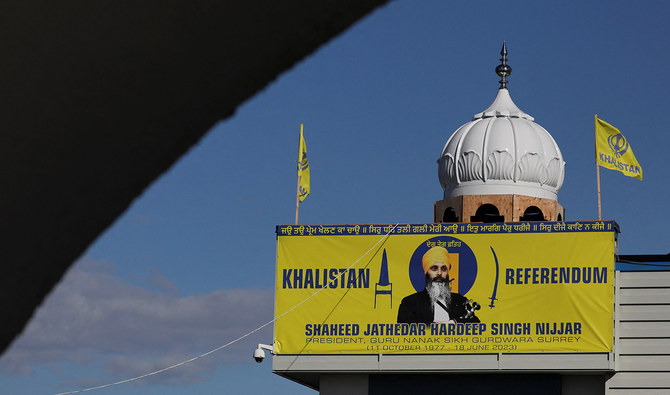

OTTAWA: Canada this week divulged it had intelligence possibly linking Indian government agents to the murder of a separatist Sikh leader, the kind of news that usually sparks uproar among democratic allies. Not this time.
India is being courted by the United States and others as a counterweight to China, and Prime Minister Justin Trudeau’s rare attack just days after New Delhi hosted a G20 Summit is putting Western nations in an awkward position.
“India is important in Western calculations for balancing China, and Canada is not,” said Stephanie Carvin, a professor of international relations at Ottawa’s Carleton University.
“This really does put Canada offside among all other Western countries,” she said.
Trudeau announced on Monday that Canada was “actively pursuing credible allegations” that Indian agents had potentially been involved in the murder of Canadian citizen Hardeep Singh Nijjar in June.
At that point Ottawa had already been discussing the matter with key allies such as the Five Eyes intelligence sharing alliance, which also includes the United States, Britain, Australia and New Zealand.
The results so far have been muted. Britain refused to publicly criticize India and said bilateral trade talks will continue as planned. Indeed, a statement from Foreign Secretary James Cleverly about the affair did not mention India by name.
Britain is in a difficult position, caught between supporting Canada and antagonizing India, a country it wants as a trading partner and ally to help confront China, said Chietigj Bajpaee, India expert at the Chatham House think tank in London.
“Short of there being any definitive evidence of India’s involvement, I think the UK response is likely to remain muted,” he said. A free trade deal would be a “major political win” for both India and Britain, Bajpaee said.
'WAITING GAME'
White House national security adviser John Kirby said the United States was “deeply concerned” and encouraged Indian officials to cooperate in any investigation. India rejects the idea it was involved in the murder.
The Washington Post reported Trudeau had pushed for a joint statement condemning India at last week’s Group of 20 summit in New Delhi and was turned down by the United States and others.
Kirby said “any reports that we rebuffed Canada in any way whatsoever are false, and we will continue to coordinate and consult with them on this.”
The muted response to Trudeau’s allegations is stark when compared to the uproar after Russian double agent Sergei Skripal and his daughter Yulia were poisoned by nerve agent in England in 2018. Britain, the United States, Canada and others threw out more than 100 Russian diplomats to punish Moscow for an attack it has always denied carrying out.
“Our Five Eyes partners are understandably reluctant to really wade into this, given everybody’s interest in advancing ties with India, in the context of the ongoing tension with China,” said Wesley Wark of the Center for International Governance Innovation think tank in Waterloo, Ontario.
“It’s a bit of a waiting game. If the Canadians come up with very solid evidence about egregious Indian state involvement in an assassination attempt, I think we’ll hear more from our allies in support,” he said.
With allies unwilling to contemplate any kind of joint condemnation of India, the Canadian options now look limited, at least until it can provide incontrovertible evidence.
“If we don’t get our allies to support this, either publicly or privately, Canada’s not going to be able to do a great deal to move India,” said Richard Fadden, former head of the Canadian Security Intelligence Service.
“And I think the greatest thing we can aspire to in the short term or the medium term is to get India not to do this again,” he told CTV.
Canadian government sources indicated they would have preferred to wait longer before making a statement but felt they had to act, given some domestic media outlets were about to break the story.
Trudeau would have never spoken “out loud if we didn’t have the information lining up into a fact base,” said one source, adding that they hoped more information would come soon.
Canada has not made public the intelligence it has because there is an active murder investigation, the senior source said.
“On the cusp of the global opportunity for India, they absolutely need to handle this responsibly — for their own interests,” the source said.


