

Riyadh looks to the future with ambitious Saudi bid to host Expo 2030

1 / 3
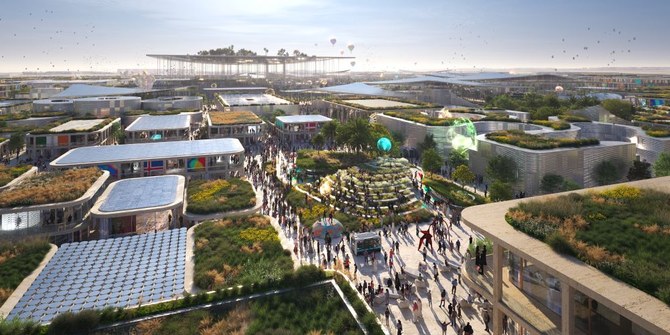
Riyadh Expo 2030. (RCRC)
2 / 3
Riyadh Expo 2030. (RCRC)
3 / 3
Riyadh Expo 2030. (RCRC)
Short Url
Updated 23 September 2023
Follow

Riyadh looks to the future with ambitious Saudi bid to host Expo 2030

  • Fate of bid, with the theme ‘The Era of Change: Together for a foresighted tomorrow,’ will be known in November
  • If bid is successful, site work will begin immediately, with spaces for participating nations available by 2028

RIYADH: Saudi authorities homed in on the notions of prosperity for all, climate action, and a different tomorrow as the main drivers of their ambitious bid to host Expo 2030 in Riyadh, the theme for which is “The Era of Change: Together for a Foresighted Tomorrow.”

“We in the Kingdom are working to achieve this vision in order to reach a prosperous and sustainable future,” Saudi Foreign Minister Prince Faisal bin Farhan said during the 172nd General Assembly of the Bureau International des Expositions in Paris in June.

“Riyadh’s bid to host the World Expo 2030 captures that vision, guided by the theme of together for a foresighted tomorrow.”

In keeping with the stated theme of the event, the Riyadh Expo website invites the world to “imagine a different future and what actions we take today to shape a prosperous and sustainable tomorrow.”

Riyadh is competing with Rome and Busan to host Expo 2030, with the winning bid due to be announced during the 173rd General Assembly of the BIE in November.

As part of the grand Saudi vision for the event, three pavilions will be created to showcase each of its main themes. Riyadh aims to “reinforce action on globally impactful projects and to collaborate on global solutions to shared challenges, through innovation, sustainability and inclusiveness,” Prince Faisal said.

As a part of its mission to host an “inclusive” expo that promotes prosperity for all, the minister said the Kingdom will provide a $343 million assistance program for 100 eligible countries to ensure the event features the most diverse range of nations and cultures at an expo to date. The financial assistance will used to fund construction and maintenance of nations’ pavilions, and the use of technology, among other things.

The Expo Riyadh proposal has a total budget of $7.8 billion, and if the bid is successful work on the site will begin immediately, with the spaces for participating nations available by 2028.

During her speech at the BIE gathering in June, Riyadh Expo Masterplan team member Lamia Al-Muhanna said the aim is to “enable the full, equal and meaningful participation of all countries” at the event, and that sustainability will a defining feature of the construction and legacy of the Expo site.

The Kingdom has also committed to helping the 100 qualifying nations create a second life for their pavilions when the expo ends, so that they can be used as schools, clinics or research centers in their home countries.

Nouf Al-Moneef, also a member of the Riyadh Expo Masterplan team, said that as a part of its focus on climate action, the Kingdom aims to ensure the event is the first carbon-negative expo. To achieve this, it will be powered by clean energy provided by solar power plants in the Kingdom. It will also promote biodiversity, work to eliminate food waste, and ensure the green management and recycling of waste.

“The principles of equality, inclusion and sustainability will also be enshrined in our landmark,” Al-Moneef said. “If the surface of the Earth was equally divided among all human beings, we would each be responsible for 238 square meters.”

If selected to host the expo, it is estimated that Riyadh will welcome about 40 million in-person visitors to the 6 million square meter site and about 1 billion through the metaverse. About 246 nations, international organizations and other entities are expected to participate. The chosen expo site is located in northern Riyadh, about a 10-minute drive from King Khalid International Airport, and is served by a Metro station.

The successful bid will be announced in November following a vote by BIE member countries.


Minzal brings Saudi traditions to life in Diriyah

Updated 07 January 2026
Follow

Minzal brings Saudi traditions to life in Diriyah

  • From leather crafts and archery to Saudi coffee, Minzal offers a lesson in ‘Sloum Al-Arab’

RIYADH: This season of Minzal places social norms and traditional etiquette at its center, with tents set up to teach what is locally known as “Sloum Al-Arab” alongside gatherings for coffee, dinner and stargazing around campfires.

“Sloum Al-Arab” refers to the unwritten customers and values that have shaped Arab and Bedouin society for centuries, including generosity, coffee preparation, courage and archery. 

In Saudi Arabia, these traditions are closely ties to cultural identity and religious belief. 

Leather products and the making of leather goods is one of the crafts featured at Minzal this year and is one of the oldest crafts still practiced in the kingdom.

“The most difficult thing I faced to work on was camel leather because it is a little tough,” Nada Samman, a leather trainer and craftsman at Minzal, told Arab News. 

Minzal continues to evolve with each season, offering activities that highlight Bedouin values, traditional skills and sports. (AN photo by Haifa Alshammari)

“The work on leather is wonderful whether it is goat leather, cow leather, Sawakni sheep, and of course, camel leather. At Minzal, we are offering multiple handicraft workshops, most specifically the leather handicrafts. We want visitors to spend time at something useful and fun."

Samman explained the workshops allowed participants to preserve heritage while engaging in meaning, hands on activities. 

Faisal Al-Khaled, a visual artist and craftsman specializing in Saudi designs at Minzal, shared a similar goal: “I want people to have, by the end of this experience, a unique and traditional art piece created by them, and that I know I helped them to preserve this craft.”

Minzal, which has been organized for several years now, continues to evolve with each season, offering activities that highlight Bedouin values, traditional skills and sports. Archery is a key feature, reflecting its deep roots in Arab and Islamic history.

Mohammed Al-Sharif, a certified archery player and coach with the Saudi Archery Federation since 2028, said the sport was closely connected to Saudi culture. It was encouraged by the Prophet Muhammad, which led people to learn and teach it through generations.

“Our traditional bow is considered one of the most important and widely used bows in Arab culture,” Al-Sharif said. “We have several styles, and professional archers specializing in traditional bow shooting … There are various types of archery, such as horseback archery and standing archery, where bow sizes vary according to specific needs, such as types used for hunting and others used during warfare.”

He explained that archery was historically part of daily life, used for protection and hunting. 

Saudi coffee also plays a significant role in the Minzal experience, with live demonstrations. One of the most frequently consumed beverages in the Kingdom, it is a symbol of hospitality and generosity.

Ahmed Al-Shuaibi explained how it was prepared at the Sloum tent, first by roasting the beans and then allowing them to cool. The beans are ground with spices in a Nigr.

“Coffee is passed from our grandparents,” he added. “In significant majlis, you see them offering our local coffee and not other types of coffee. We organized this corner so that young generations can visit and learn this.”