

EU foreign, security chief claimed some member states baffled by Tunisia migration pact

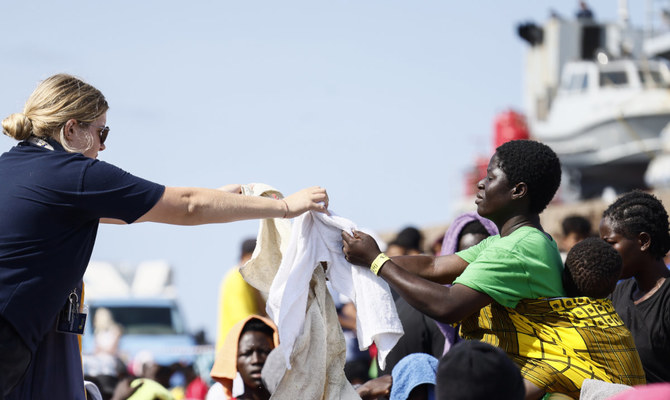
Migrants wait to be transferred from the Lampedusa Island to the mainland, on Sept. 15, 2023. The pact, signed in July with Tunisia by Von der Leyen, Italian Prime Minister Giorgia Meloni, and Dutch Prime Minister Mark Rutte was aimed at stemming migration to Europe from Tunisia. (AP)
Short Url
Updated 18 September 2023
Follow

EU foreign, security chief claimed some member states baffled by Tunisia migration pact

  • The North African country had become one of the most popular routes for people smugglers working in Africa after Libya became too dangerous

LONDON: EU member states were left confused when European Commission President Ursula von der Leyen hurried into a migration pact with Tunisia, The Guardian revealed on Monday.

In a letter dated Sept. 7, the High Representative of the EU for Foreign Affairs and Security Policy Josep Borrell noted that concerns about the pact were raised in July both verbally and in writing.

In a letter to Oliver Varhelyi, the European commissioner for neighboring countries, Borrell said: “As you know … in July, several member states expressed their incomprehension regarding the commission’s unilateral action on the conclusion of this (memorandum of understanding) and concerns about some of its contents.

“After the foreign affairs council meeting on July 20 some member states referred these concerns by written procedure to you,” he added.

The pact, signed in July with Tunisia by Von der Leyen, Italian Prime Minister Giorgia Meloni, and Dutch Prime Minister Mark Rutte was aimed at stemming migration to Europe from Tunisia.

The North African country had become one of the most popular routes for people smugglers working in Africa after Libya became too dangerous.

The letter also revealed that foreign affairs ministers had observed that the correct steps to adopt the procedure had not been followed by the commission, and therefore the MoU could not be “considered a valid template for future agreements.”

Why Borrell wrote the letter two months after the deal was inked is unknown. However, it appears to have been an attempt to ensure that a similar deal was not repeated with other North African nations without proper consultation with member states.

In the letter, Borrell said: “The participation in the negotiation and the signing ceremony of a limited number of EU heads of government does not make up for the institutional balance between the council and the commission.”

The letter was written shortly before Sunday’s visit by Von der Leyen and Meloni to Lampedusa, a small island off the coast of Sicily that the Italian PM said was struggling with migrants from Tunisia.

The deal was aimed at combating criminal gangs running smuggling operations and strengthening border controls and search and rescue operations.


German parliament speaker visits Gaza

Updated 54 min 1 sec ago
Follow

German parliament speaker visits Gaza

  • Germany has been one of Israel’s staunchest supporters as the European power seeks to atone for the legacy of the Holocaust

BERLIN: The speaker of Germany’s lower house of parliament briefly visited the Israeli-controlled part of the Gaza Strip on Thursday, the body told AFP.
Julia Kloeckner spent “about an hour in the part of Gaza controlled by Israeli army forces,” parliament said, becoming the first German official to visit the territory since Hamas’s attack on Israel in October 2023 that sparked the devastating war.
Since the start of the conflict, Israel has drastically restricted access to the densely populated coastal strip.
In a statement shared by her office, Kloeckner said it was essential for politicians to have access to “reliable assessments of the situation” in Gaza.
“I expressly welcome the fact that Israel has now, for the first time, granted me, a parliamentary observer, access to the Gaza Strip,” she said.
However, she was only able to gain a “limited insight” into the situation on the ground during her trip, she said.
Kloeckner appealed to Israel to “continue on this path of openness” and emphasized that the so-called yellow line, which designates Israeli military zones inside the Gaza Strip, must “not become a permanent barrier.”
The German foreign ministry did not immediately respond to a request for comment from AFP.
Germany has been one of Israel’s staunchest supporters as the European power seeks to atone for the legacy of the Holocaust.
But in recent months, Chancellor Friedrich Merz has occasionally delivered sharp critiques of Israeli policy as German public opinion turns against Israel’s actions in Gaza.
In August, Germany imposed a partial arms embargo on Israel, which was lifted in November after the announcement of what has proved to be a fragile ceasefire for Gaza.
Merz visited Israel in December and reaffirmed Germany’s support.
But in a sign of lingering tension, Germany’s foreign ministry on Wednesday criticized Israeli plans to tighten control over the occupied West Bank as a step toward “de facto annexation.”