Russia denies losing front-line village to Ukraine forces

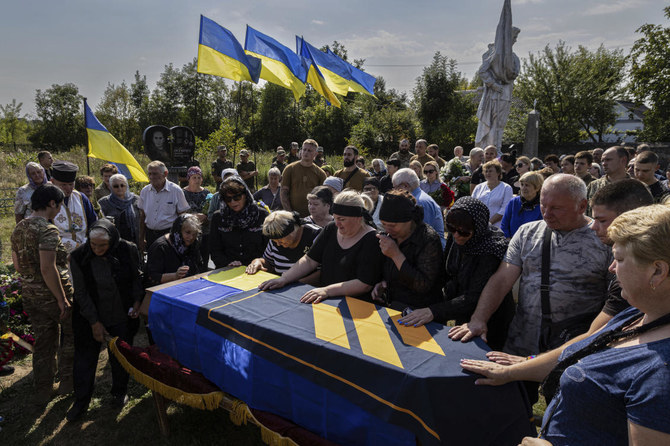
Tatiana Burchik, center, mother of Ukrainian soldier Vadym “Gagarin” Belov says her last goodbyes to her son near his coffin at a cemetery in Polonne, Khmelnytskyi region on Sept. 13, 2023. (AP)
Short Url
Updated 16 September 2023
Follow

Russia denies losing front-line village to Ukraine forces

  • Ukraine’s General Staff said Friday that the village was back under Ukrainian control
  • Kyiv has been pushing back against Moscow’s forces since June

MOSCOW: Russia said Saturday that its forces had not been pushed out of Andriivka, a village near the key frontline town of Bakhmut, a day after Ukraine said it had “liberated” the site and inflicted heavy losses on enemy troops.
Andriivka is around 14 kilometers (nine miles) south of Bakhmut in the Donetsk region, where Kyiv has been pushing back against Moscow’s forces since June.
Ukraine’s General Staff said Friday that the village was back under Ukrainian control.
But in its daily bulletin, Russia’s defense ministry said that “in the Donetsk sector, the enemy... continues to carry out assaults... trying in vain to dislodge Russian troops in the localities of Andriivka and Klishchiivka.”
The statement adds to the confusion surrounding the situation on the ground in the village, which had just a few dozen residents before Russia’s offensive.
On Thursday, Ukraine’s deputy defense minister Ganna Malyar backtracked on an announcement earlier in the day that Kyiv had retaken Andriivka after troops on the ground said fighting was ongoing.
On Ukrainian television on Friday, a spokesman for a brigade fighting in the area said the village was “completely destroyed,” adding that “Andriivka no longer exists.”
Bakhmut, the nearby city that was once home to around 70,000 people, was captured by Russian forces in May following one of the longest and bloodiest battles of Russia’s invasion.
Ukrainian forces, however, almost immediately began pushing back around the northern and southern flanks of the city and have been posting incremental gains.


Long truck lines at Colombia-Ecuador border as tariffs loom

Updated 4 sec ago
Follow

Long truck lines at Colombia-Ecuador border as tariffs loom

  • Colombia responded with a matching tariff and said it was suspending energy sales to Ecuador
  • The maneuvers have concerned those who haul goods across the border

IPIALES, Colombia: Hundreds of truck drivers waited for hours in miles-long lines to cross the border between Colombia and Ecuador as reciprocal tariffs loomed.
Ecuador this month said it would impose 30 percent tariffs on dozens of products from Colombia, with Ecuadoran President Daniel Noboa accusing his neighbor of not doing enough to combat drug trafficking along their shared border.
Colombia responded with a matching tariff and said it was suspending energy sales to Ecuador. The reciprocal tariffs are set to take effect February 1.
The maneuvers have concerned those who haul goods across the border, and truckers attempting to enter Ecuador with Colombian goods on Friday formed long lines stretching to the southern Colombia border city of Ipiales.
The truckers feel “uncertainty because we don’t know what’s going to happen,” Alvaro Jaramillo, a Colombian truck driver with 18 years of experience, told AFP.
Jaramillo arrived at the border on the Pan-American Highway about noon and by 7 p.m. local time (0000 GMT) had still not reached the customs post.
Trade between the two countries is of vital importance to his family and “all the transporters” in the area, he said.
He hopes the situation will be resolved through dialogue and that the two countries can begin working together.
But the dispute is intensifying.
Ecuador this week increased the tariff for transporting Colombian crude oil through its pipeline by 900 percent after Colombia last week suspended energy sales.
The Ecuadoran Foreign Ministry has said that there is “dialogue” between the two nations, but the country’s foreign minister, Gabriela Sommerfeld, said on Friday that there is still no agreement on a tariff deal.
Aerial footage captured by AFP on Friday showed hundreds of trucks waiting to cross the Rumichaca International Bridge separating the two countries.
“The traffic increased dramatically” this week, said truck driver Alexander Revelo, estimating it is up about four times more than average.
The two countries share a border of approximately 600 km (370 miles), where Colombian guerrillas and drug traffickers operate.
Ecuador has the highest homicide rate in Latin America, with a high of 52 murders per 100,000 inhabitants.
Colombia is the world’s largest producer of cocaine. Most of it passes through Ecuador before being transported by sea, primarily to the United States and Europe.
Noboa has defended the tariffs as compensation for the money invested in border security.