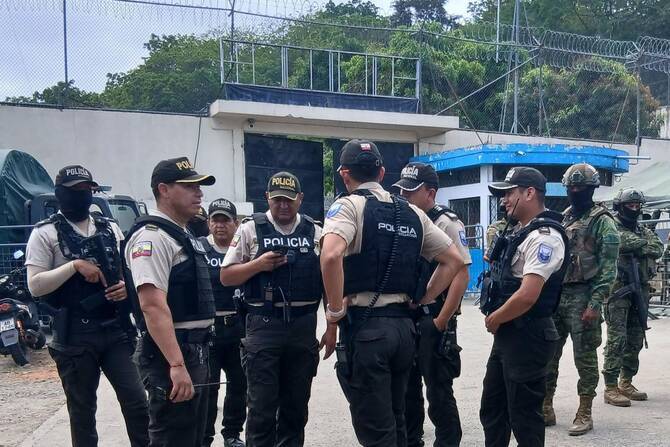
Five shot dead at pool hall in Ecuador

Five people were killed in a shooting at a pool hall in western Ecuador, police said Saturday -- the latest homicides in a country struggling through a bloody wave of drug gang violence. (AFP/File)
Short Url
Updated 25 October 2025
Follow

Five shot dead at pool hall in Ecuador

  • Three men got out of a van and opened fire at the hall in Santo Domingo
  • Similar killings have occurred at pool halls in Santo Domingo in recent months

QUITO: Five people were killed in a shooting at a pool hall in western Ecuador, police said Saturday — the latest homicides in a country struggling through a bloody wave of drug gang violence.
Three men got out of a van and opened fire at the hall in Santo Domingo, located about 60 kilometers (37 miles) from the capital Quito, a police official said, describing the incident as a “dispute between organized crime groups.”
Beyond the five people killed, one more was wounded, the official told local news outlet Alfa & Omega.
Similar killings have occurred at pool halls in Santo Domingo in recent months.
Nestled between the world’s biggest cocaine producers, Colombia and Peru, a growing gang presence has turned once-peaceful Ecuador into the country with South America’s highest homicide rate, according to the InSight Crime think tank.
In the first half of 2025, the number of homicides increased 47 percent as compared with the same period last year, according to the Ecuadoran Observatory on Organized Crime.


Faced with Trump, Greenlanders try to reassure their children

Updated 6 sec ago
Follow

Faced with Trump, Greenlanders try to reassure their children

NUUK: In a coffee shop in Greenland’s capital Nuuk, Lykke Lynge looked fondly at her four kids as they sipped their hot chocolate, seemingly oblivious to the world’s convulsions.
Since Donald Trump returned to the White House last year with a renewed ambition to seize Greenland, international politics has intruded into the Arctic island’s households.
Dictated by the more or less threatening pronouncements of the US president, it has been an unsettling experience for some people here — but everyone is trying to reassure their children.
Lynge, a 42-year-old lawyer, relied on her Christian faith.
“There’s a lot of turmoil in the world,” she said. “But even if we love our country, we have even higher values that allow us to sleep soundly and not be afraid,” she said.
As early as January 27, 2025, one week after Donald Trump’s inauguration, the Greenlandic authorities published a guide entitled “How to talk to children in times of uncertainty?“
“When somebody says they will come to take our country or they will bomb us or something, then of course children will get very scared because they cannot navigate for themselves in all this news,” said Tina Dam, chief program officer for Unicef in the Danish territory.

- Unanswerable questions -

This guide — to which the UN agency for children contributed — recommends parents remain calm and open, listen to their children and be sensitive to their feelings, and limit their own news consumption.
As in many parts of the world, social media, particularly TikTok, has become the primary source of information for young people.
Today, children have access to a lot of information not meant for them, said Dam — “and definitely not appropriate for their age,” she added.
“So that’s why we need to be aware of that as adults and be protective about our children and be able to talk with our children about the things they hear — because the rhetoric is quite aggressive.”
But reassuring children is difficult when you do not have the answers to many of the questions yourself.
Arnakkuluk Jo Kleist, a 41-year-old consultant, said she talked a lot with her 13-year-old daughter, Manumina.
The teenager is also immersed in TikTok videos but “doesn’t seem very nervous, luckily, as much as maybe we are,” she added.
“Sometimes there are questions she’s asking — about what if this happens — that I don’t have any answers to” — because no one actually has the answer to such questions, she said.

- ‘Dear Donald Trump’ -

The Arctic territory’s Inuit culture also helped, said Kleist.
“We have a history and we have conditions in our country where sometimes things happen and we are used to being in situations that are out of our control,” said Kleist.
“We try to adapt to it and say, well, what can I do in this situation?“
Some Greenlandic children and teenagers are also using social media to get their message out to the world.
Seven-year-old Marley and his 14-year-old sister Mila were behind a viral video viewed more than two million times on Instagram — the equivalent of 35 times the population of Greenland.
Serious in subject but lighthearted in tone, the boy addresses the American president.
“Dear Donald Trump, I have a message for you: you are making Greenlandic kids scared.”
Accompanied by hard stares, some serious finger-wagging and mostly straight faces, he and his sister go on to tell Trump: “Greenland is not for sale.”
“It’s a way to cope,” his mother, Paninnguaq Heilmann-Sigurdsen, told AFP of the video. “It’s kid-friendly, but also serious.
“I think it’s a balance between this is very serious, but also, this is with kids.”