

Ancient AlUla ‘Mustatil’ structures shed light on Arab rituals

1 / 2
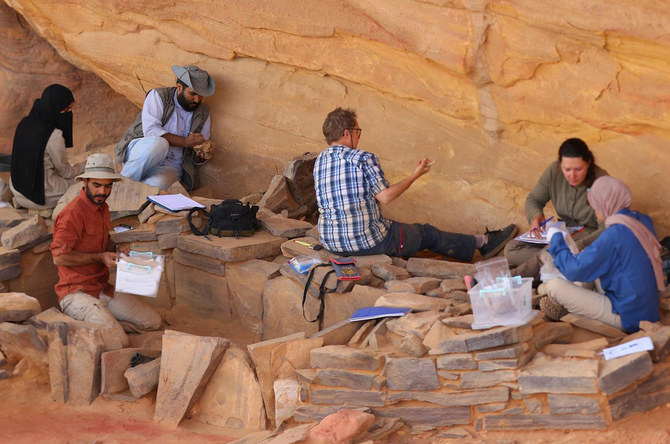
Over 1,600 Mustatils have been identified in the northern Arabian Peninsula through aerial surveys. (SPA)
2 / 2
Over 1,600 Mustatils have been identified in the northern Arabian Peninsula through aerial surveys. (SPA)
Short Url
Updated 22 September 2023
Follow

Ancient AlUla ‘Mustatil’ structures shed light on Arab rituals

  • Neolithic people in late 6th millennium B.C. conducted social, cultural and religious rituals, according to recent studies
  • Over 1,600 Mustatils characterized by low stone walls and open design

RIYADH: Recent studies published on the Mustatil structures, meaning rectangle, in northwest Arabia suggest that the Neolithic people in the late 6th millennium B.C. conducted a complex set of social, cultural and religious rituals, the Royal Commission for AlUla said on Tuesday.

The Mustatils likely saw sacrifices of domestic animals, revealing the Bedouin nature of the community. They were possibly created to encourage social cohesion, and used as markers to identify land occupation, the RCU said in a release.

Over 1,600 Mustatils have been identified in the northern Arabian Peninsula through aerial surveys. These structures are characterized by low stone walls and open design.

The latest studies on the Mustatils have been peer reviewed, including one conducted by Archeorient Laboratory and Lyon 2 University in France. The findings are featured in the book published last month “Revealing Cultural Landscapes in North-West Arabia” written by Dr. Awel Abu-Azizeh and edited by a team led by Dr. Rebecca Foote, director of archaeology and cultural heritage at the RCU.

Abu-Azizeh’s study on the “Horn Chamber” in a Mustatil in the northeast of AlUla, which dates to between 5300 and 5000 B.C., revealed that it is smaller than in most Mustatils. The chamber has given archaeologists a greater understanding of the region’s collective rituals and domesticated animals.

An article by Dr. Melissa Kennedy of Australia’s University of Sydney, published in PLOS ONE magazine last March, focused on a Mustatil located in a valley east of AlUla, and excavations showed a chamber similar to those identified in Abu-Azizeh’s study, which dates to between 5200 and 5000 B.C.

The studies come amid the RCU preparing to organize the AlUla World Archeology Summit from Sept. 13 to 15, an international event aimed at promoting the preservation of cultural heritage.


Saudi Arabia expresses concern over UAE pressure on STC, warns against threats to its security

Updated 30 December 2025
Follow

Saudi Arabia expresses concern over UAE pressure on STC, warns against threats to its security

  • Saudi Arabia stressed that any threat to its national security constituted a “red line”
  • Riyadh further emphasized the importance of the UAE responding to Yemen’s request to withdraw its military forces within 24 hours

Riyadh: Saudi Arabia on Tuesday expressed regret over what it described as pressure by the United Arab Emirates on Southern Transitional Council (STC) forces to carry out military operations in Yemen’s Hadramout and Al-Mahra governorates, warning that such actions pose a direct threat to the Kingdom’s national security and regional stability.

In a statement, the Saudi Ministry of Foreign Affairs said the reported moves were inconsistent with the principles of the Arab Coalition that supports the internationally recognised government of Yemen and undermined ongoing efforts to achieve security and stability in the country.


The ministry referred to earlier statements by the Yemeni Presidential Leadership Council and the coalition leadership concerning the movement of ships carrying weapons and heavy vehicles from Fujairah port to Mukalla without official authorization.

Saudi Arabia stressed that any threat to its national security constituted a “red line,” adding that it would not hesitate to take all necessary measures to confront and neutralize such risks.

The Kingdom reaffirmed its support for Yemen’s security, stability, and sovereignty, as well as its full backing of the Yemeni Presidential Leadership Council and its government. It also reiterated that the southern issue is a just cause that can only be addressed through dialogue as part of a comprehensive political solution involving all Yemeni parties, including the STC.

Riyadh further emphasized the importance of the UAE responding to Yemen’s request to withdraw its military forces within 24 hours and to halt military or financial support to any Yemeni faction.

The statement called for wisdom to prevail in order to preserve Gulf unity, bilateral relations, and the shared goal of regional stability and development.